My daughter was waiting impatiently for me to finish cutting her chicken when a woman in a tailored black suit stopped beside our table.
She didn’t introduce herself.
Instead, she looked me over from my wet jacket to my battered work boots.
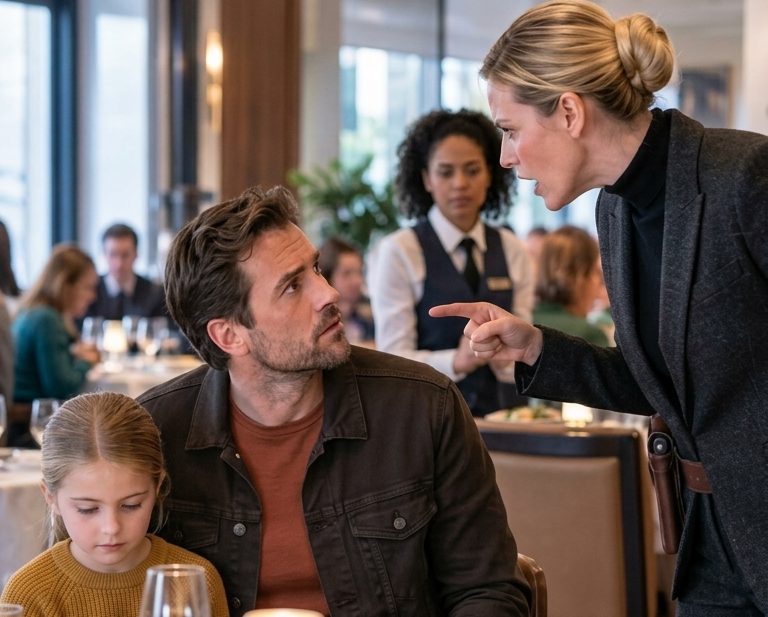
Then she said, “Sir, I think there has been a mistake with your seating.”
I glanced around the elegant dining room.
“What kind of mistake?”
“This section is intended for a different category of guest.”
Sophie lowered her fork.
She was eight, but she understood the implication immediately.
“Dad, does she want us to leave?”
I smiled at her.
“No. Finish your dinner.”
The woman’s name tag read **Vanessa Cole — General Manager**.
I’d come specifically to meet her.
She just didn’t know it.
My name is Daniel Mercer.
I hold the controlling interest in Bellmont Hospitality, the company that owns Bellmont House and several other restaurants.
Normally, a general manager would recognize the person who effectively owned the business.
But my circumstances made anonymity easy.
My wife died three years earlier, and afterward I stepped away from almost every public-facing part of the company. I stopped attending openings, awards dinners, and most management conferences.
Sophie needed a father more than Bellmont needed another executive shaking hands at corporate events.
As a result, many newer employees knew Daniel Mercer’s signature better than his face.
That suited me perfectly that night.
We’d received repeated complaints about Bellmont House.
Customers claimed staff members judged them before they’d even ordered. People dressed casually were given poor tables or exaggerated wait times, while guests wearing expensive clothes were immediately accommodated.
More troubling were reports from employees who said those practices weren’t accidental.
They were instructions.
I could have sent investigators.
Instead, I brought Sophie to dinner.
My faded jeans, old boots, and rain-soaked coat apparently made Vanessa’s assessment easy.
“You can finish your current course,” she told me, “but afterward we’ll need the table.”
I looked at the empty booths around us.
“Are you expecting a large crowd?”
Her smile disappeared.
“We manage seating according to business needs.”
Seven nearby tables were vacant.
I said nothing.
Instead, I sent one text.
**Bellmont House. Bring the audit. Come tonight.**
Then I put my phone away and returned to Sophie’s dinner.
Vanessa walked off looking satisfied.
A few minutes later, our server appeared carrying a slice of chocolate cake.
Sophie’s face lit up.
“That’s huge!”
The server laughed.
“That’s why we brought two forks.”
Her name was Maria.
She had just set down the plate when Vanessa’s voice cut across the room.
“Maria.”
Maria’s smile vanished.
Vanessa approached.
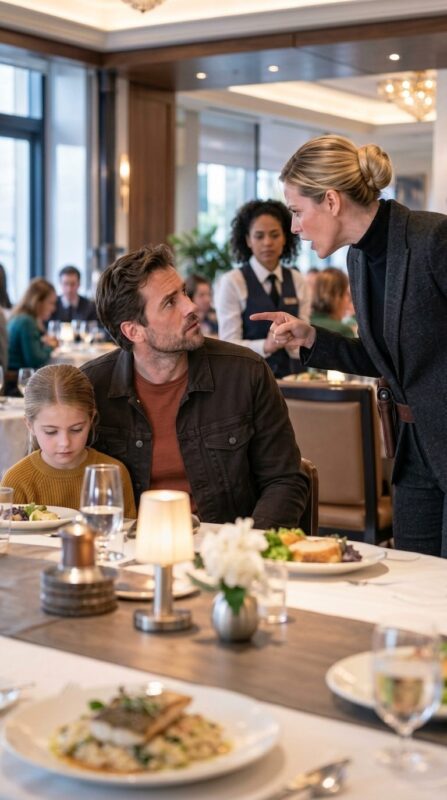
“Why are you serving dessert?”
“Because they ordered it.”
“I told you this table was leaving.”
Maria hesitated.
“The dessert had already been entered.”
“Then you cancel it.”
Sophie stopped smiling.
Vanessa continued criticizing Maria loudly enough for neighboring customers to hear.
Finally, she said, “Maybe you’d prefer to go home early tonight.”
Maria lowered her eyes.
I put my fork down.
“Does threatening your staff usually improve service?”
Vanessa turned.
“This doesn’t involve you.”
“You’re reprimanding our server beside our table. I’d say you’ve made it involve us.”
Her jaw tightened.
“Sir, I’ve already been patient.”
“So have I.”
She reached for her radio.
“Security, please come to table seventeen.”
Then she looked at me.
“You have two minutes.”
My phone buzzed.
The message contained only three words.
**We’re in lobby.**
I smiled.
“Perfect.”
Vanessa misunderstood the smile.
She thought she’d won.
Then I turned toward Maria.
“One question before we leave.”
Maria looked nervous.
“Were you instructed to tell casually dressed customers there were no tables available even when the restaurant wasn’t full?”
Her face went blank.
Vanessa immediately interrupted.
“Maria, don’t answer that.”
That reaction told me almost enough.
I asked another question.
“Were certain reservations transferred into Vanessa’s section so their spending would count toward her performance numbers?”
Maria stared at me.
Then she whispered, “Yes.”
Vanessa stepped closer.
“Who told you about that?”
“Several people.”
“What people?”
Before I answered, two familiar figures entered the dining room.
Rachel Lin, our corporate attorney, carried a thick folder.
Paul Harris, the regional director, walked beside her.
Paul spotted me.
“Daniel.”
Vanessa looked at him.
Then at me.
Paul stopped beside our booth.
“We have the complete audit, Mr. Mercer.”
Silence spread across the nearest tables.
Vanessa’s expression changed.
“Mr… Mercer?”
I stood and extended my hand toward Paul.
“Thanks for coming.”
Vanessa looked genuinely confused.
Then recognition arrived.
“Daniel Mercer?”
“Yes.”
“The Daniel Mercer?”
“I wasn’t aware we had several.”
Her face turned pale.
Security arrived.
The two guards looked from Vanessa to Paul and seemed unsure whom they were supposed to remove.
“Stay,” I told them. “We may need witnesses.”
Rachel opened the folder.
Fourteen customer complaints had been filed during the previous nine weeks.
Several described guests being judged according to clothing and apparent wealth.
Staff interviews revealed something worse.
Employees had allegedly been instructed to manipulate wait estimates, seating arrangements, and reservation assignments.
Bonus records showed additional irregularities.
Vanessa finally found her voice.
“So that’s what this is? An undercover operation?”
“No.”
I pointed toward Sophie’s plate.
“This is dinner.”
“You deliberately dressed like that.”
“I dressed comfortably.”
“You came here expecting me to fail.”
“I came here hoping the complaints were wrong.”
I let that settle.
“You proved they weren’t.”
Rachel interrupted.
“We also discovered another issue.”
She removed several pages.
Complimentary meals worth thousands of dollars had been authorized over several months.
The system listed them as compensation for dissatisfied customers.
Investigators couldn’t find many of those complaints.
But security recordings showed something else.
Several recipients appeared repeatedly.
They were Vanessa’s friends.
Vanessa immediately shook her head.
“That’s ridiculous.”
Rachel slid the authorization sheets across the table.
“Each approval came through your login.”
Vanessa stared at the pages.
She had no answer.
I turned to Paul.
“Do you need anything else?”
“No.”
“Then terminate her access and employment.”
Vanessa’s head snapped toward me.
“You can’t fire me during service.”
“I can.”
“I’ve given years to this restaurant.”
“And tonight you’ve demonstrated exactly what those years produced.”
She grabbed her purse.
Then, as she turned toward the employees watching from across the dining room, she said bitterly, “None of you would have this place without me.”
Maria finally raised her head.
“That’s not true.”
Vanessa stopped.
Maria’s voice shook, but she kept speaking.
“The cooks who stay late built this place. The servers who cover double shifts built it. The hosts you blame when reservations go wrong built it.”
Several employees nodded.
“You managed us,” Maria finished. “You didn’t create us.”
Nobody applauded.
They didn’t need to.
Vanessa surrendered her keys.
The same security officers she’d called to remove Sophie and me accompanied her from the building.
I returned to the booth.
Sophie was staring at me.
“What?”
She narrowed her eyes.
“You own the restaurant?”
“Part of a company that owns it.”
“That’s basically yes.”
I laughed.
“Fair enough.”
She looked toward Maria.
“Is she in trouble?”
“No.”
“But she told you the truth.”
“Exactly.”
Sophie seemed satisfied.
Then she looked at her dessert.
“My cake melted because you’re secretly important.”
I picked up my fork.
“That’s probably my fault.”
Three weeks later, Bellmont House temporarily reduced service while we reviewed management procedures.
Employees received compensation for bonuses that had been unfairly manipulated.
A confidential reporting system was introduced so workers could bypass local managers when necessary.
Maria became assistant manager.
Four months later, after completing management training, she took over the restaurant.
Half a year passed before Sophie and I returned.
She insisted on table seventeen.
During dinner, the front door opened.
A couple entered with two children.
All four wore clothes spotted with dried paint, as though they’d spent the day renovating a house.
The father stopped just inside.
He looked at the elegant room and then down at himself.
I recognized the hesitation.
Before he could turn around, the host approached.
“Good evening.”
The man gestured awkwardly toward his clothes.
“We probably should’ve changed first.”
The host smiled.
“You came for dinner, didn’t you?”
“Yes.”
“Then you’re dressed well enough.”
She led the family toward an open table.
Sophie watched the entire exchange.
Then she looked at me.
“Nobody made them feel weird.”
“No.”
“That’s good.”
“That’s the idea.”
She lifted her lemonade.
I raised my water glass.
We tapped them together.
Six months earlier, table seventeen had shown me exactly what was wrong with my company.
Now, sitting in the same place, I saw what had changed.
Not the furniture.
Not the menu.
Not the prices.
The definition of who deserved to feel welcome.
And this time, it included everyone who walked through the door.