“I live here by myself,” the little girl said to the man standing in the doorway, soaked from the rain—but what he heard next would stay with him long after the storm passed.
The downpour came without warning, crashing over the quiet streets of Tiradentes. Within seconds, the cobblestones shimmered under sheets of water, and the air filled with the rich scent of wet soil and fresh bread from a nearby bakery.
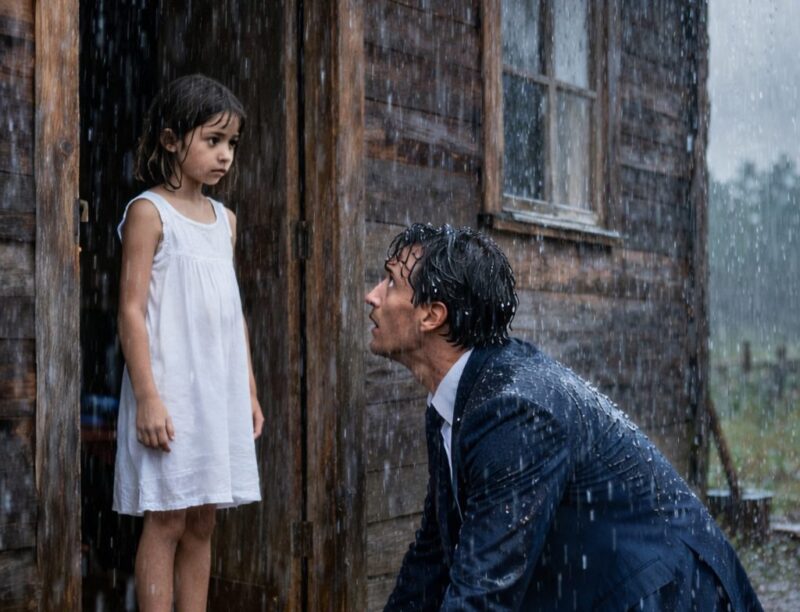
Demetrio Valverde, fifty-two, wasn’t used to being caught off guard. A powerful figure in the construction world, he was a man who built certainty from chaos. But now, his expensive suit clung to him, heavy and cold, as thunder echoed through his chest.
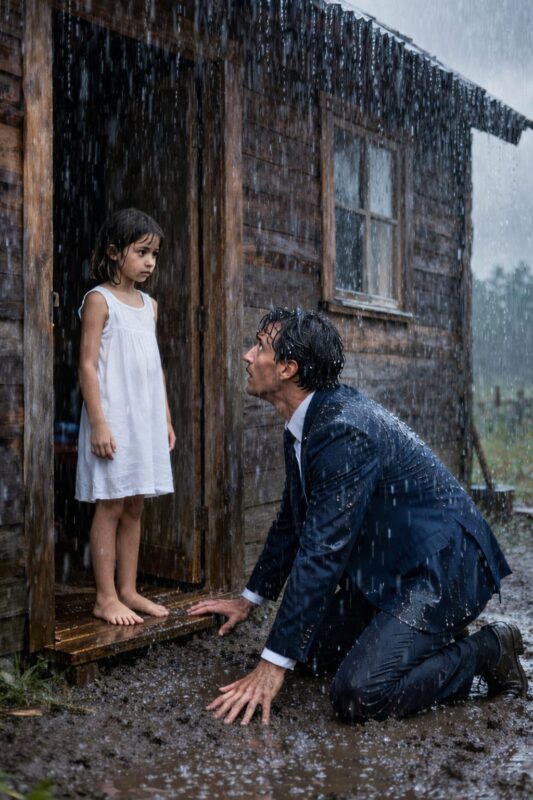
Searching for cover, he noticed an aging house across the street—its pale walls worn, its shutters chipped with time. The front door was slightly open, as if inviting or warning.
He hesitated… then knocked.
“Hello? Anyone inside?”
A small girl appeared in the gap. Her clothes were too large for her frame, her hair tangled, her eyes unsettlingly calm.
“I live here by myself,” she said softly.
The words didn’t feel like a child’s imagination. They landed with weight.
“By yourself?” he asked.
Before she could reply, a piercing cry erupted from deep inside the house—sharp enough to freeze the air.
The girl stepped back instantly.
Something in Demetrio tightened. He didn’t enter. Instead, he turned away, retreating into the rain, a strange heaviness settling in his chest as he crossed back to his apartment.
The next day, life in the town carried on as though nothing had happened. Sunlight returned. Cafés buzzed. Tourists wandered.
But Demetrio couldn’t forget.
At exactly three o’clock that afternoon, the scream came again.
And the next day.
And the next.
Always at the same hour.
Always filled with the same fear.
He tried to ignore it. He told himself it wasn’t his responsibility. He had learned long ago that getting involved only brought pain. Years earlier, he had lost his wife, Mariana, on another storm-filled night—and since then, he had sealed himself off from anything that might break him again.
But the house across the street wouldn’t let him remain untouched.
Sometimes, after the scream, there was a silence so complete it felt unnatural. Other times, drifting through the wind, came a quiet melody—a fragile voice humming.
He knew that tune.
Mariana used to hum it in their kitchen on slow mornings.
The memory struck him like a blow.
Across the street, Maristela Santos had noticed it too. A retired teacher, she had spent decades learning how to read what wasn’t said—the quiet signs others overlooked.
She didn’t ignore them.
One morning, she walked to the house and knocked.
Creusa Santos answered. Her face was tight, her eyes guarded, her politeness forced.
When Maristela asked about the child, the response came quickly.
“She’s unwell. It’s better you stay away.”
But behind the words, Maristela heard something else—a faint movement, careful and restrained. The sound of a child trying not to be heard.
She left, but not quietly.
Her message was clear: she would not forget.
That same night, a realization struck Demetrio.
The girl wasn’t a stranger.
She was Livian—the daughter of Joaquina, a woman who had once worked for him. A woman he barely noticed, too focused on his own life to see what might have been hidden beneath her quiet professionalism.
Now, every scream felt like a debt he had ignored.
He began recording the sounds. At the same time, Maristela went to the authorities.
Within days, action was taken.
At three in the afternoon, the door of the house was opened—not by chance, but by force.
Inside, they found decay, neglect, and fear that had settled into the walls. The girl was there, small and silent, surrounded by charcoal drawings of birds covering the surfaces around her—dozens of them, as if she had been trying to draw herself a way out.
Livian was taken from the house.
As she was carried outside, wrapped in a clean blanket, Demetrio watched from his window. For the first time in years, he allowed himself to cry—not out of grief, but out of something unfamiliar… awakening.
Recovery was slow. Careful. Fragile.
When it became clear that no one could take her in, Demetrio made a decision that surprised even him.
“I want to be the one who stays,” he said.
Adoption wasn’t easy. Doubts lingered. So did fear. But something stronger guided him—a quiet certainty that this time, he wouldn’t turn away.
Months later, his once-immaculate apartment had transformed. Drawings covered the walls. Laughter echoed through the rooms.
And a small voice called him “Dad.”
One evening, they released a healed bird back into the open sky. Livian watched it carefully, then smiled.
“If it wants to stay, it stays. If it wants to go, it goes.”
In that moment, Demetrio finally understood.
Love wasn’t about holding someone in place.
It was about creating a space where they felt safe enough… to choose you.