I Returned Because of You
“You haven’t paid for that.”
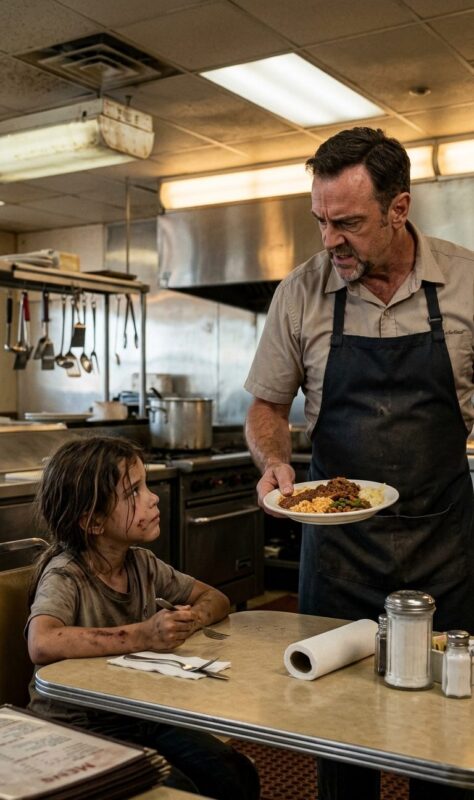
The waiter’s harsh voice cut through the small diner like a blade.
The little girl standing beside the booth immediately froze, her tiny fingers tightening around the cracked plate she carried as though it were the only thing keeping her steady.
She looked no older than eight.
Maybe nine.
Her coat was paper-thin against the winter cold outside, its sleeves stretched and stained from long wear. Strands of tangled hair framed her pale face, and her shoes were so worn they looked ready to fall apart with every step.
On the plate sat a simple breakfast.
Eggs.
Toast.
A few fried potatoes.
To everyone else in the diner, it was ordinary.
To her, it looked like survival.
Without warning, the waiter grabbed the plate from her hands.
For a brief second, her fingers lingered in the air, refusing to accept that the food was gone.
“I said you didn’t pay,” he repeated impatiently.
Silence settled over the diner for one uncomfortable breath.
Then the noise returned.
Coffee cups clinked.
Forks scraped across plates.
A man in a suit glanced at the girl before returning to his newspaper.
A woman near the window tightened her grip on her purse.
Two teenagers exchanged amused whispers.
No one helped.
No one questioned why a child was hungry and alone so early in the morning.
The girl lowered her eyes to the floor.
“I’m sorry,” she whispered.
The waiter let out a cold laugh.
“Sorry won’t cover the check.”
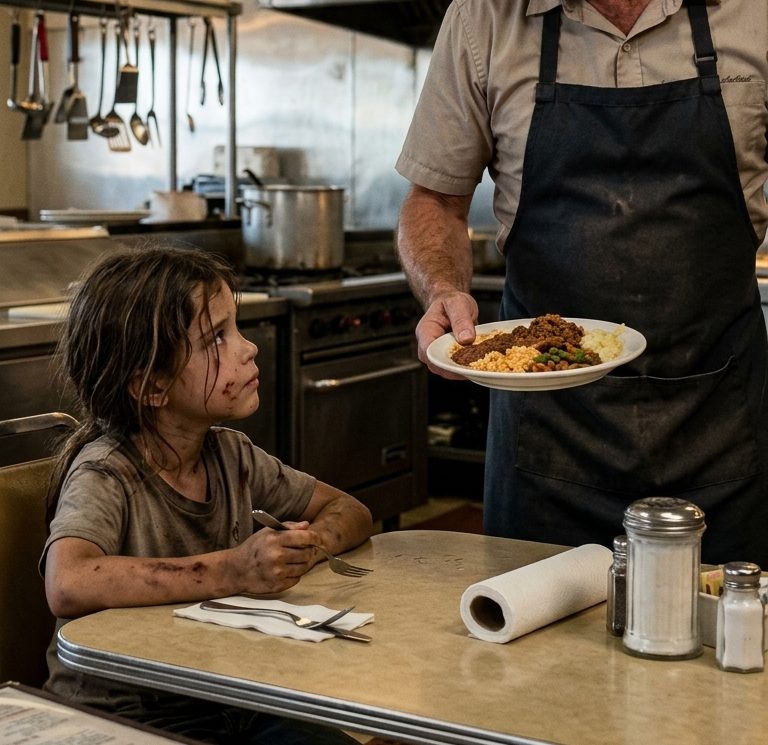
Her cheeks turned red with embarrassment, but she fought back tears.
She had already learned that crying usually made people colder, not kinder.
Slowly, she stepped away from the table while the warm smell of butter, coffee, and toasted bread drifted around her like torture.
Then the kitchen door opened.
A woman stepped out quietly.
She wasn’t dressed like the customers filling the booths.
Her apron carried streaks of flour.
Her hair was pinned back carelessly.
Her hands looked rough and tired from endless hours in hot water.
She looked at the waiter.
Then at the little girl.
Without saying a word, she walked behind the counter and prepared another breakfast herself.
Fresh eggs.
Golden toast.
Potatoes.
And a small glass of orange juice.
She carried the plate over and gently placed it in front of the child.
The soft sound of ceramic touching the table seemed strangely powerful.
Almost holy.
“It’s alright,” the woman said gently.
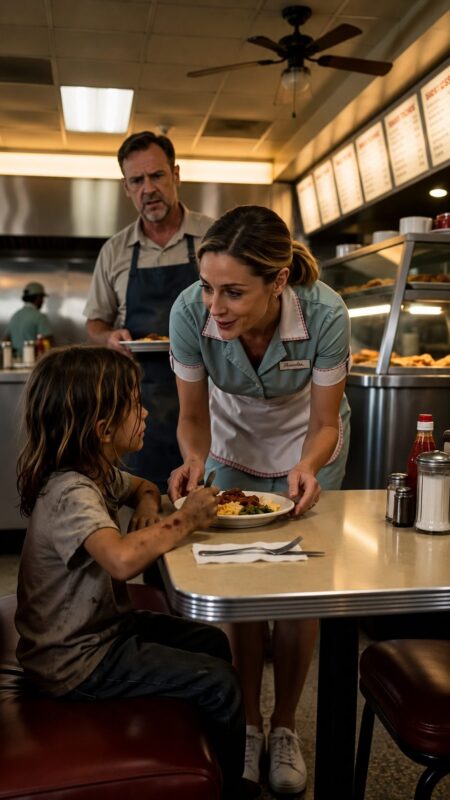
“You can eat.”
The little girl never forgot that moment.
Not because of the food.
But because someone had finally looked at her and seen a person instead of a burden.
Life didn’t suddenly become easier after that morning.
There were still nights spent in shelters.
Still empty pockets.
Still days when hope felt weaker than hunger.
But whenever life became cruel, she remembered the waitress’s voice.
“It’s alright. You can eat.”
Those words stayed with her for years.
Almost twenty years later, the bell above the diner door rang once again.
Rain tapped softly against the windows as a young woman stepped inside.
Time had changed the place.
The booths were faded now.
The walls looked older.
But the familiar smell of coffee still filled the air.
Behind the counter stood the same waitress, flour lightly dusting her apron.
Only now, silver streaks touched her hair.
The young woman paused, emotion tightening in her chest as she looked at her.
Then she slowly walked forward.
The waitress offered a polite smile.
“Just one today?”
The young woman shook her head softly.
“You probably don’t remember me,” she said.
The older woman gave a small apologetic smile.
“I’m sorry, sweetheart. I meet a lot of people.”
The young woman’s eyes filled with tears.
“One winter morning,” she began quietly, “a little girl walked in here starving.”
The waitress suddenly became still.
“She didn’t have money for breakfast,” the woman continued. “And everyone pretended she didn’t exist.”
Recognition slowly appeared on the waitress’s face.
The oversized coat.
The shaking hands.
The child struggling not to cry.
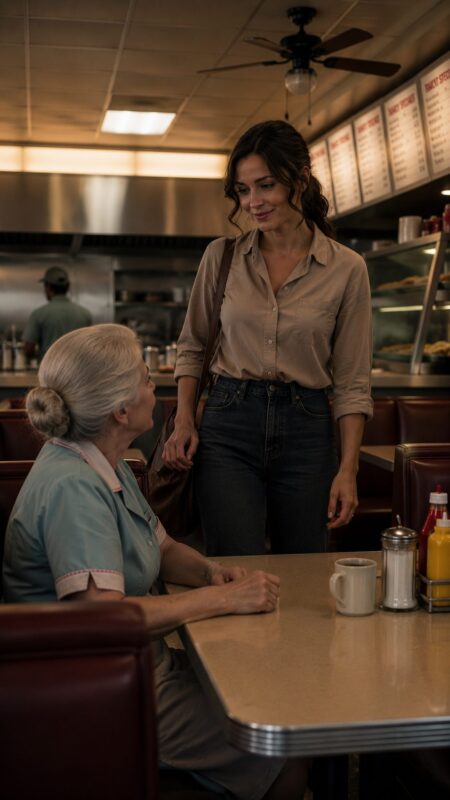
“Oh my God…” she whispered.
The young woman nodded.
“That little girl was me.”
For a moment, neither of them moved.
Then the waitress hurried around the counter and pulled her into a tight embrace.
“I used to think about you,” she admitted softly.
“For years.”
The young woman wiped tears from her cheeks.
“You changed my life that day.”
The waitress shook her head gently.
“All I did was buy you breakfast.”
“No,” the young woman replied.
“You gave me dignity.”
Her voice trembled with emotion.
“You showed me kindness when the world had none left for me.”
Then she reached into her purse and placed a small set of keys onto the counter.
The waitress looked down in confusion.
Across the street, workers were hanging a large sign above a newly renovated building.
FREE MEALS FOR CHILDREN.
The young woman smiled warmly.
“I bought that building.”
The waitress covered her mouth in shock.
“And I want you to run it with me.”
The diner became silent once more.
Because sometimes a single act of compassion doesn’t end after one moment.
Sometimes it returns years later…
and changes everything for both people involved.