I was sixty-three when I finally married the woman I’d loved since high school. We’d spent forty-five years living separate lives, only to find each other again when time was running out.
Eight days after our wedding, she passed away.
I thought the greatest surprise of my life had been seeing her again. But after her funeral, her son handed me an envelope and said something I’ll never forget.
“Tom, Mom told me to make sure you’re sitting down before you open this.”
Inside was a letter containing a secret she’d kept from me for decades.
And what I discovered would give my life an entirely new direction.
My name is Thomas Bennett, though nearly everyone calls me Tom. For twenty-three years, I’d served as a pastor in a small community where people knew me as someone who listened, offered encouragement, and visited those who needed company.
My weekly visits to the county hospital were especially important to me.
One rainy afternoon, a nurse named Susan approached me near the elevators.
“Pastor Tom, there’s a patient in Room 214 who could use some company. Her name is Margaret. She’s been having a difficult week.”
I agreed and followed her down the corridor.
Nothing could have prepared me for the woman waiting inside.
She was resting against several pillows, gazing toward the window.
When she turned toward me, I recognized her immediately.
“Maggie?”
Her expression changed from confusion to astonishment.
“Tommy Bennett?”
For several seconds, neither of us moved.
Then she laughed.
It was the same bright, unmistakable laugh I’d fallen in love with when we were teenagers.
Forty-five years disappeared in an instant.
Margaret Collins had been my first love.
We’d met at seventeen, when she accidentally knocked my books from my hands outside the school library.
Instead of apologizing, she’d grinned and said, “You should really watch where you’re going.”
From that moment, we’d been inseparable.
We attended school dances together, shared milkshakes at the local diner, and spent summer evenings talking about the future.
I wanted to become a pastor.
Margaret dreamed of opening a bakery.
We even planned our wedding, although neither of us had enough money to buy a proper engagement ring.
Then graduation arrived.
Margaret received a scholarship in another state, while I left to study theology.
We promised to remain together.
For a while, we exchanged letters almost every day.
But distance, responsibilities, and the passing years gradually pulled us apart.
Eventually, we lost contact.
Both of us married other people and built families. We experienced happiness, disappointment, and the ordinary challenges of adulthood.
Years later, we each lost our spouses.
I never expected to see Margaret again.
Yet there she was, sitting in a hospital bed, looking at me as though I’d walked straight out of an old photograph.
We spent that first afternoon remembering our youth.
She teased me about my gray hair.
I reminded her that she’d once ruined an entire school bake sale by forgetting to add sugar to the cupcakes.
“They weren’t ruined,” she protested. “They were educational.”
I laughed harder than I had in years.
After that visit, I returned every afternoon.
Margaret was receiving care for advanced cancer. Her doctors had explained that her condition was serious and that treatment could no longer cure it.
But she refused to let her illness define every conversation.
We talked about books, music, our children, and the strange paths our lives had taken.
Sometimes we sat quietly together.
Other times, we laughed until the nurses came to check on us.
Then, one afternoon, Margaret asked me a question that changed everything.
“Tommy, do you remember what you said to me behind the school gym?”
I smiled.
“I said a lot of foolish things behind that gym.”
“You promised we’d get married.”
I nodded.
“I remember.”
She studied me carefully.
“Well, I’ve waited forty-five years. Are you going to keep your word or not?”
I laughed.
But Margaret wasn’t smiling.
“I’m serious, Tom.”
She reached for my hand.
“I’ve had a good life. I loved my husband, raised my son, and built something I’m proud of. But finding you again feels like a gift I never expected.”
Her voice softened.
“I don’t know how many days I have left. I’d like to spend them as your wife.”
I sat beside her bed, unable to speak.
Finally, I answered.
“Maggie, I’d be honored.”
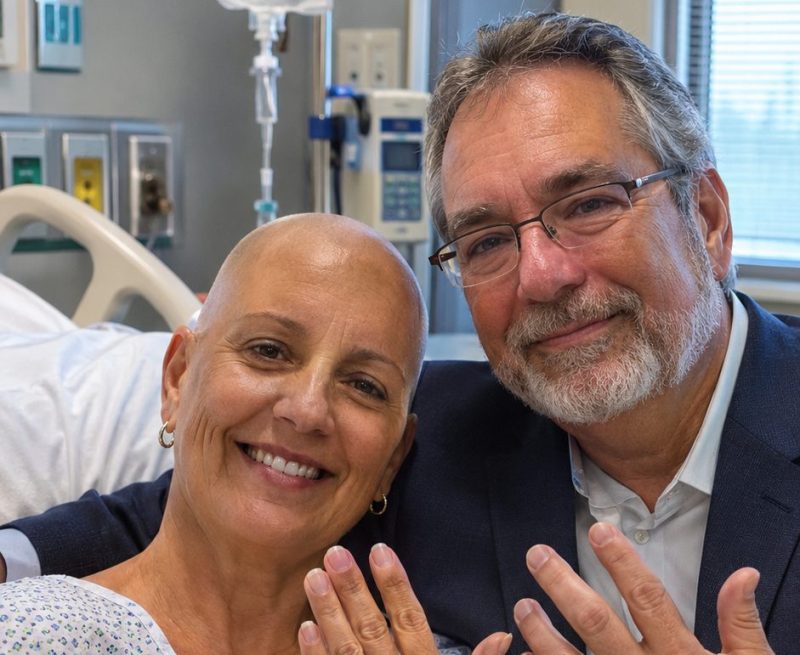
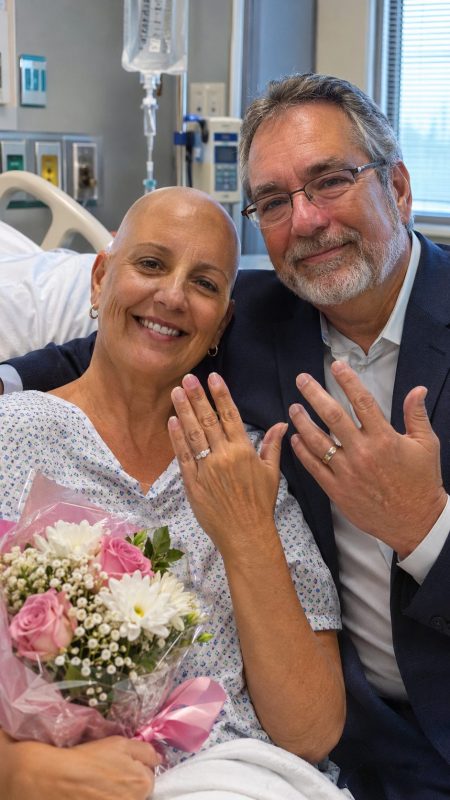
Three days later, we were married in her hospital room.
Wade, her adult son, helped organize the ceremony.
The nurses brought flowers, a friend played soft music, and a handful of people gathered to witness our vows.
I found two inexpensive wedding bands at a small jewelry shop.
Margaret’s ring had a little pink heart engraved on the inside.
When she noticed it, her eyes brightened.
“You remembered,” she whispered.
At seventeen, she’d always said she wanted a pink heart somewhere on her wedding ring.
“Of course I remembered.”
She squeezed my hand.
“Forty-five years late, Tommy. But you finally got it right.”
There was no lavish celebration or honeymoon.
We shared a small cake, took photographs, and spent the evening telling stories.
For the next five days, I remained close to her.
We watched old movies, listened to our favorite songs, and talked about the lives we’d lived apart.
Sometimes Margaret fell asleep while holding my hand.
I never wanted those moments to end.
Eight days after our wedding, she passed away peacefully.
I knew her illness was serious, but knowing that didn’t make saying goodbye any easier.
At her funeral, the church was filled with relatives, friends, former employees, and neighbors.
People told stories about Margaret’s generosity, determination, and extraordinary sense of humor.
I listened, grateful to discover how many lives she’d touched.
After the service, Wade approached me outside.
“Tom, Mom left something for you.”
He handed me a cream-colored envelope.
“She gave me strict instructions. I’m supposed to tell you to sit down before reading it.”
I managed a small smile.
“That sounds like Maggie.”
I sat on a nearby bench and unfolded the letter.
“Dear Tommy,
First, congratulations on finally becoming my husband.
Second, I hope you’re sitting down, because I’ve decided to leave you something rather substantial.
You are now the owner of my bakery.
Yes, the whole bakery.
Please don’t fall over. I don’t want Wade blaming me for another hospital visit.”
I stared at the page.
Then I read it again.
Margaret had left me a business.
And not a small one.
For thirty years, she’d owned one of the most successful bakeries in the county.
I knew the place well. I’d purchased birthday cakes, bread, and pastries there many times.
But I’d never known Margaret was its owner.
I looked at Wade.
“Your mother owned that bakery?”
He nodded.
“She started it with almost nothing. By the time she retired from daily operations, it had become one of the most respected businesses around.”
“Why didn’t she tell me?”
“Because she wanted the wedding to be about the two of you,” Wade replied. “She didn’t want money entering the conversation.”
He explained that Margaret had already discussed her wishes with an attorney. Her estate plan transferred ownership to me after her death.
I felt overwhelmed.
At the bottom of the letter, Margaret had written one additional sentence.
“Before you decide what to do with the bakery, ask Denise about my special toast.”
Two days later, I visited the bakery.
The moment I opened the door, I was greeted by the comforting aroma of warm bread, butter, and cinnamon.
Customers chatted at small wooden tables while employees carried trays of freshly baked pastries.
Denise, the longtime manager, recognized me immediately.
“Tom! Maggie said you’d come.”
I showed her the letter.
“Apparently, I’m supposed to ask you about toast.”
Denise burst out laughing.
“Oh, she really couldn’t resist, could she?”
She pointed toward the menu above the counter.
Near the bottom, written in cheerful lettering, were three words:
“Tommy’s Terrible Toast.”
I stared.
“What’s that supposed to mean?”
Denise grinned.
“It’s one of our most popular breakfast items.”
The description underneath read:
“Cinnamon-sugar toast created in honor of Maggie’s first sweetheart, who couldn’t prepare breakfast without setting off the smoke alarm.”
I couldn’t believe it.
“She made a recipe about me?”
“Years ago,” Denise said. “She told us about the time you tried to make breakfast for her family and nearly ruined her mother’s favorite frying pan.”
I remembered the incident perfectly.
I had been seventeen and hopeless in the kitchen.
Denise guided me toward a photograph hanging near the register.
There we were, Margaret and me, standing outside our high school with our arms around each other.
Beneath the photograph was a handwritten message:
“Some love stories deserve a second chance. Some cooks deserve to be permanently banned from the kitchen.”
I laughed, then unexpectedly began to cry.
Margaret had carried those memories with her all those years.
But my happiness soon gave way to anxiety.
I was a pastor, not a businessman.
I didn’t understand payroll systems, commercial leases, food suppliers, or inventory management.
Every conversation about the bakery seemed to introduce another problem I didn’t know how to solve.
Within days, I began considering selling it.
Perhaps someone more experienced could keep Margaret’s business successful.
One evening, while reading her letter again, I noticed a message written on the reverse side.
“Tommy, if you’re thinking about giving up because you don’t know what you’re doing, stop.
You don’t have to know everything.
Find good people, trust them, and remember that kindness is a skill you already possess.
I believe in you, even when you don’t.”
I sat at my kitchen table for a long time.
Then I picked up the phone.
The next morning, I met with Wade and Denise.
“I want to keep the bakery,” I told them. “But I can’t do it alone.”
Denise smiled.
“You won’t have to.”
Wade offered to manage the accounting and financial planning.
Denise would continue supervising the employees, ordering supplies, and handling daily operations.
I would learn the business gradually and help wherever I could.
At first, my contributions were modest.
I greeted customers, cleaned tables, delivered orders, and carried boxes.
I even learned to prepare a few simple pastries, although Denise wisely kept me away from the ovens whenever possible.
As the weeks passed, I began discovering another side of Margaret’s life.
She had quietly supplied bread and pastries to families facing financial difficulties.
Every Friday, her employees prepared extra packages for people who needed help.
No publicity.
No photographs.
No requests for recognition.
Just food delivered with dignity.
When Denise told me about the program, I realized why Margaret had trusted me with the bakery.
For years, our church had wanted to organize regular meals for elderly residents who lived alone.
We had volunteers and a suitable meeting space, but we lacked the resources to provide meals consistently.
Now we had a bakery.
I spoke with Wade and Denise about expanding Margaret’s charitable work.
Together, we developed a plan.
The bakery would provide bread and baked goods, volunteers would prepare and serve lunches, and donations would help cover additional ingredients and expenses.
We named the project “Margaret’s Table.”
Our first gathering took place on what would have been her sixty-fourth birthday.
That morning, I arrived before sunrise.
Denise was already preparing trays of bread, while volunteers arranged tables and placed flowers in small glass jars.
By noon, thirty-two guests had arrived.
Some were widowed. Others lived far from their families. A few simply wanted somewhere welcoming to spend an afternoon.
An elderly man named Harold sat alone near the window.
I brought him a plate of food and introduced myself.
“Have you been here before?” I asked.
He shook his head.
“Not for something like this.”
Then he looked around the room.
“You know, Pastor, it’s been nearly a month since I last sat down and ate with another person.”
I pulled out the chair opposite him.
“Then let’s make today a good one.”
Before lunch ended, Harold was laughing with two other guests and making plans to meet them again.
Across the room, people who had entered as strangers were exchanging stories and telephone numbers.
I watched them and suddenly understood what Margaret had been trying to tell me.
The bakery wasn’t simply a place that sold food.
It was a place where kindness could become something tangible.
As we finished cleaning, Denise approached me with a small wooden box.
“Maggie left this with me,” she said. “She wanted you to receive it once you found a reason to keep the bakery.”
Inside was another envelope.
My name was written across the front in Margaret’s familiar handwriting.
I opened it carefully.
“My sweet Tommy,
If you’re reading this, you’ve probably discovered something wonderful to do with my little bakery.
I knew you would.
You spent your life helping people feel less alone. I hoped this place would give you another way to continue that work.
Please don’t think of our story as forty-five wasted years.
We both lived meaningful lives, loved our families, and experienced things that shaped who we became.
Then, when we least expected it, we found each other again.
Those final days with you were among the happiest of my life.
Don’t spend the years ahead wishing we had been given more time.
Use them to create more happiness for others.
Love is never wasted when you pass it along.
And please, darling, let Denise handle the toast.
Always,
Your Maggie.”
I folded the letter and held it close.
For the first time since Margaret’s passing, the sadness in my heart felt a little lighter.
Six months later, Margaret’s Table was serving lunches twice a week.
Local businesses donated ingredients, volunteers offered their time, and the bakery became a gathering place for people who had once felt forgotten.
Some guests began volunteering themselves.
Others formed friendships that extended well beyond our meals.
Harold, the gentleman I’d met on opening day, became one of our most dependable helpers.
Every Saturday morning, I visited the bakery before my other responsibilities began.
I ordered Tommy’s Terrible Toast, found an empty table beneath our old high school photograph, and enjoyed a quiet breakfast.
The cinnamon was always just right.
The bread was never burned.
Sometimes I looked at Margaret’s picture and remembered the seventeen-year-old girl who had challenged me to make breakfast without ruining it.
Back then, I’d believed we would grow old together.
Instead, we spent nearly half a century apart and shared only eight days as husband and wife.
For a long time, that seemed terribly unfair.
But Margaret had taught me to look at our story differently.
She hadn’t left me a lifetime of memories from a long marriage.
She’d left me the opportunity to build new memories while honoring the love we’d rediscovered.
Through her bakery, I gained friends, purpose, and a second family.
And every meal we served carried a little of her generosity into someone else’s life.
I used to think that the value of a love story depended on its length.
Now I know that even a handful of days can transform everything that follows.
Margaret and I didn’t get the future we imagined at seventeen.
But because of her, countless people now have a place where they’re welcomed, remembered, and never expected to eat alone.
And whenever someone asks why the bakery serves a dish called Tommy’s Terrible Toast, I tell them about a remarkable girl who waited forty-five years for a promise to be kept.
Then I tell them the most important part.
Some promises last longer than we ever expect.
And some kinds of love continue giving long after the people who began them are gone.