“If you can play that violin, I’ll marry you.” The challenge was meant as a joke—but what followed turned the entire ballroom silent.
Armoury House shimmered with wealth. Crystal glasses clinked beneath towering chandeliers, silk gowns glided over polished marble, and effortless laughter filled the air. This was more than a gathering—it was a display of power, where status spoke louder than words.
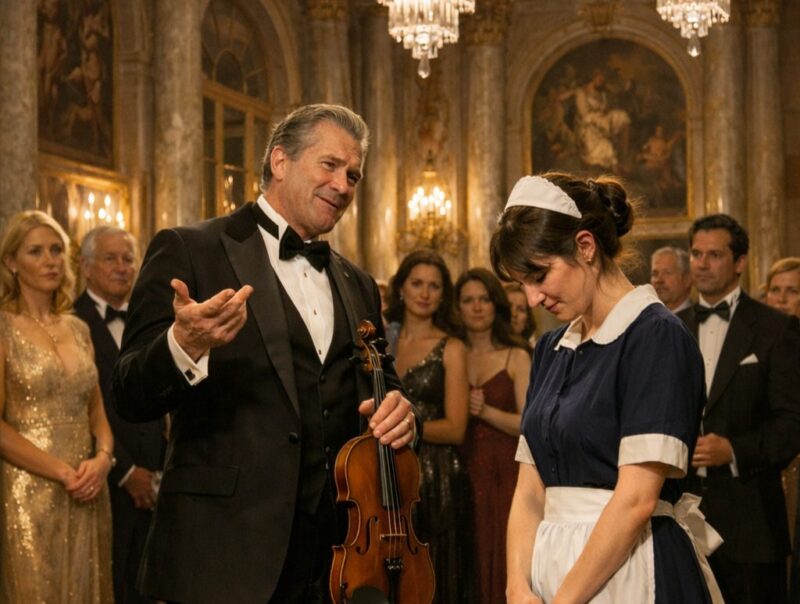
At the center stood Mauricio del Río, heir to a vast empire. He carried himself like a man who had never been refused, his confidence shaped by privilege rather than experience. To him, the evening was a spectacle—and everyone else, merely background.
Not far away stood Mara Quiroga.
Dressed in a simple black uniform with a white apron, she moved quietly between guests, balancing a tray of champagne. No one noticed her. She was part of the setting—useful, silent, invisible.
Until Mauricio decided otherwise.
Bored with admiration, he scanned the room and fixed his gaze on her. A faint smile curved his lips. He reached for an antique violin displayed among the decorations and tapped his glass to draw attention.
“Ladies and gentlemen,” he said smoothly, “we need something more entertaining.”
The room fell quiet.
He stepped toward Mara, lifting the violin.
“If you play this,” he announced, his voice carrying easily, “I’ll marry you. Tonight.”
A pause.
Then laughter burst out—loud, mocking, merciless.
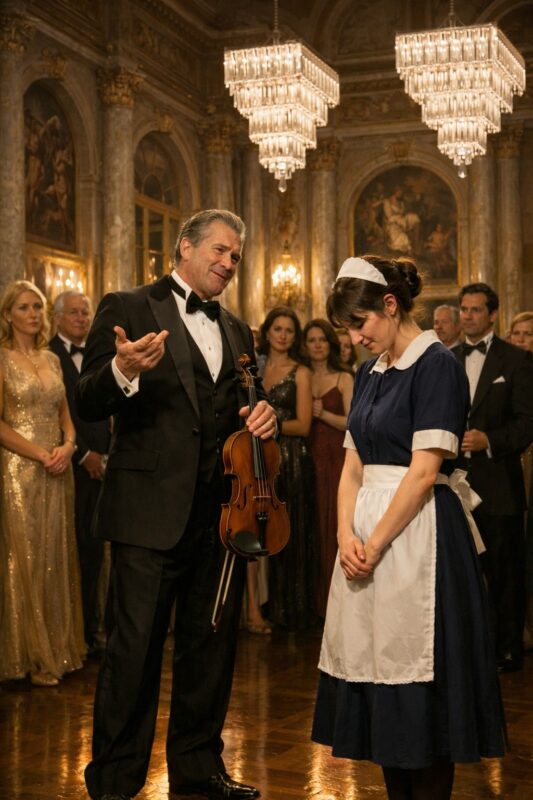
He leaned closer, his tone dropping. “Go on,” he murmured. “Or go back to cleaning. That’s where you belong.”
Mara felt the heat rise in her chest. The room seemed to close in around her. For a moment, she couldn’t breathe.
She shut her eyes.
And remembered.
Her mother’s gentle voice, steady and calm:
“Never let the world’s noise silence your music.”
Mara opened her eyes again.
Carefully, she set the tray aside and took the violin.
She held it for a brief second—
Then played.
A single note drifted into the air.
Pure.
Steady.
Undeniably beautiful.
The laughter vanished.
The sound expanded into a melody—rich, controlled, deeply expressive. Her hands moved with precision, each note unfolding with emotion and strength. The room stilled completely. Conversations died. Even the air seemed to listen.
This was no accident.
This was mastery.
Mauricio’s smile faded.
When the final note dissolved, silence remained—thick and unbroken.
Inside the violin case, Mara noticed a sheet of music. The handwriting struck her instantly.
Her mother’s.
She lifted the instrument once more.
Across the room, Maestro Octavio Landa leaned forward, studying her closely. Something about her posture, her control—it was unmistakable.
The bow met the strings again.
A flawless tone rang out. She adjusted the pitch by ear with quiet confidence, then played a smooth scale, finishing with a soft vibrato that sent a ripple through the crowd.
Mauricio forced a slow clap. “Impressive,” he said, though his voice had tightened. “But let’s hear something real.”
He turned to the guests. “A true masterpiece. If she fails, she’s finished in this city.”
A murmur of unease spread.
Mara said nothing. She looked at the sheet—her mother’s final composition, a demanding Adagio few dared to perform.
She began.
The music unfolded like a story—aching, powerful, alive. Notes lingered, trembled, and soared, pulling emotion from every corner of the room. Time seemed to slow. No one spoke. No one moved.
Maestro Landa stepped forward, his voice shaking. “That technique… Quiroga…”
Recognition spread like a wave.
The atmosphere changed. The same guests who had laughed now stood transfixed, some quietly wiping tears. Wealth and status no longer mattered.
Only the music did.
And Mauricio—once the center of attention—was forgotten.
Each note stripped away his arrogance.
When the final sound faded, the silence returned—deeper than before.
Then applause erupted.
The room rose to its feet. The orchestra struck their stands. Landa, overcome, exclaimed, “She’s Renata Quiroga’s daughter!”
The revelation electrified the crowd.
Mauricio slammed his hand down. “This proves nothing!”
But his voice carried no power now.
An older man stepped forward, his expression cold. “Your arrogance has exposed you,” he said. “Her talent outweighs everything you own.”
Mauricio stood alone—no longer admired, but exposed.
Mara placed the violin back in its case.
She looked at him, calm and steady. “Respect and talent aren’t things you can buy.”
The room fell silent once more.
“My mother played to uplift people—not to humiliate them.”
A faint smile touched her lips. “And your proposal? Even if it were sincere… I would never marry someone so poor that all he has is money.”
A quiet stir passed through the crowd.
Holding the violin case, Mara walked toward the exit. The guests moved aside, lowering their eyes in respect.
Mauricio remained where he was—beneath the glittering chandeliers, surrounded by the ruins of his pride.
Outside, the cool night air met Mara’s face.
She had entered unnoticed.
She left unforgettable.
No longer invisible.
But the rightful bearer of a legacy—and a voice the world could no longer ignore.