Margherita found them early on a quiet autumn morning, when the park still felt half-asleep. She had come, as always, to feed the pigeons—coffee in one hand, breadcrumbs in the other.
Routine kept her steady. Predictable things were easier.
At first, she almost walked past the bench.
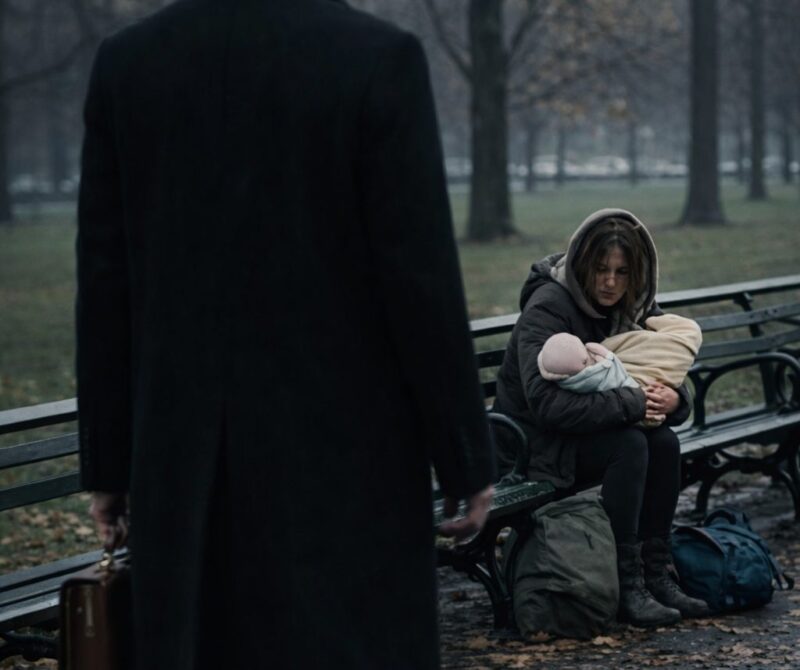
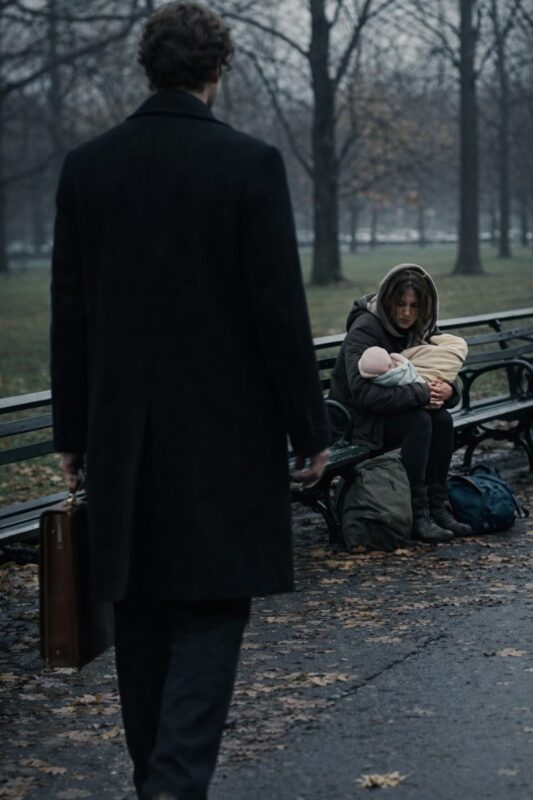
The woman sitting there didn’t look dangerous—just exhausted. Her head rested against the cold metal armrest, eyes closed, two small bundles clutched tightly to her chest. Around her feet, a few worn bags held everything she owned.
Margherita hesitated, then sat at the far end of the bench. She said nothing, simply poured her coffee and watched the birds scatter.
A soft cry broke the silence.
She leaned closer. One bundle moved—a tiny face, flushed and wrinkled, crying with all its strength. A baby. Then the second one stirred, its thin cry waking the woman instantly.
“It’s okay… it’s okay,” she murmured, her voice tired from repetition.
Margherita observed her quietly. Something stirred inside her—not pity, but recognition.
“Boy or girl?” she asked.
The woman’s eyes snapped open, guarded. “Both. A boy and a girl.”
“How old?”
“Three months.”
Margherita nodded. “Do you have somewhere to go today?”
A pause. “No.”
“Are you hungry?”
The silence answered for her.
Margherita handed over her thermos. “It’s still warm.”
Her name was Clara. That came later, after coffee and shared food. The babies were Leo and Sofia.
Clara spoke about them with certainty, as if they were the only solid thing left in her life.
“Leo always cries first,” she said. “Sofia just watches. Like she understands everything.”
Margherita smiled faintly. But when she looked at the boy, something unsettled her. The shape of his face… the familiar lines…
“What’s your last name?” she asked carefully.
“Ferrante,” Clara replied. “It used to be Greco.”
Margherita froze.
“My son’s name is Adriano Greco.”
The air between them grew heavy.
Clara stiffened. “You should go.”
“He doesn’t know, does he?” Margherita asked gently.
Clara’s silence said everything.
“I wrote him a letter,” she admitted. “But I never sent it. He had his life… his success. I didn’t want to become another problem.”
“You weren’t a problem,” Margherita said firmly.
Clara shook her head. “I was something he left behind.”
Margherita picked up her phone.
“Don’t,” Clara whispered.
But she had already started dialing.
Adriano arrived twenty minutes later.
He saw his mother first. Then Clara.
And then the babies.
His world seemed to stop.
“Clara…” he said quietly.
“I didn’t ask for this,” she replied.
“I know.”
He stared at the children—his children. Everything he had built suddenly felt distant, almost irrelevant.
“How long?” he asked.
“Eleven days,” she said. “Outside.”
Something broke inside him.
“Why didn’t you call me?”
“Why would I?”
“Because they’re mine,” he said, his voice raw with emotion.
“You were building your empire,” she answered softly.
They left the park together.
Not for him. Not for pride. But for the children.
The days that followed changed everything.
Adriano canceled meetings, cleared his schedule, and stayed. He learned slowly—awkwardly—how to care for them. Late nights, quiet moments, small victories.
For the first time in years, he wasn’t chasing anything.
He was present.
Clara watched from a distance at first, guarded but observant. She had survived alone. She didn’t need him.
But gradually, she began to see something different—a man trying, not perfectly, but sincerely.
Weeks passed.
Then months.
They spoke carefully, rebuilding what had been lost. Not rushing. Not pretending.
“Day by day,” she told him.
“Day by day,” he agreed.
A year later, they returned to the same bench.
The park was warm now, full of life.
Leo slept peacefully. Sofia watched everything with bright, curious eyes.
Clara paused, looking at the place where everything had changed.
“I was angry that day,” she admitted. “But now… I’m grateful.”
Adriano took her hand.
This time, she didn’t pull away.
Nearby, Leo stirred and smiled at his father.
And for the first time in a long while, Adriano felt certain.
Not ahead. Not behind.
Exactly where he was meant to be.