My eight-year-old daughter, Sonia, said something during our morning drive that instantly put me on edge.
“Dad, someone comes into your bedroom at night after you’re asleep.”
I looked at her through the rearview mirror.
Sonia had never been the type to invent frightening stories. She noticed everything, spoke carefully, and rarely exaggerated.
“Someone? Who?”
“A man. I don’t know him. He walks very quietly. Mom knows he’s there, but she just closes her eyes.”
For hours, I told myself she must have misunderstood something or awakened from a vivid dream.
But once I got home, small details began bothering me.
My wife looked exhausted. She wore long sleeves even on warm days. Sometimes, when I reached for her unexpectedly, she seemed to tense before quickly pretending everything was fine.
Then her phone rang.
She stepped into the laundry room to answer it.
I wasn’t trying to listen, but I heard one sentence before her voice dropped to a whisper.
“Come tonight, once he’s asleep.”
A cold feeling settled in my stomach.
Later, I sat beside Sonia and gently asked her to tell me exactly what she had seen.
“The man comes really late,” she said. “He brings a black thing with him. Mommy never yells. She just looks unhappy.”
That night, my wife got into bed around eleven.
“Did you take your pill?” she asked.
I nodded.
What she didn’t know was that I had thrown it away.
I waited in darkness, breathing slowly and pretending to be deeply asleep.
For more than two hours, nothing happened.
Then, at 1:13 a.m., I heard the bedroom door open.
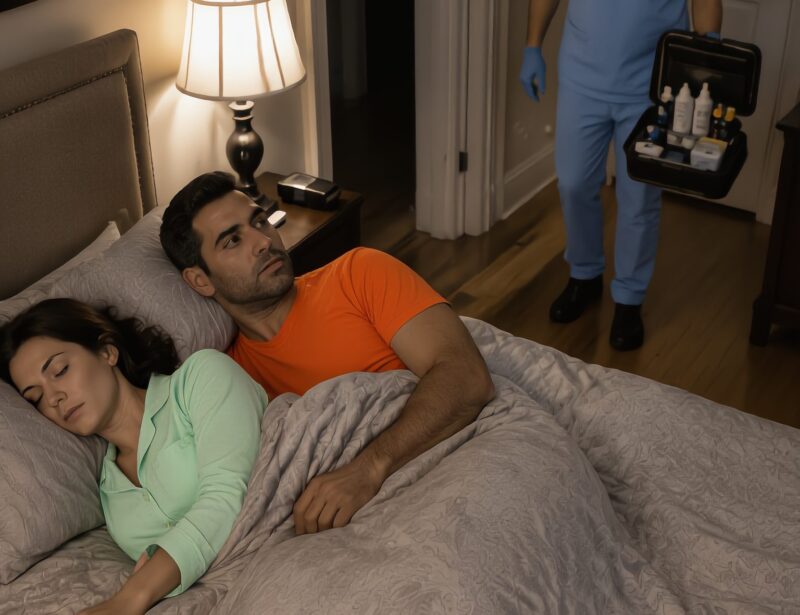
A tall figure entered carrying a slim black case.
He didn’t hesitate or search for his way through the room. He moved quietly toward my wife as though he had done this many times before.
She shut her eyes.
“This should be quick,” he murmured.
My wife nodded.
My entire body went rigid.
I was about to jump up when another sound stopped me.
The sharp snap of disposable gloves.
A moment later, I caught the familiar scent of antiseptic.
The man placed his case down and opened it. My wife pulled the fabric of her nightshirt away from her shoulder.
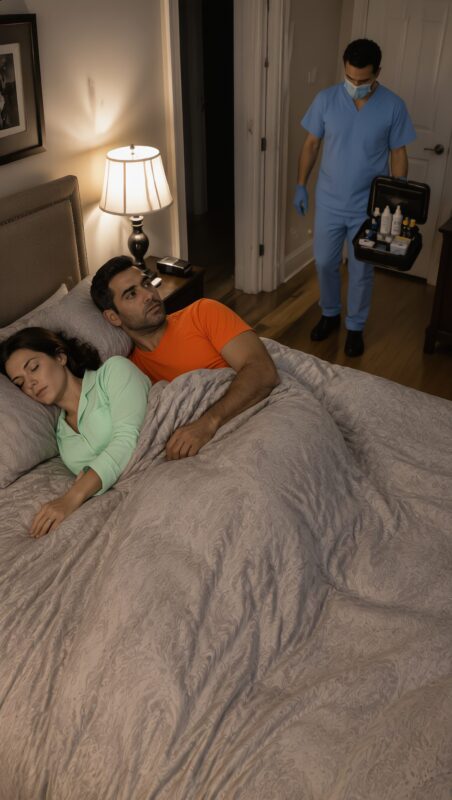
Something metallic gleamed in his hand.
I switched on the bedside lamp.
“Stop!”
The stranger spun around.
For one terrifying second, nobody moved.
Then my eyes dropped to his hand.
He was holding a syringe.
The open case beside him contained sealed medical supplies, medication, dressings, gloves, and an identification badge from a nearby hospital.
The man slowly raised his free hand.
“I’m Dr. Marcus Hale,” he said. “I’m treating your wife.”
I turned toward her.
Tears were already running down her cheeks.
“Treating you for what?”
She hesitated, then pulled the neckline of her shirt farther aside. A small dressing covered part of her shoulder.
“I’ve been ill for months.”
Everything I had imagined suddenly collapsed.
There was no affair. No sinister stranger. No secret betrayal.
There was only an illness my wife had been hiding from me.
She explained that her doctors had started treatment months earlier. It wasn’t easy, but they were cautiously optimistic. Some treatments could be administered at home, and she had arranged the late visits because she didn’t want Sonia watching medical procedures or becoming frightened.
“But why hide it from me?” I asked.
She wiped her face.
“After your father died, I saw what grief did to you. You became terrified whenever someone you loved got sick. I kept thinking I’d tell you when I had something reassuring to say.”
She looked down.
“Then every day I waited made telling you harder.”
The sleeping pills suddenly made sense.
So did the whispered calls, her exhaustion, the long sleeves, and the late-night visitor.
Before I could say anything else, a small voice came from the doorway.
“Mom?”
Sonia stood there barefoot, holding her stuffed rabbit against her chest.
“Are you leaving us?”
My wife immediately reached for her.
“No, sweetheart. Come here.”
Sonia climbed between us, and I wrapped my arms around them both.
I couldn’t promise that everything would be fine. None of us knew that.
But I could promise something else.
“No more secrets,” I said. “Whatever happens, we deal with it together.”
The next morning, we sat with Sonia and explained the situation as simply as possible. Her mother was sick. Doctors were giving her medicine to help her recover. Sonia hadn’t caused it, and she wasn’t responsible for fixing it.
She remained silent for several seconds.
Then she looked at me.
“I told you there was a man.”
A reluctant smile crossed my face.
“You certainly did.”
“But you thought I was imagining it.”
“I did.”
She hugged her rabbit tighter.
“You should listen to me next time.”
I kissed the top of her head.
“I will.”
The following months weren’t easy. Our lives became filled with appointments, test results, treatments, sleepless nights, and long periods of waiting.
Some days frightened us.
Others gave us hope.
But there were no more secrets.
Then one afternoon, the doctor gave us the news we had been praying for.
The treatment was working.
That evening, we sat together on the front porch while the sky slowly darkened.
Sonia suddenly pointed above the houses.
“Dad, look. The moon found us.”
My wife squeezed my hand.
I looked at them both and smiled.
“I guess it knows where we live.”
That strange night at 1:13 taught me something I would carry with me forever.
When people stop talking, fear begins inventing its own explanations.
And fear rarely chooses the kindest one.
Love works differently.
It asks.
It listens.
It remains present when the truth is frightening.
Because sometimes the secret that looks like betrayal is actually someone trying to protect the people they love.
And sometimes the strongest thing you can tell someone is simply this:
You don’t have to face it alone.