My Intoxicated Brother Left My 7-Year-Old Daughter Alone in a Lake. When I Tried to Save Her, My Parents Demanded That I Keep His Secret.
“WHERE IS MY LITTLE GIRL?”
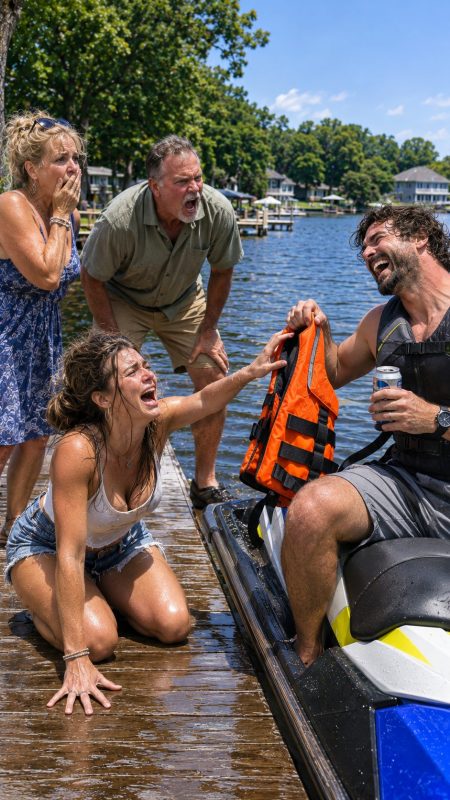
My voice shook as my brother Rhett casually stepped off his jet ski. He was holding something that made my blood run cold.
My seven-year-old daughter Winnie’s orange life jacket.
“She was complaining about wearing it,” he muttered. “So I took it off.”
I could barely process his words.
Just moments earlier, I had watched Winnie disappear into the water hundreds of yards from shore. Rhett had continued driving, never once stopping to check whether she was safe.
I reached for my phone to contact emergency services.
Before I could dial, my father blocked me.
“Gwen, don’t you dare involve the police! Your brother has two previous DUI convictions. Do you understand what another charge would mean?”
I looked from my father to my mother, expecting her to defend her granddaughter.
Instead, she whispered, “Please don’t destroy this family over an accident.”
An accident?
My child was missing in a vast lake, and they were discussing my brother’s reputation.
That was the moment I realized just how little my daughter’s safety mattered to them.
My name is Gwen Delgado, and I was thirty-eight when a holiday gathering exposed a truth about my family that I could never forget.
We had traveled to my parents’ summer house at the Lake of the Ozarks for Independence Day.
The weather was beautiful. Relatives crowded the patio, hamburgers sizzled on the grill, and children played near the shoreline.
My brother Rhett had started drinking before lunch. By midafternoon, he was speaking loudly and stumbling over his words.
I noticed, but my parents dismissed my concerns.
“It’s a holiday, Gwen,” my mother said. “Stop worrying about everything.”
I had strictly forbidden Rhett from taking Winnie onto the lake, especially after seeing how much he’d consumed.
Unfortunately, I stepped inside to retrieve sunscreen.
When I returned a few minutes later, my daughter was nowhere to be found.
“Where’s Winnie?” I asked.
My mother pointed toward the water.
“Rhett took her for a little ride. She was excited.”
I rushed down the wooden steps toward the dock.
In the distance, I spotted his jet ski cutting through the waves. A small figure in a pink swimsuit sat behind him.
Winnie.
Before I could shout, Rhett accelerated across a rough patch of water.
The jet ski bounced sharply.
I saw my daughter’s arms fly upward.
Then she vanished beneath the surface.
I screamed.
Rhett continued toward the opposite side of the lake before eventually turning back.
When he arrived at the dock without Winnie, I confronted him.
“Where did she fall? Why didn’t you stop?”
He frowned, apparently annoyed by my questions.
“Relax. She’s been taking swimming lessons. She probably made it back.”
I stared at the water.
Three hundred yards separated the place where she’d fallen from the nearest shore.
Even an experienced adult could struggle in those conditions.
And Winnie was only seven.
My father stepped between us as I tried calling 911.
“Think carefully before you do something you’ll regret,” he warned.
I pulled away.
“The only thing I’ll regret is wasting another second.”
My nephew Sam stood nearby, looking frightened.
I placed my phone in his hands.
“Sam, call emergency services. Tell them exactly what happened. Don’t let anyone stop you.”
He nodded and began dialing.
I took the life jacket from Rhett and entered the lake.
Years earlier, I had been a competitive swimmer. I’d spent countless mornings practicing endurance and rescue techniques.
Yet nothing could have prepared me for the fear I felt that afternoon.
Every wave seemed to hide something.
Every second felt unbearable.
I swam toward the area where I’d last seen Winnie, repeatedly calling her name.
“WINNIE! IT’S MOM! CAN YOU HEAR ME?”
Only the wind answered.
Then I noticed a tiny pink object drifting nearby.
It was a strawberry-shaped hair tie.
Winnie’s favorite.
That morning, she’d insisted I use it because she wanted her hair to look pretty for the holiday photographs.
Seeing it alone in the water terrified me.
I forced myself to keep searching.
A moment later, a faint sound carried across the waves.
“Mom?”
I stopped and listened.
“Mommy, I’m here!”
I turned and spotted a little figure holding tightly to a yellow floating cushion.
Winnie was frightened and exhausted, but she was still holding on.
I reached her as quickly as I could.
“Mommy, I tried to swim,” she whispered. “But the waves were too big.”
“You did exactly what you needed to do,” I told her, helping her into the life jacket. “Hold on to me now.”
She wrapped her arms around me.
“I remembered what you said. Find something that floats and don’t let go.”
A nearby couple had noticed our struggle. They approached in their motorboat and carefully helped us aboard.
By the time we reached the dock, emergency personnel were arriving.
Winnie was taken to a hospital, where doctors monitored her condition.
Fortunately, she recovered physically.
I had never been so grateful to hear a doctor say that my child would be all right.
But what happened afterward changed our family permanently.
Investigators interviewed everyone who had witnessed the incident.
They also tested Rhett’s blood alcohol concentration.
The result was 0.19—more than twice the usual legal driving limit of 0.08.
Witnesses confirmed that he had been operating the jet ski recklessly and had failed to stop after Winnie fell.
He was arrested.
When my mother learned what had happened, she called me in a rage.
“You’ve ruined your brother’s life! He’s going to lose everything because of you!”
I listened until she finished.
Then I answered, “Rhett endangered my daughter. I called for help. Those are not the same thing.”
She hung up.
My father refused to speak to me for weeks.
Neither seemed willing to acknowledge that Winnie had nearly lost her life.
In September, Rhett appeared before a judge.
The court sentenced him to three years of imprisonment, five years of probation, mandatory treatment for alcohol misuse, and restrictions on operating watercraft.
After the hearing, he asked to speak with me.
For the first time, he didn’t look arrogant.
He looked ashamed.
“Gwen,” he said quietly, “I can’t remember the moment she fell. I don’t remember leaving her behind.”
I studied his face.
“That’s what makes it so frightening, Rhett. You were responsible for her, and you were too intoxicated even to remember what happened.”
He lowered his eyes.
“I’m sorry.”
I wanted his apology to mean something.
But I knew it couldn’t erase Winnie’s memories.
For months, my daughter struggled with anxiety whenever she heard rushing water or saw videos of boats.
She sometimes woke during the night, asking whether I would be able to find her again.
We worked with a counselor who helped her process the experience.
Eventually, she agreed to return to swimming lessons.
Her instructor was gentle and patient. At first, Winnie would only sit beside the pool. Later, she put her feet into the water.
Little by little, she began swimming again.
I celebrated every moment of progress without pressuring her.
Meanwhile, my parents gradually began to understand the damage they’d caused.
My father was the first to reach out.
He came to my house one afternoon and asked to speak privately.
“I’ve replayed that day in my head a hundred times,” he admitted. “I was terrified Rhett would end up in prison. But I should have been terrified for Winnie.”
His voice broke.
“I chose the wrong person to protect.”
I accepted his apology, but I explained that trust would not return overnight.
Winnie deserved the freedom to decide when she was ready to spend time with her grandparents again.
He agreed.
My mother needed longer to acknowledge her mistakes, but eventually she apologized as well.
Two summers after the incident, Winnie surprised me with a request.
“Mom, can we go boating somewhere quiet?”
I asked whether she was certain.
She nodded.
“I think I’m ready.”
We chose a small, peaceful lake with calm water and rented a boat.
Before boarding, Winnie carefully fastened her orange life jacket.
She’d also asked me to put a strawberry-shaped hair tie in her ponytail.
When I noticed it, she explained, “I want to remember that I was brave.”
We spent the afternoon enjoying the sunshine and watching birds glide over the water.
Eventually, Winnie reached for my hand.
“Mom, when Uncle Rhett left, I thought nobody knew where I was.”
I squeezed her fingers gently.
“I’m so sorry you were frightened.”
She looked up at me.
“But you found me.”
“Yes,” I said. “And I’m grateful every day that I did.”
She rested her head against my shoulder.
For the first time in two years, the lake felt like a place where we could make a happy memory.
My parents once believed that reporting my brother was an unforgivable betrayal.
But I no longer confuse loyalty with protecting someone from the consequences of their choices.
Rhett was an adult who knowingly took dangerous risks.
Winnie was a child who trusted him to keep her safe.
When that trust was broken, my responsibility was clear.
I didn’t destroy my brother’s future.
His own actions brought those consequences.
And although our family will never be quite the same, I have no regrets about refusing to remain silent.
Because when I had to choose between protecting my brother’s reputation and protecting my daughter’s life, there was never really a choice.
My daughter came first.
She always will.