Seat 8A
One hour and fifty minutes after departing New York for Madrid, the cabin speakers crackled.
The captain’s voice followed—steady, but strained.
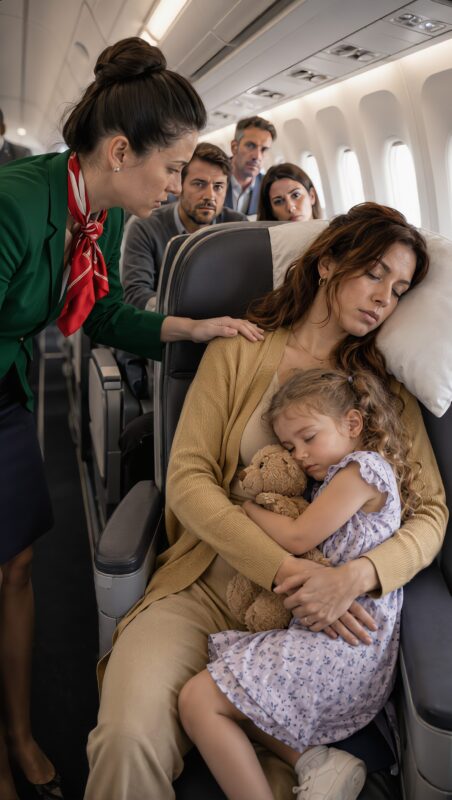
“If there is a passenger with fighter-jet experience on board, please identify yourself to the cabin crew at once.”
The relaxed mood disappeared.
Parents gathered their children close. Nervous passengers whispered across the aisle. Nobody could understand why an aircraft over the Atlantic would need someone trained to fly military jets.
Few noticed the woman at the window in 8A.
Laura Vance, thirty-eight, sat beneath a travel blanket in a soft green sweater. A novel rested unopened on her knees. She had skipped dinner, requested water, and made it clear that she wanted no conversation.
She looked like an ordinary, tired traveler.
Eighteen months earlier, Laura had flown F-16s for the U.S. Air Force.
She had spent years learning how to respond to alarms, engine failures, lost systems, and the terrifying seconds in which one decision could determine whether people lived or died.
Then Captain Gabriel Torres—her wingman, closest friend, and the person who knew her better than anyone—died in a crash.
Laura believed she should have saved him.
She left the Air Force, avoided airplanes whenever she could, and built a life that asked nothing extraordinary of her. She had no desire to be admired, needed, or called brave.
Then the captain repeated the request.
Laura heard the fear beneath his professional tone.
A flight attendant came quickly down the aisle.
“Excuse me,” she said, stopping beside Laura. “Do you know of anyone in this section with military flight experience?”
Laura looked around. A child slept against his father’s shoulder. An older woman clutched her husband’s hand. Rows of strangers were trapped above the ocean, unable to see the danger ahead.
She had sworn she was finished with aviation.
But she could still hear her instructor’s voice from years ago:
When people are in danger, a pilot acts.
“I have flight experience,” Laura said.
The attendant froze.
Laura stood.
“I was an Air Force fighter pilot,” she said. “I flew F-16s.”
The cockpit was in chaos.
The first officer lay unconscious behind the captain’s seat. Warning messages crowded the displays. Captain Andrew Vance was struggling against a violent shudder in the controls.
“The autopilot stopped responding,” Andrew said. “Now the computer is sending contradictory fault reports.”
Laura studied the instruments.
“Do not fight it,” she told him. “The aircraft is receiving bad commands. Cut off the secondary data channel.”
Andrew looked uncertain, but he followed her instruction.
The aircraft bucked hard.
Then the shaking suddenly eased.
For several seconds, neither of them spoke.
The relief did not last.
A severe storm blocked their original route, fuel margins were falling, and a doctor confirmed that the first officer appeared to have been drugged. The coffee thermos he had used earlier was nowhere to be found.
Then another alert appeared.
Hydraulic pressure for the right landing gear was failing.
At the same time, someone began striking the cockpit door.
Andrew checked the security feed.
Richard Sterling, the airline’s director of flight operations, was outside.
“Do not open that door,” Laura said.
They diverted toward a small emergency airport in northern Spain. Rain swept across the windshield as Laura moved into the first officer’s vacant seat.
During descent, two landing-gear indicators changed to green.
The third did not.
“If the right gear fails when we touch down,” Andrew said, “we could lose the runway.”
Laura placed both hands on the controls.
“Then we hold the centerline until the aircraft stops.”
The landing was brutal.
The jet struck the runway, leaned sharply right, and filled the cockpit with the sound of strained metal. Laura used rudder and differential thrust to counter the pull while Andrew kept the nose pointed straight ahead.
For a few agonizing moments, the aircraft seemed ready to collapse.
Then something slammed into place beneath the fuselage.
The damaged gear locked.
The aircraft slowed safely and came to a complete stop.
In the cabin, passengers wept, applauded, and shouted with relief.
Airport police detained Richard Sterling before he could leave the terminal. When he saw Laura, his expression hardened.
“Laura Vance,” he said. “You were not supposed to be on this flight.”
Investigators later uncovered a criminal operation involving fraudulent maintenance records and counterfeit aircraft components. Sterling had allegedly arranged for the flight’s systems to malfunction, for the first officer to be poisoned, and for the aircraft to disappear in an accident that would destroy the evidence.
The investigation also uncovered the truth about Gabriel Torres.
Before joining the airline, Sterling had worked with a defense contractor that provided defective avionics to Laura’s squadron. Those components had caused Gabriel’s crash.
Laura had not failed him.
A recovered transmission proved that Gabriel understood she had done everything possible.
For eighteen months, she had punished herself for a tragedy she did not cause.
When she visited Gabriel’s mother, the older woman took Laura’s hands.
“You did not leave my son,” she said. “But he would never want you to abandon your own life.”
Sterling was later convicted on federal charges.
Laura chose not to return to the military. Instead, she began teaching at a civilian flight academy.
On her first day, she wrote a sentence on the classroom board:
AN EMERGENCY DOESN’T CARE ABOUT YOUR PAST.
Then she turned to her students.
“When things go wrong, stay focused,” she said. “Understand the problem, make the best decision you can, and trust the people beside you.”
For a long time, the sound of jet engines had brought Laura back to the worst day of her life.
Now, when she watched training aircraft rise into the open sky, she felt something else.
She felt ready to live again.