No one came to her defense when she was humiliated, and that collective silence exposed the true nature of a powerful company.
That morning, the corporate building moved in its usual rhythm: flawless suits, hurried footsteps, and indifferent glances that never settled. Into this cold routine stepped an elderly woman, quietly pushing a cleaning cart.
Her uniform was modest, her gloves worn, her face composed. The name on her badge meant nothing to anyone. No one greeted her. No one asked who she was. To them, she was barely there.
She crossed the lobby with the careful presence of someone used to being overlooked. Each movement was soft, deliberate. Yet her arrival would reveal something long hidden within those walls. She hadn’t come to clean.
She had come to witness.
### Subtle cruelty
As the day progressed, the atmosphere sharpened. The remarks became lighter in tone but heavier in meaning.
A young man in an elegant suit passed by, barely acknowledging her.
“Watch it—don’t dirty the entrance,” he said casually, as if addressing an object.
A few nearby employees laughed. Others chose not to react. She continued working, her head slightly lowered—not from weakness, but from quiet observation. She was seeing how easily disrespect had become routine.
Later, a polished woman approached, coffee in hand.
“Do you always work this slowly? We don’t pay you to linger,” she said, her smile empty of warmth.
The cleaner’s fingers tightened around the cloth, but she remained silent. Inside that silence were years of resilience—of building a life grounded in dignity, of holding onto values that seemed absent here.
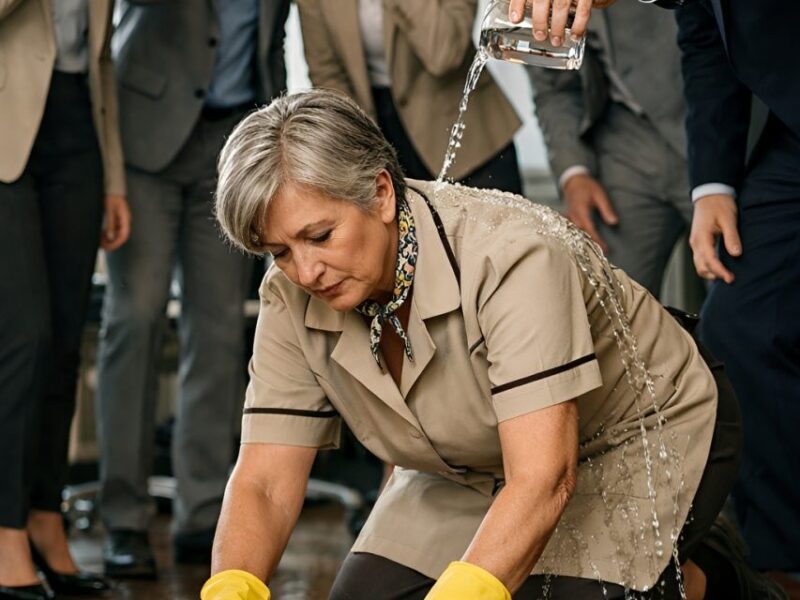
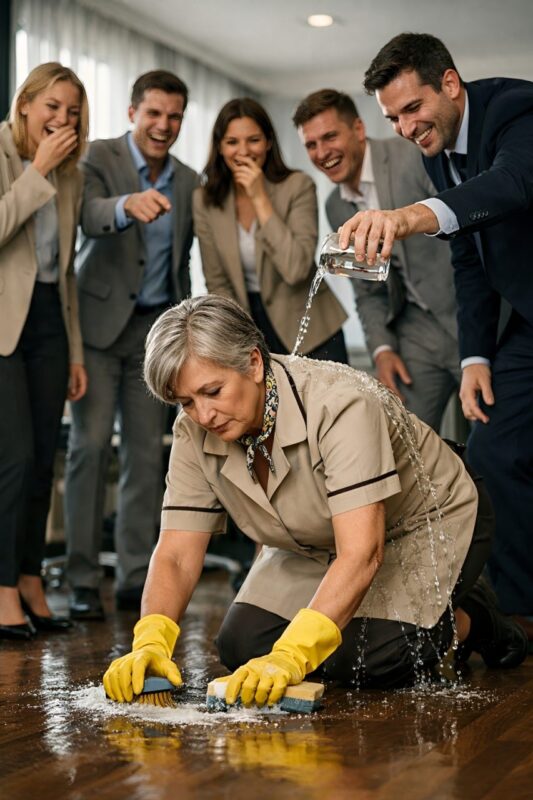
The harshest moment came near the end of the day. A supervisor walked past and, feigning carelessness, splashed water across her back.
“Oh, sorry… that’s what happens when you’re in the way,” he said, as laughter followed.
The laughter hurt more than the water. It was shared, accepted. No one intervened.
She slowly lifted her gaze. There was no anger—only a quiet sadness. Not for herself, but for what those people had become.
### The turning point
As evening fell and she began putting away her supplies, she noticed a man entering the building. He carried himself differently—no uniform, no cart, just a quiet authority.
Their eyes met briefly. No words were exchanged. None were needed.
Hours later, an urgent meeting was called. Employees gathered in the conference room, uneasy and uncertain.
The CEO entered without notes, his voice calm but firm.
“Today,” he said, “my mother worked here as a cleaner. And you revealed the true face of this company.”
The room fell silent.
Footage from the day appeared on the screen: mocking remarks, careless laughter, deliberate humiliation, and those who chose to look away.
Someone attempted to justify it.
“We didn’t know who she was…”
The CEO shook his head.
“That’s exactly the problem. You decided that if she wasn’t important, she didn’t deserve respect.”
That same day, those responsible lost their positions—not as revenge, but as consequence. And an uncomfortable truth surfaced: silence in the face of disrespect is also a form of participation.
What remained
The following morning, the woman returned—this time without her uniform. She walked beside her son.
Some employees avoided her gaze. Others greeted her with genuine respect.
Before leaving, she spoke quietly, yet her words carried weight:
“You never know who stands behind a simple appearance. But dignity is not defined by what someone wears.”
As the elevator doors closed, one thing became clear:
What had truly been cleansed that day was not the building—
but the truth within it.
A necessary truth.
Because in the end, respect is the only measure that truly matters.