Nobody in the ballroom expected the girl to move.
A moment earlier, hundreds of conversations had filled the enormous room. Glasses had clinked, musicians had played softly beneath crystal chandeliers, and elegantly dressed guests had drifted between tables.
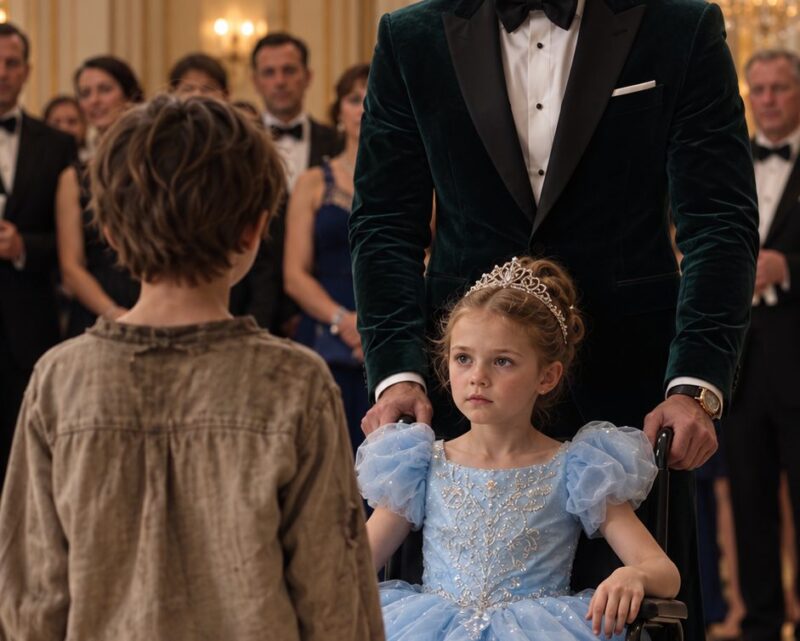
Now there was only silence.
At the center of it stood a barefoot boy named Eli.
His shirt was faded, his knees were dusty, and one trembling hand was stretched toward the girl sitting in a wheelchair.
She stared at him.
Then at his hand.
Her father tightened his grip on the handles behind her.
“That’s enough,” he said.
Eli didn’t move.
Neither did the girl.
Her father had heard too many promises over the years.
Every new specialist had brought another possibility. Every treatment began with optimism. Every encouraging prediction gave his daughter another reason to imagine a different future.
And when things didn’t happen as hoped, he was the one who watched that hope disappear from her face.
Eventually, he’d decided that protecting her meant expecting less.
No impossible promises.
No strangers playing savior.
No more letting someone turn his daughter’s life into a performance.
So when Eli had walked across the ballroom and offered his hand, her father’s first reaction had been anger.
But Eli wasn’t behaving like the others.
He hadn’t claimed he could fix anything.
In fact, he hadn’t promised anything at all.
He simply stood there.
Waiting.
The girl looked over her shoulder.
“Dad?”
Her father’s expression softened.
“What is it, sweetheart?”
“I want to try.”
Four words.
They frightened him more than anything else she could have said.
He wanted to tell her she didn’t need to prove herself.
He wanted to push the chair away from the staring crowd and protect her from whatever happened next.
Then he saw her face.
She wasn’t asking whether she would succeed.
She was asking whether she was allowed to try.
His fingers slowly released the wheelchair.
“Okay.”
The girl turned back toward Eli.
Her hand rose uncertainly.
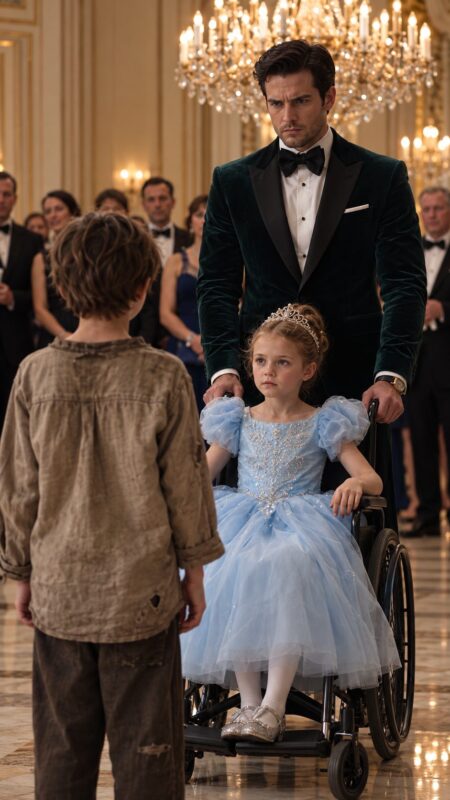
Eli stepped closer, but not too close.
Their fingers met.
He didn’t squeeze tightly.
He didn’t pull.
He simply gave her something steady to hold.
“Don’t let go,” she whispered.
“I won’t.”
She shifted forward in the chair.
Her father instinctively reached toward her.
She noticed.
“No, Dad.”
He stopped.
“I’ve got you.”
“I know.”
She took a breath.
“But let me do this part.”
That sentence nearly broke him.
He lowered his hands.
The girl planted her feet on the polished floor and pushed against the armrests.
Nothing happened.
A few guests looked away.
She tried again.
Her arms shook.
Her breathing became uneven.
Eli remained completely still.
“Take your time,” he said.
She pushed once more.
This time, her body lifted from the seat.
Only a little.
Then another inch.
Her father covered his mouth.
The girl straightened as much as she could.
For several seconds, she stood between the wheelchair and the barefoot boy.
The room erupted with startled whispers.
She barely heard them.
Her eyes were locked on Eli.
And she was smiling.
Not because everything had suddenly changed.
Not because standing once meant tomorrow would be easy.
She smiled because the moment belonged to her.
Then her strength gave out.
Her father moved forward, but she lowered herself back into the chair before he needed to catch her.
Eli dropped to his knees beside her.
His expression was crushed.
“I thought you’d take a step.”
The girl was breathing hard.
“So did I.”
“I’m sorry.”
She stared at him.
Then something unexpected happened.
She laughed.
Eli blinked.
“Why are you laughing?”
“Because you’re acting like I failed.”
His face reddened.
“You wanted to walk.”
“Yes.”
She looked down at her feet.
“But yesterday I wouldn’t even try to stand.”
Eli considered that.
“So today was better?”
“Much better.”
A reluctant smile appeared on his face.
Behind them, her father wiped his eyes.
He had spent years measuring progress by results.
Distance walked.
Seconds standing.
Numbers on medical reports.
His daughter had just taught him another way.
Sometimes progress was simply being brave enough to attempt what fear had convinced you to avoid.
He crouched beside Eli.
“What’s your name?”
“Eli.”
“Who did you come here with?”
The boy’s smile vanished.
“No one.”
Her father frowned.
“What do you mean?”
Eli stared at the floor.
“I don’t really have anyone.”
The girl immediately reached for his hand again.
Eli looked up.
“So now you do,” she said.
Her father met his daughter’s eyes.
This time, he didn’t interfere.
He smiled.
The months afterward weren’t a fairy tale.
There was no sudden transformation.
There were appointments, exercises, evaluations, difficult afternoons, and mornings when yesterday’s progress seemed to have vanished.
Some therapy sessions ended with celebration.
Others ended early.
But something important had changed.
Eli became part of their lives.
He sat beside her during appointments, carried her water bottle, made ridiculous jokes when exercises became frustrating, and never treated her wheelchair like something that made her less complete.
Most importantly, he never promised success.
If she stood, he celebrated.
If she couldn’t, he stayed.
One rainy afternoon, after a particularly frustrating session, she found him waiting outside.
She sat quietly beside him.
“Eli?”
“Yeah?”
“Did you really think I was going to walk that first night?”
He shook his head.
“No.”
She looked surprised.
“Then why did you come over?”
Eli shrugged.
“You looked scared.”
“That doesn’t answer my question.”
He thought about it.
Then he extended his hand, palm upward, exactly as he’d done beneath the ballroom chandeliers.
“I figured being scared is easier when somebody else is there.”
She stared at his hand before placing hers inside it.
“So you never believed you could make me walk?”
“No.”
“Then what did you believe?”
Eli smiled.
“That if you tried, somebody should stay until you were finished.”
She squeezed his fingers.
All her life, adults had tried to give her certainty.
Eli had given her something better.
Permission to fail without being abandoned.
That first night, she hadn’t crossed the ballroom.
She hadn’t taken a miraculous first step.
She had simply risen from her chair for a few precious seconds.
To everyone watching, it might have looked like a small victory.
To her, it was enormous.
Because the most important movement she’d made that evening hadn’t been standing.
It had happened moments earlier—
when someone reached toward her without promising a miracle,
and she finally chose to reach back.