On the Coldest Night, a Cat Came to a Dying Woman — Bringing What It Had Spared — Cherry
The cat watched Margaret as though expecting a response.
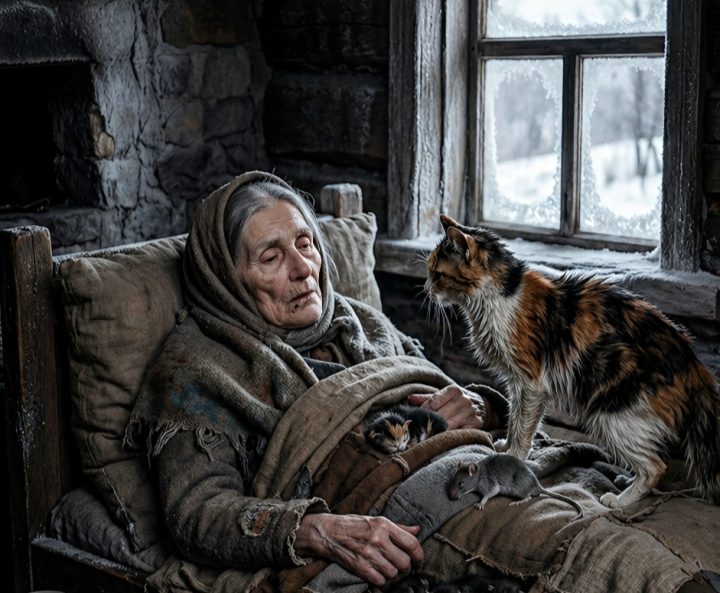
On the worn blanket lay another rat—gray, heavy, already stiffening in the cold. For most people, it would have been a dreadful sight.
For Margaret, it meant survival.
She tried to reach for it, but her hand would not move.
Not from revulsion—from weakness.
Her fingers no longer obeyed her, as if they belonged to someone else. Her nails had turned bluish, and the skin across her knuckles was split and dry.
The cat stayed beside her, leaving the catch untouched.
Its ribs showed faintly through its damp fur. Beneath its body, tiny kittens whimpered. It needed food more than anyone under that roof.
Still, it waited.
Margaret lifted her gaze.
There was no softness in the cat’s eyes. No comfort, no promises, no illusions.
Only a simple command: *Eat.*
With shaking hands, the old woman picked up the rat.
A knife rested on a stool near the bed. Once, it had been used for bread, onions, bits of fat, apples for baking.
Now it felt like something else entirely—her last fragile link to the living world.
She forced herself to eat.
Not slowly by choice, but because her body no longer remembered how to take in food.
Every bite hurt. Her throat tightened, her stomach resisted. But along with the pain, something returned.
Warmth.
Not in the room.
Inside her.
The cat only lay down beside its kittens after Margaret set the remains aside.
First, it fed them.
Only then did it finish what was left.
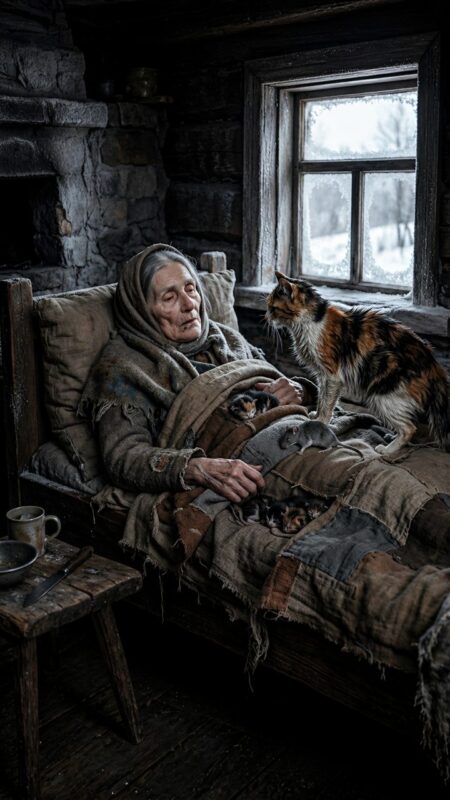
Margaret watched, and for the first time in days, her feelings shifted.
Gratitude was no longer enough.
She felt shame.
A quiet, almost childish shame—as though it were not an animal lying there, but a silent, stronger being who had come where no human had.
In the village, everyone carried their own burden.
Hunger doesn’t turn people cruel right away. It makes them count first.
How much flour remains.
How long a child can last.
Whether sharing a bowl of soup today means losing tomorrow.
So Margaret did not blame them.
She understood the hollow echo of an empty granary. She had seen women avert their eyes in church when faced with another’s weakness.
Not because they didn’t care.
Because they were afraid.
Afraid their turn would come next.
But the cat did not think like people.
It simply came back.
By the third day, Margaret found herself listening for the faint sound at the window.
It was a fragile hope, one she was almost ashamed to admit.
Too many things in her life had vanished and never returned.
Her son who went to war.
Her other son lost to hunger.
Her husband, who once tended the stove in the evenings.
The warmth of summer.
Fresh bread.
Voices filling the house.
All gone.
All silent.
And yet—the cat kept returning.
Sometimes early.
Sometimes closer to midday.
Once, it did not come until nearly nightfall. Margaret lay still, staring at the window, trying to push away thoughts of wolves, traps, and desperate strangers.
The kittens crawled beneath the blanket—blind, damp-nosed, clinging to life with tiny claws.
She covered them gently with her hand.
If the cat didn’t come back, she feared the kittens would fade too.
And then there would be nothing left but cold.
At last, just before dusk, she heard scratching at the window’s edge.
Margaret closed her eyes.
Not from exhaustion.
From relief too deep for her frail body.
The cat staggered inside, dusted with snow, a fresh wound by its ear.
Another rat hung from its jaws.
It carried the prey to the bed, leapt up heavily—almost slipping—but managed to steady itself.
Once again, it laid the offering in her lap.
Margaret whispered softly:
“My grace…”
That was the name she gave it.
**Gnade.**
The cat did not respond. It only flicked its ear and curled beside its kittens.
But from that moment on, the name stayed.
No one in the village remembered Margaret right away.
Father Benedict made his rounds when the weather allowed, though he had grown used to silence after knocking.
That winter, doors often opened too late.
Sometimes, they found someone who had passed quietly—without light, without prayer, without even a final sip of warmth.
Other times, there was nothing but an empty room and footprints leading away into the snow.
People left to search for food—and never came back.
Margaret’s house stood at the far edge of the village. It took several days before anyone reached it.
Father Benedict approached with a heavy heart.
He remembered her as she once was.
Straight-backed.
Neatly dressed.
Hands skilled enough to knead dough, mend clothes, and carry water without effort.
He would have baptized her grandchildren—if life had granted her any.
But there were none.
He had buried her husband.
He had listened as she asked about her son after the war.
And he had fallen silent when news came of the other.
There is a kind of sorrow that leaves even a priest with no words.
He knocked.
Silence.
He pushed the door.
It resisted at first—the snow had piled high, the wood swollen with damp—but finally gave way.
Inside, the air smelled of cold, worn fabric, and something sharp, animal.
He removed his hat.
He had expected death.
Instead, a faint voice came from the bed:
“Don’t come too close, Father… she has little ones.”
The priest paused.
Margareta was sitting upright, supported by a pile of pillows. Her face had turned pale and hollow, as though the life had drained from it, leaving only her eyes. Still, she was breathing.
Four small kittens slept across her lap. Near her hip, a calico cat rested, slowly licking its paw.
Father Benedict said nothing for a long while. At last, he crossed himself.
“Margareta… what have you been living on?”
The old woman glanced toward the cat.
“She brings it.”
“Who does?”
“The cat.”
He assumed she was not fully in her senses. Starvation can twist the mind—make a person see bread where there is only stone, hear voices that are no longer there.
Margareta gestured weakly toward the windowsill.
Three frozen rats lay there, arranged with care, like a small reserve.
The priest stepped closer.
He had seen rats in barns before. He knew how they survived when people could not, finding grain in places where others had already given up. But never had he seen a cat gathering food for a human.
“She brings it to me,” Margareta said quietly. “First to me. Then she feeds the kittens. After that, she eats.”
He turned toward the animal.
The cat raised her head and met his gaze—calm, almost severe—as if he were a stranger allowed inside, but not entirely trusted.
Father Benedict gave Margareta what little he could: a thin nettle broth, a dense piece of dark bread that barely resembled bread at all, and a scrap of fat wrapped in cloth.
He considered taking the kittens away, thinking it might ease her burden.
Margareta suddenly clutched the blanket.
“No.”
It was the first firm word he had heard from her.
“They came with her. They stay.”
He did not argue. It became clear to him that the kittens were no longer a hardship.
They were a sign that something in this house was still beginning—not only ending.
After that, Father Benedict started visiting more often. He did not always bring food; sometimes there was nothing to give.
On those days, he carried hot water in a sealed container so Margareta could warm her hands. Sometimes he brought bits of wood for the fire. Other times, he simply sat beside her bed, listening to the soft cries of the kittens nestled against their mother.
And Gnade kept going out.
Even when there was soup in the house. Even when Margareta could swallow a few spoonfuls without fainting.
The cat continued to hunt.
Each day she disappeared into the snow.
Each day she came back.
Sometimes with one rat. Sometimes with two.
Once she returned with a small, thin one, dropped it onto the blanket, and seemed almost displeased with it.
For the first time in weeks, Margareta smiled.
Her lips split, a trace of blood appearing.
But the smile was real.
“It’s all right,” she whispered. “It’s enough for today.”
The cat blinked slowly.
Perhaps she understood nothing.
Or perhaps she understood more than people would ever admit.
Nineteen days went by.
Nineteen times Margareta heard the faint rustle at the window and the quiet return of a small creature that had no reason to save a human life.
For nineteen days, the cat decided how their strange household would survive:
First the old woman.
Then the kittens.
Then herself.
At the beginning of March, the wind shifted.
The snow still covered the ground—heavy, dirty—but it had begun to weaken.
Water started dripping from the roof.
The entire village noticed.
People stepped outside, staring at the icicles, afraid to celebrate too soon.
After such hunger, spring did not feel like a season—it felt like a rumor.
Father Benedict managed to arrange food deliveries for those who could no longer walk.
It was not much. It was clumsy. For many, it came too late.
But for Margareta—it arrived in time.
That morning, Gnade left as she always did.
The kittens had grown stronger. They crawled across the blanket, nudging into folds of fabric, tumbling over one another.
Margareta sat against the wall, holding a cup of hot water to warm her hands.
She was still painfully thin. But she was no longer lying there waiting for death.
She listened for the window.
By midday, the cat returned.
Another rat hung from her jaws.
She leapt onto the bed and placed it gently on Margareta’s lap—
just as she had done the very first time.
The old woman took it.
“Thank you,” she said softly.
Gnade held her gaze for a long moment.
Then she lay down beside the kittens.
And this time, she did not leave.
Margareta did not understand it right away.
An hour passed.
Then another.
The cat slept, her paws tucked beneath her body. From time to time, she opened her eyes, checked on the kittens, and drifted back to sleep.
The next day, she did not go to the window.
Nor the day after.
As if she knew the worst had passed.
As if her task was finished.
From then on, Margareta’s home slowly began to return to life.
Not the life it had once been.
That life was gone.
Her sons did not walk through the door. Her husband did not cough by the stove. The lively sounds of summer no longer filled the yard.
But each morning, the kittens played on the blanket.
The cat rested on the windowsill, watching the street.
Father Benedict brought soup, sometimes bread, sometimes news.
Margareta began to stand again.
First for a minute.
Then as far as the chair.
Then all the way to the stove.
In April, she opened the door herself for the first time.
The air smelled of damp earth.
The snow near the fence had darkened, and beneath it, patches of muddy grass appeared.
Margareta stood in the doorway, holding the frame. Gnade sat beside her.
The four kittens tumbled around her feet.
A neighbor passing by with an empty bucket stopped.
She looked at Margareta for a long time.
Then said quietly:
“We thought you were gone.”
Margareta felt no offense.
She only ran her hand gently along the cat’s back.
“I once believed the same thing,” she murmured.
The neighbor dropped her gaze.
In that village, people owed each other many things—but their guilt was never equal.
Hunger leaves more than graves behind.
It leaves a quiet tension among those who survive.
People remember who kept their doors closed,
who failed to offer a place at the table,
and who did not even bring a cup of warm water.
Margareta never reproached anyone.
Perhaps that was the most difficult part.
Blame can be endured.
But silent forgiveness can burn far deeper.
Gnede remained with her.
The kittens grew up in that house where death had once lingered beside the bed, waiting patiently.
They slept on the bench, chased bits of thread, scratched at the worn chair.
Margareta scolded them with a soft, almost maternal irritation:
“You little troublemakers.”
Still, she always saved them the warmest spot.
Gnede became the true keeper of the home—
not a pet, not a decoration.
She was a being who had once made a choice,
and through that choice, altered another life.
Margareta lived four more years.
They were not easy years,
nor wealthy ones,
but she was no longer alone.
She often sat by the window, watching the cat curled on a folded blanket.
At times, it puzzled her how people could speak so easily about mercy, duty, and love—yet when it truly mattered, all those words disappeared.
It came instead on damp paws,
slipping through a narrow gap,
giving birth to kittens on the chest of a dying woman,
and returning at dawn with food.
When Margareta passed away, Gnede was there.
The kittens, already grown, rested quietly on the bed.
The house was still—but not empty.
Father Benedict recorded her passing and added something unusual to the church register.
He wrote about the cat—
how she hunted in the snow,
how she carried food to a woman too weak to stand,
and how she fed herself last.
Afterward, people argued about what it all meant.
Some called it instinct.
Some dismissed it as coincidence.
Others simply shrugged—because it is easier than accepting what stands before you.
But Margareta knew.
She had seen that steady gaze above the gray rat on the blanket.
She had felt that fragile warmth on the first night.
She had heard, in a house nearly emptied of life, four blind kittens searching for milk.
Love does not always arrive in a gentle form.
Sometimes it carries no comforting scent.
Sometimes it has no voice.
Sometimes it offers what it needed for itself.
In her later years, Margareta never told the story loudly.
If someone asked, she would only stroke the cat and say quietly:
“She came when no one else did.”
And that was enough.
Because in the harshest winter, salvation does not always come from the strongest—
but from the one who, even in hunger, lays its find not at its own feet,
but into your hands.