“Open It, Son.” The Black Card That Revealed a Forty-Year Betrayal
The black card struck the marble counter with a crack so sharp it cut through every conversation in the grand bank lobby.
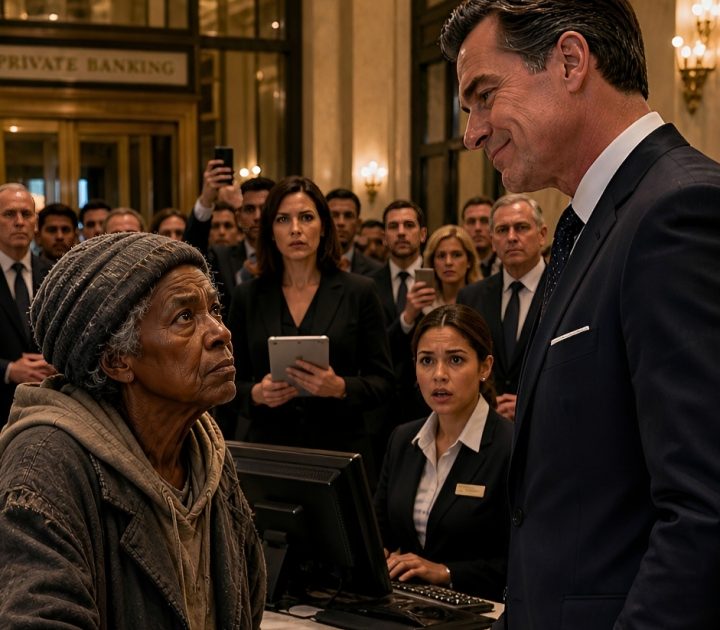
“I SAID—CHECK MY BALANCE!”
Margaret Elise Hayes stood beneath the chandelier’s glow, raindrops still clinging to her gray wool coat. Her cane was planted firmly at her side, her posture unshaken. At ninety, she was small enough to be overlooked—but nothing about her felt insignificant. Her eyes were steady, dark, and carrying the weight of patience that had finally worn thin.
Behind the counter, the young teller looked like she wished she could disappear.
“Ma’am,” she said carefully, “I understand you’re upset, but this card doesn’t appear in our system. It may be inactive or—”
“It is not inactive,” Margaret said, her tone quiet but absolute.
A man near the private lounge let out a faint laugh. Nearby, a woman in a cream blazer leaned toward her husband and murmured—just loud enough to be heard—“Poor thing. She’s confused.”
Margaret heard it.
She didn’t turn.
She never did. All her life, people had mistaken her silence for weakness, her age for irrelevance, her restraint for defeat.
The teller tried again. “If you have another form of identification, perhaps we can—”
Margaret’s gloved hand pressed harder against the counter. “I’ve already given you identification. I’ve given you the card. Now check my balance.”
A quiet tension spread through the room—the kind that unsettles places built on control and quiet privilege. Conversations faded. Phones lowered. Even the security guard by the revolving doors glanced toward the executive elevators, unsure if this was routine or something more serious.
Then Charles Hayes appeared.
He moved through the lobby with effortless authority, like a man walking through something that belonged to him—because it did. His name was stamped across trust documents. His portrait hung high above. His father’s bronze bust stood at the entrance, beneath polished words about legacy, loyalty, and integrity.
Charles had inherited everything.
The institution. The reputation. The admiration.
And the arrogance that comes from never asking who built it first.
Beside him, his assistant Janet Moore followed closely, tablet in hand. She had worked with him long enough to recognize the expression on his face.
It was the one he wore before putting someone in their place.
“Is there a problem here?” Charles asked.
Margaret turned to face him.
For a brief second, something passed across her expression—not fear, not surprise.
Recognition.
He didn’t recognize her.
The realization stung less than she expected.
Perhaps because that wound had healed long ago.
Or perhaps because today wasn’t about being remembered.
It was about being proven.
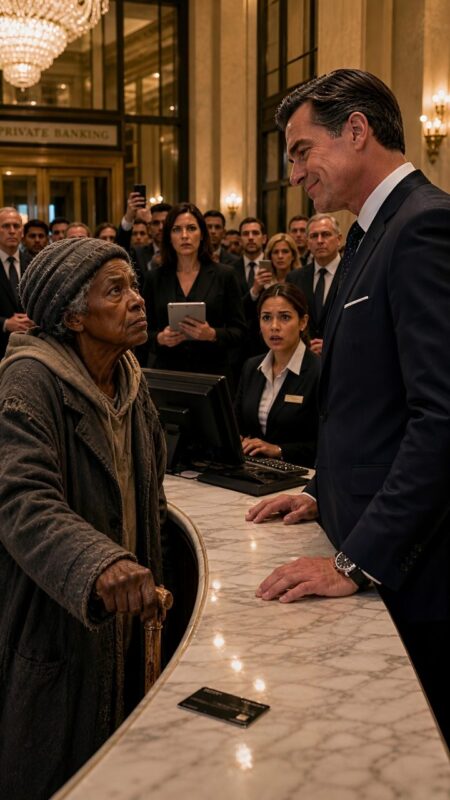
“I asked for my balance,” Margaret said.
Charles glanced at the card. His gaze moved over her coat, her cane, her simple pearl earrings, her old-fashioned hat. He saw inconvenience—not power.
“Ma’am,” he said smoothly, his voice softened for the audience around them, “you’re in the wrong bank.”
A few quiet smiles flickered across the room.
Margaret didn’t smile.
“No,” she replied calmly. **“You’re the wrong man.”**
The air shifted.
Janet’s fingers froze above her tablet.
“Excuse me?” Charles said, his tone tightening.
Margaret nudged the card toward him. “Check it.”
He gave a low, dismissive chuckle. “This is a private institution. We don’t entertain scenes like this.”
“Then stop performing,” Margaret said.
A hush fell.
Charles’s jaw tightened.
He wasn’t used to being challenged—not by staff, not by clients, and certainly not by a woman he had already dismissed.
“Fine,” he snapped, grabbing the card. “Let’s finish this.”
The teller stepped aside, both relieved and uneasy.
Charles walked behind the terminal himself. Holding the card between two fingers, as if it were something unpleasant, he slid it into the reader.
Margaret watched him closely.
His hands.
They were unmistakable.
His father’s hands.
That had been the first thing she noticed years ago, when she saw his photograph in a magazine—the same long fingers, the same squared nails, even the faint scar near the thumb.
Arthur Hayes had gotten that scar opening a cheap bottle of wine the night he promised her everything.
The memory rose without warning.
A cramped apartment above a bakery in Queens. Arthur laughing with his sleeves rolled up. Margaret, just twenty-one, reckless with trust, signing papers she barely understood because he spoke of building a future. A shared account. A company formed before the family name meant anything. Her mother’s inheritance becoming the foundation of it all.
Then Arthur disappeared.
No farewell.
No divorce.
No explanation.
Months later, the only response came in the form of a lawyer’s letter, cool and impersonal, insisting that all matters had been resolved.
Margaret had been expecting a child when she opened it.
Within two weeks, the child was gone.
For forty years, she never stepped inside Hayes National Trust.
Not because time had erased the memory—
but because she had spent those years building her case.
Charles began working at the terminal.
At first, his expression showed nothing but routine indifference.
Then came irritation.
Then something far less certain.
He typed again.
The screen’s glow reflected in his eyes.
The faint curve of his smile disappeared.
Janet leaned closer. “Is something wrong?”
He didn’t respond.
His fingers moved faster, then halted. A second authorization code. Then a third. The teller stared at the monitor, pressing a shaking hand to her lips.
Silence settled heavily over the lobby.
Phones rose again.
Margaret caught the quiet tone of a recording beginning somewhere nearby.
Good.
Let them witness it.
Charles swallowed; the movement was visible above his collar.
“That… doesn’t make sense,” he muttered.
Margaret tapped her cane once against the marble.
The sound rang out.
“Well?” she prompted.
He looked up. For the first time, his face held no trace of amusement.
“This account…” He glanced back at the screen, his voice thinning. “This account controls the entire holding company.”
A ripple of shock moved through the room.
Janet frowned at the display. “The holding company?”
Charles stepped back as if burned. “No. That’s impossible. This account hasn’t been accessed in forty years.”
Margaret approached slowly.
Each step was measured, each tap of her cane deliberate.
“I was waiting,” she said.
Janet lowered her voice. “Waiting for what?”
Margaret looked directly at Charles, her gaze reducing him to something smaller.
“For the man who stole it to climb high enough.”
Fear sharpened his expression. “You don’t know what you’re talking about.”
“I know precisely what I’m saying.”
“This is a system error.”
“No,” Margaret replied calmly. “The error was believing your father when he convinced me that love and business could share the same signature.”
Charles went still.
Those words struck deeper than anything on the screen.
Margaret gestured toward the monitor. “Check the signature authority.”
He didn’t move.
“Check it,” she repeated.
Janet reached for the keyboard, but Charles quickly covered her hand. “Don’t.”
That was enough.
Everyone noticed.
A heavier murmur spread across the lobby. The security guard straightened. The teller instinctively stepped away from Charles.
Margaret’s eyes hardened.
“You inherited his cowardice,” she said quietly.
Charles turned sharply. “Who are you?”
The question should have hurt.
Instead, it unlocked something final within her.
Margaret reached into her bag and removed a folded document, worn with age but protected in a clear sleeve. She laid it on the counter.
The teller leaned closer.
Janet’s tablet shifted in her hands.
Charles stared at it.
A marriage certificate.
State of New York.
Arthur William Hayes.
Margaret Elise Whitman.
June 14, 1964.
His lips parted.
“No…” he breathed.
Margaret’s voice remained steady.
“He married me before he abandoned me.”
Janet covered her mouth.
The woman in the cream blazer fell silent.
The man who had laughed earlier lowered his gaze.
Charles looked between the document and Margaret’s face, searching for doubt—any flaw, any hesitation, any hint that this was fiction.
He found none.
“My father would have told me,” he said.
Margaret’s smile was tinged with sadness. “Your father told people whatever made him richer.”
“He was married to my mother.”
“Yes,” Margaret said. “Later.”
His face twisted. “You’re lying.”
Margaret leaned closer. “Then explain why the original holding account was never transferred. Explain why your father kept a single locked cabinet in his private office. Explain why, when he died, he ordered it burned instead of archived.”
Charles’s eyes flicked toward Janet.
That small movement betrayed him.
Janet saw it too.
“You knew about the cabinet,” she whispered.
“Janet,” he snapped.
But her expression had already changed.
Margaret slipped the certificate back into her bag and pointed at the screen. “Now read the authority.”
Charles inhaled slowly and turned back to the terminal.
The entire lobby leaned in.
His hands trembled as he navigated deeper into the account. One line appeared. Then another. And finally—the one that changed everything.
His voice cracked.
“Primary owner…” He hesitated.
Margaret waited.
“Say it,” she said.
He looked as though he might collapse.
“Primary owner: Margaret Elise Hayes.”
The gasp that followed was no longer simple shock.
It carried judgment.
Charles staggered back. “Hayes?”
Margaret closed the distance between them until only inches remained. She looked fragile, almost breakable—yet in that moment, she seemed to eclipse every portrait hanging on the walls.
“Yes,” she said quietly. “Hayes.”
For the first time, Charles stopped seeing her as an inconvenience, a client, or a confused elderly woman who had wandered in by mistake.
He saw her as proof.
“And according to that account,” Margaret continued, her low voice drawing the entire room into silence, **“you’ve been using my money your whole career.”**
Charles parted his lips, but nothing came out.
Across the counter, realization crashed over Janet. The unexplained transfers. The silent restructures. The charitable foundation that conveniently elevated Charles’s reputation. The sudden promotions. The discreet removal of auditors who had asked too many questions.
She had always told herself it was business.
Now she knew—it was theft in a tailored suit.
Charles reached for his phone. “I need legal.”
Margaret’s cane snapped into place, blocking him.
“No.”
He stared down at it, offended by the interruption.
Without hurry, Margaret slipped a hand into her purse and withdrew a thick, cream-colored envelope. It looked deliberate—aged, sealed, and marked with a single line of dark blue ink:
*To Charles Hayes, when he finally faces the truth.*
She held it toward him.
“Go on,” she said. “Open the second surprise.”
Charles didn’t move.
“Mr. Hayes…” Janet murmured.
Margaret’s voice sharpened, cutting through the tension. **“Open it, son.”**
The word *son* sliced across the room.
Charles recoiled. “Don’t call me that.”
Margaret’s expression shifted—not anger, but something heavier. A grief worn so long it had settled into her very being.
“I’ve earned that right,” she said.
His hand hovered uncertainly near the envelope.
For a brief second, he no longer looked like a powerful executive. He looked like a boy cornered by a truth he had never been meant to uncover.
At last, he took it.
The paper quivered slightly in his grip.
Inside was a letter.
Not from Margaret—
from Arthur Hayes.
The handwriting was unmistakable. Charles had seen it countless times—on birthday cards, official memos, framed quotations in the boardroom. The same elegant tilt, the same dramatic loops.
He unfolded the pages.
His eyes traced the first line—
—and froze.
Beside him, Janet went pale.
Charles shook his head once. “No.”
Margaret remained silent.
He began reading aloud—not by choice, but because the weight of the room demanded it.
“Margaret… if you are reading this, then I lacked the strength to do the only honorable thing while I was alive.”
His voice broke on the word *strength*.
“I built Hayes National Trust with your money, your trust, and the account I promised would protect our family. When I left, I told myself it was for survival. The truth is far worse—I chose ambition.”
The lobby fell so quiet that the rain tapping against the glass sounded like distant applause.
Charles lowered the pages.
Margaret’s eyes shimmered, though no tears fell.
“Keep going,” she said.
He swallowed hard and continued.
“I remarried before repairing the damage of my first life. I let the world call my second family legitimate because the world prefers clean narratives. But neither blood nor law vanishes simply because a man is ashamed.”
The color drained from Charles’s face.
“Charles…” Janet whispered.
He reached the next lines—and nearly lost his balance.
“I have secured one final record, accessible only through the authority tied to the account. Margaret Hayes is not merely the original holder of the company—she is the controlling owner of the institution built in her name. If my son Charles rises to lead the bank without making restitution, Margaret holds full authority to remove him.”
A ripple moved through the crowd.
“Oh my God…”
Charles looked at Margaret as though she had undone him entirely.
“You set this up.”
Her reply came almost gently. “No. Your father did.”
“That letter could be fake.”
Janet’s response was immediate. “It’s his handwriting.”
Charles turned sharply. “You work for me.”
Something in Janet changed—something final.
“No,” she said firmly. “I work for the bank.”
The words struck harder than any blow.
Charles flushed with anger. “You don’t understand what she’s doing. She just wants money. That’s all this is—a bitter old woman trying to take what my family built.”
Margaret’s gaze darkened.
“Your family?” she repeated.
She turned toward the room—the cameras, the employees who had spent years lowering their eyes as Charles passed.
“I came here with a card,” she said. “He came here with my life.”
Charles lunged toward the terminal, but a security guard stepped in front of him.
“Sir,” the guard said quietly, “please step back.”
Charles stared at him in disbelief. “Do you know who I am?”
Margaret answered before anyone else could.
“That,” she said, “is exactly the question.”
Janet raised her tablet, her fingers moving with renewed urgency. “The authority on the account is still valid. The original trust files are attached, and there’s an emergency provision from the board.”
Charles pivoted toward her. “Stop.”
Her voice quivered, but she pressed on. “If Margaret Elise Hayes appears and is verified, executive control can be suspended pending a full ownership review.”
In that moment, the power behind Charles’s title seemed to crumble, slipping away piece by piece.
His breathing turned uneven. His eyes flicked to the phones recording him, to the clients watching openly, to the staff who had stopped pretending not to listen.
He lowered his tone. “Margaret… we can handle this upstairs.”
Finally, she smiled.
Not warmly.
With quiet, cutting amusement—like she had found something mildly entertaining.
“I spent forty years downstairs,” she said evenly. “You can manage ten minutes here.”
Charles’s jaw tightened. “What do you want?”
The question settled heavily across the lobby.
Money—that’s what most assumed.
Revenge—what some secretly hoped for.
Ruin—what Charles clearly feared.
Margaret’s gaze drifted to the black card lying beside the terminal. Then she looked past it—to the employees behind the counters, the anxious young teller, the guard, Janet, and the clients who had laughed too early.
“I want a complete audit,” she said. “Everything. The holding company. The foundation. Executive bonuses. Every transaction authorized under Charles Hayes.”
Charles froze.
That silence spoke louder than any document ever could.
Janet’s expression hardened. “There’s more.”
Margaret gave a small nod. “I’m aware.”
Charles leaned forward slightly. “You’re not.”
Margaret stepped closer. “I know about the pension fund.”
The words struck Janet like a blow.
Behind the counter, the young teller began to cry, quietly but uncontrollably.
The color drained from Charles’s face.
Margaret’s voice softened—but that softness only sharpened her words. “I know about the retirement accounts you emptied and disguised as restructuring losses. I know about employees forced back to work at seventy. I know about the widows who were told the market failed them—when it was you.”
Charles looked around the lobby. Not at clients anymore.
At witnesses.
“How?” he whispered.
Margaret lifted the envelope slightly.
“Your father was a thief,” she said. “But toward the end, he grew afraid of what you were becoming. He sent me copies. Not enough to save himself—just enough to stop you.”
Charles shook his head weakly. “He loved me.”
“Yes,” Margaret replied. “And he feared you.”
For the first time, tears filled his eyes.
They didn’t make him look innocent.
They made him look trapped.
Janet turned the tablet toward Margaret. “The emergency clause requires biometric confirmation—and one verbal command.”
Margaret’s eyes settled on the screen.
Charles’s voice fell to a fragile whisper. “Please.”
That one word achieved what his anger never could.
It reached the woman who had once loved his father—who had once dreamed of a quiet life above a bakery, raising a child, believing the Hayes name might stand for something warm, something real.
For a fleeting instant, she no longer saw the man before her as a banker.
She saw a boy—abandoned, shaped by Arthur’s lies.
Then reality surged back.
The employees. The lost pensions. The decades taken. The women dismissed as delusional. The accounts buried beneath flawless signatures.
Margaret pressed her thumb to the scanner.
A soft chime sounded.
Janet spoke. “Directive?”
Margaret held Charles’s gaze, her voice steady and composed.
**“Suspend Charles Hayes effective immediately. Freeze all executive accounts. Forward the audit to the board and federal authorities.”**
Charles gripped the edge of the counter to keep from falling.
The lobby erupted into chaos.
When he made another attempt to reach his phone, the guard calmly removed it from his hand. Janet stepped back—not out of anger, but with the quiet sorrow of someone who finally understood the truth about the man she had supported.
Charles looked at Margaret, shattered by fear and fury.
“You’ve ruined me,” he said.
Margaret gave a faint shake of her head.
“No,” she answered. “I only checked the balance.”
—
Hours later, after the crowd had vanished and news vans lined the street outside, Margaret sat alone in the president’s office.
It no longer belonged to Charles.
Rain traced slow lines down the tall window behind her. In the lobby, the bronze bust of Arthur Hayes had been removed by order of the board, leaving a pale, untouched square on the marble floor.
A quiet knock broke the silence.
Janet stepped in.
“There’s another document,” she said softly. “It was included with the sealed records. I thought you should review it first.”
Margaret nodded.
Janet placed the file on the desk.
Margaret opened it—and at first, the contents made no sense.
Then everything seemed to shift.
A hospital record. 1965.
Her child had not died two weeks after Arthur left her.
The form read: transferred.
Private adoption arranged.
Male infant.
Margaret’s hand rose to cover her mouth.
Janet’s voice trembled. “There’s a name listed with the sealed adoption.”
Margaret couldn’t breathe.
Outside, along the corridor, police escorted Charles Hayes past the glass wall. His shoulders sagged, his face hollow—no longer powerful, no longer commanding, just empty.
Margaret looked back at the document.
At the name printed at the bottom.
Charles Arthur Hayes.
The file slipped from her fingers.
“Margaret…” Janet whispered.
Slowly, Margaret stood, steadying herself with her cane, and walked toward the glass as Charles passed.
As if sensing her presence, he turned.
For the first time that day, silence stretched between them.
The hatred in his eyes faltered—giving way to confusion.
Margaret lifted a trembling hand and pressed it against the glass.
Charles stared back. Beneath the scandal, beneath the wealth, beneath the lies and the stolen years, something deeper began to surface.
The truth.
Arthur hadn’t just abandoned her.
He had taken their son—and raised him on a fortune that was never his.
Tears finally slipped down Margaret’s face.
But she did not break.
She straightened, lifting her chin as she had in the lobby—as she had through every silent year—and spoke the only truth that could hold both justice and grief.
The balance was never money.