She Came to My Gate Selling Oranges for Her Mother’s Medicine—One Question About a Photo Unraveled My Entire Life
The July heat in Los Angeles was suffocating, pressing down like it had nowhere else to go.
Beyond the trimmed hedges and iron gates of my Bel Air property, the street shimmered under the harsh sun. Inside my glass-walled office, everything was still, cooled, controlled.
My inbox was overflowing—contracts, acquisitions, new hotel developments in multiple states. By every standard that mattered on paper, I was successful.
I’m Alexander “Alex” Carter. For more than ten years, I’ve built luxury resorts, high-rises, and commercial projects from California to New York. The headlines called me relentless. Visionary. Self-made.
But lately, the success felt hollow. My days were full. My life felt empty.
I was staring at the untouched pool when one of the security screens flickered.
Someone was at the gate.
That wasn’t normal. Security almost never allowed anyone that close. Yet there she stood—a girl. Twelve, maybe thirteen. Small, thin, her dark hair tied back in a loose, messy ponytail. A faded school shirt hung off her shoulders. She carried a plastic bag filled with oranges, so heavy it pulled her slightly to one side.
She wiped her forehead, took a steadying breath, and pressed the intercom.
I could have ignored her. Turned back to my work, my quiet routine.
But her legs were trembling. Her lips were tight, like she was holding herself together.
I pressed the button.
“Yes?”
She flinched slightly. “Good afternoon, sir. I’m sorry to disturb you. My name is Isabella.”
Her voice was gentle but firm—the kind of politeness that comes from growing up too fast.
“I’m selling oranges. They’re very sweet, I promise. Five for three dollars. I’m trying to buy medicine for my mom.”
You hear stories like that in this city all the time. But something about hers didn’t feel practiced.
It felt real. Worn down. Honest.
“Wait there,” I said.
I stepped outside, the heat hitting me instantly. When the gate opened, she looked at me with a mix of caution and hope.
“How much for everything?” I asked.
Her eyes widened. “Everything? Sir, I… I don’t have change if it’s a big bill.”
I handed her a hundred. “Keep it.”
Her hands shook as she took it. Tears filled her eyes immediately. “Thank you. I promise they’re good.”
Up close, she looked even more fragile.
“When was the last time you ate?” I asked.
She hesitated. “I’m okay.”
“No, you’re not.” I opened the gate wider. “Come inside. You need water.”
She stepped through slowly, like she didn’t quite belong there.
Her dusty sneakers left faint marks on the polished floor. She looked around at the high ceilings, the wide staircase, the walls of glass.
“Do you live here alone?” she asked.
“Yes.”
She nodded—but the answer seemed to weigh on her.
I told her to sit while I went to the kitchen. I made a large sandwich, poured juice, gathered fruit and protein bars—anything quick and filling. My hands moved faster than they ever did during business deals.
When I came back, she wasn’t at the table.
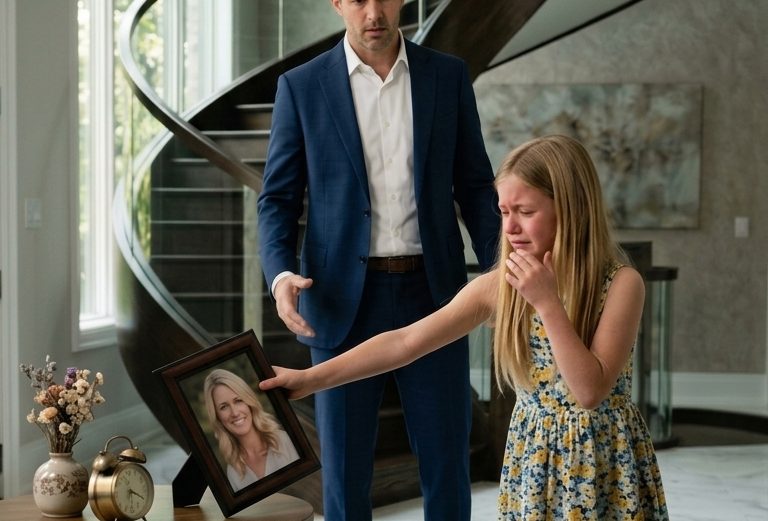
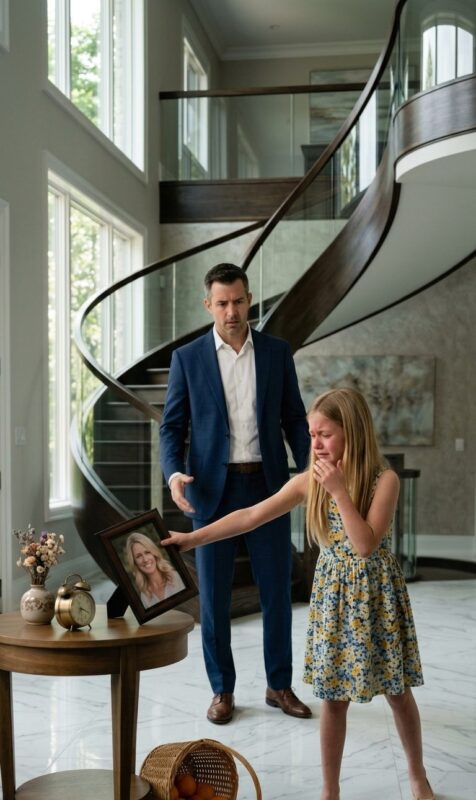
She stood near the staircase, holding a silver picture frame.
My chest tightened.
It was a photograph I had never managed to put away—a woman laughing in sunlight, her hair glowing, her eyes full of life.
Elena Rivera.
The woman I had loved… who vanished ten years ago without a word.
The girl’s shoulders shook as she stared at the image.
“Sir…” she whispered, turning to me, tears running down her face. “Why do you have a picture of my mom?”
Everything seemed to tilt.
“What did you just say?”
“That’s my mom,” she cried. “Her hair was longer then, but that’s her. That’s my mama. Elena.”
My heart started pounding.
“Your mother’s name is Elena Rivera?”
She nodded, crying harder. “Yes. Are you the ‘Alex’ she talks about when she thinks I’m asleep? She says your name… and then she cries.”
My legs nearly gave out.
“She… says my name?”
“Sometimes,” Isabella said softly. “She says she’s sorry.”
The realization hit all at once.
“How old are you?” I asked.
“Twelve.”
Twelve.
Elena disappeared ten years ago.
I stepped closer, studying her face—the shape of her nose, the set of her jaw. Elena’s features.
And something else.
Mine.
“Take me to her,” I said quietly, my voice breaking. “Now.”
We drove east, leaving behind perfect streets for cracked pavement and worn-down buildings. Isabella guided me gently.
“Turn at the yellow bridge. Past the laundromat. We live on Elm.”
The building leaned like it was too tired to stand straight. Third floor. Apartment 307.
Inside, the air smelled of damp walls and stale cooking oil.
One room. A mattress on the floor. A small hot plate. A plastic table.
And on the mattress—
Elena.
Too thin. Pale. She coughed before she could finish her sentence.
“Isabella?” she rasped. “Did you sell the—”
Then she saw me.
She froze.
“No,” she whispered. “This can’t be real.”
“It is,” I said softly. “It’s me.”
Tears ran down her face.
“How did you find us?”
“Your daughter came to my gate selling oranges,” I said quietly. “She also asked why I had your photo.”
Elena went still, covering her mouth as if the truth had slipped out too soon.
“I was going to tell you,” she whispered. “That night… I already knew I was pregnant.”
The room seemed to close in. “What?”
“Your mother found me,” she continued, her voice low but steady.
My chest tightened. “Victoria?”
Elena nodded. “She showed up with two men pretending to be officers. Said I would destroy your future. She brought cash… and a bus ticket. Told me to disappear.”
“And if you didn’t?”
“She said she’d accuse me of stealing. That no one would ever believe someone like me over a Carter.”
A bitter sickness settled in my stomach.
“I tried to reach you,” Elena said. “But she answered your phone. Told me you didn’t want the child. That you laughed about it.”
“I never knew,” I said, my voice rough. “I looked for you. She told me you had left—with someone else.”
We stood there, the weight of ten lost years stretching between us.
Isabella held tightly to her mother’s side.
“She’s mine… isn’t she?” I asked, almost afraid of the answer.
Elena met my eyes and nodded.
I straightened immediately.
“You’re not staying here another night.”
“We have nowhere else—”
“You do now.”
I helped Elena down the stairs while Isabella gathered her few belongings into a small backpack.
At the hospital, the top doctors stepped in. Pneumonia. Severe anemia. Serious—but treatable.
By morning, the DNA results were ready.
99.9999%.
I crouched in front of Isabella.
“You’re my daughter.”
Her face brightened in an instant.
“I love you, Dad.”
That afternoon, I drove to Pasadena.
My mother sat on her terrace, calm and composed, as always.
“Alex, you look awful,” she said.
“Do you remember threatening Elena Rivera?” I asked.
For a brief second, her expression shifted.
“I did what was necessary,” she replied coolly. “She would have ruined everything you built.”
“You took my child from me.”
I set the DNA report in front of her.
“You have a granddaughter. And you let her grow up with nothing—just to protect your reputation.”
For the first time, she seemed shaken.
“I’m removing you from the board,” I continued. “You’ll keep your allowance. But your control ends today. Elena and Isabella are my family.”
Her voice softened, almost hesitant.
“Is she… beautiful?”
“She’s incredible,” I said. “And she deserved so much more.”
Weeks later, beneath soft white lights in our backyard, Elena stood beside me. Isabella stood between us, holding both our hands tightly.
When we were pronounced husband and wife, Isabella squeezed our hands even harder, smiling up at us.
Later that night, I stopped by the staircase. The old photo of Elena was no longer alone. Next to it was a new one—Elena and Isabella laughing in the kitchen, flour smeared across their cheeks.
“Dad!” Isabella called out. “Cake!”
I lifted her into my arms.
“One brave little girl walked up to my gate,” I said, kissing her forehead. “And changed my entire life.”
I had spent years building towers and businesses across the country.
But the most important thing I ever built began with a tired child standing in the heat, asking gently,
“Sir… would you like to buy some oranges?”