SHE WAS TOLD TO “STAND LIKE EVERYONE ELSE.” WHAT HAPPENED NEXT CHANGED THE ENTIRE COURTROOM
For years, I trained myself to exist without being noticed.
Quiet steps. Measured movements. Always aware of where I could sit if my body gave out.
My name is Talia. I’m thirty-seven, and most people never realize I wear a prosthetic leg. I’ve learned how to walk in a way that hides it—smooth enough to pass, steady enough to avoid questions.
At least, most days.
Until something slips. Until pain hits. Until someone assumes effort can replace reality.
That Tuesday morning, I walked into the Jefferson County Courthouse with a folder of medical records and three unpaid parking tickets. I wasn’t there to argue—I just wanted to resolve it and leave.
Simple.
Or so I thought.
The courtroom felt lifeless. Fluorescent lights buzzed overhead. People stared at their phones, waiting for their names to be called.
When mine echoed through the room, I stood carefully, gripping my cane.
Behind the bench sat Judge Marlene Keating—precise, composed, distant.
She scanned my file briefly, then spoke without looking up.
“Ms. Monroe. Before we continue—stand properly.”
I blinked, unsure I had heard correctly.
“Your Honor,” I said quietly, “I am standing.”
Her eyes lifted, sharp and impatient.
“Then stand correctly.”
The room seemed to tighten around me.
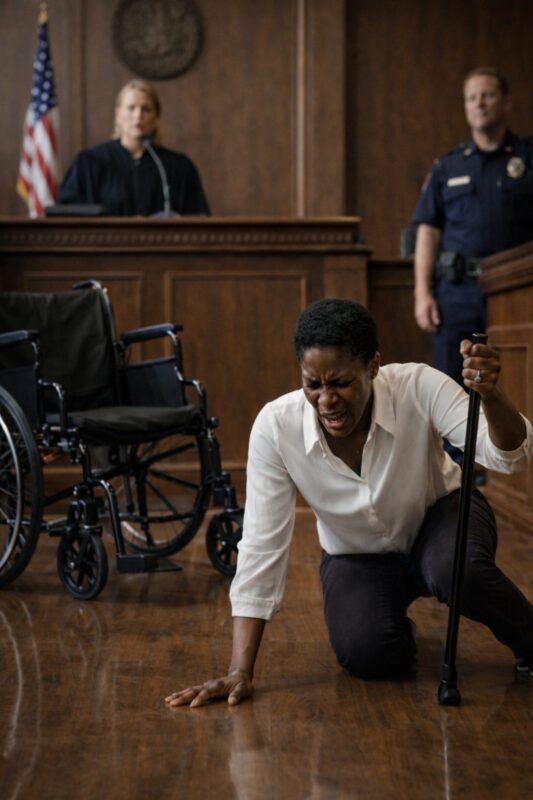
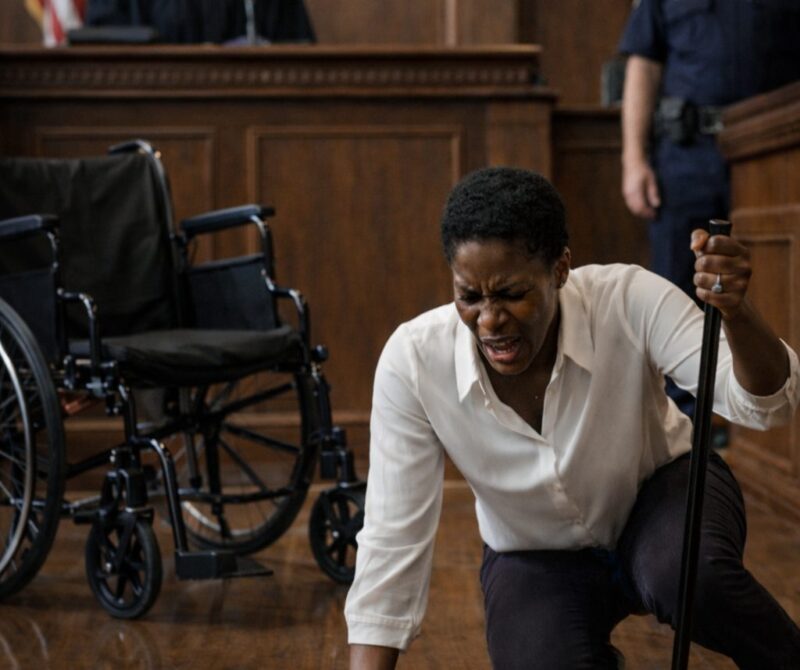
I shifted my weight, trying to straighten, trying to meet an expectation my body couldn’t fully satisfy. I forced myself upright, pretending balance wasn’t fragile, pretending my cane was optional.
Then it happened.
My cane slid.
My prosthetic locked.
And I went down.
The impact was loud—but not dramatic. Just real.
Everything stopped.
No whispers. No movement.
Only silence.
As I hit the ground, my bag tipped open. Something metallic slipped out, rolling across the polished floor until it came to rest near the front.
A voice, barely above a whisper, cut through the stillness.
“That’s a Bronze Star…”
Every head turned.
And suddenly, the room saw me.
I pushed myself up, fighting through the pain spreading through my hip. My hands shook—not from injury alone, but from the weight of being exposed.
When I looked toward the bench, the judge no longer looked certain.
A man stood from the gallery—a young attorney.
“Your Honor,” he said, steady and clear, “what just happened needs to be addressed.”
The judge’s tone hardened. “You are not part of this case.”
“No,” he replied calmly. “But I am part of this court. And this wasn’t just procedure—it was something else.”
A ripple moved through the room.
The bailiff stepped forward, helping me stand. My cane steadied me again, but the damage—physical and otherwise—was already done.
The judge glanced at the medal on the floor.
“Is that yours?”
“Yes.”
“What did you receive it for?”
I hesitated.
Then answered.
“I was an Army medic. Kandahar. I pulled soldiers from a burning vehicle after an explosion.”
Silence deepened.
“I lost my leg later,” I added, voice steady. “Complications. Recovery wasn’t simple.” I met her eyes. “I’m not here for sympathy. I’m here because life didn’t pause while I learned how to walk again.”
Something shifted.
People looked at me differently now—not with curiosity, but with understanding.
The judge cleared her throat. “The late fees will be removed. You may go.”
That was it.
A clean ending. A neat solution.
But I didn’t move.
“I didn’t fall because I wasn’t trying,” I said quietly. “I fell because I wasn’t believed.”
No one spoke.
Outside, the hallway felt colder than the courtroom.
The adrenaline faded quickly, replaced by sharp pain and exhaustion. I leaned against the wall, gripping my cane tighter than I wanted to admit.
The attorney approached me.
“You didn’t deserve that,” he said simply.
I exhaled slowly. “I didn’t want any of this. I just wanted to get through the day.”
He nodded.
“Then don’t focus on getting even,” he said. “Focus on making it right.”
That word stayed with me.
Not revenge.
Something stronger.
Before I could respond, a reporter rushed toward us, camera already rolling.
“Are you the veteran who fell in court?”
The label hit instantly.
Not my name. Not my story.
Just a moment.
The attorney stepped between us. “No statements.”
The noise blurred—until I noticed someone else.
The court clerk.
Standing in the doorway.
Watching.
Shaken.
She stepped closer, voice barely audible.
“This has happened before.”
Everything inside me went still.
Before?
In that instant, the story changed.
It wasn’t just my fall.
It wasn’t just one moment.
It was a pattern.
Something quiet. Repeated. Ignored.
Until now.
In the days that followed, the truth surfaced.
Records. Complaints. Stories that had never been heard.
People who had stood where I stood—and left feeling smaller than when they walked in.
The situation grew beyond one case.
Beyond one courtroom.
Time passed.
Changes came.
Policies shifted. Training improved. Accessibility became a priority instead of an afterthought.
Accountability—real accountability—finally entered the room.
And me?
I stopped trying to disappear.
One year later, I returned to the courthouse.
This time, I didn’t hide my prosthetic.
I didn’t hide anything.
A reporter asked, “Do you feel like you’ve won?”
I looked at the building. At what had changed. At what had been forced into the light.
Then I answered:
“I didn’t win.”
I paused.
“We just made sure it doesn’t happen the same way again.”