The Baker Handed a Loaf to a Destitute Old Woman — Then Murmured: “She Doesn’t Know Who I Am”
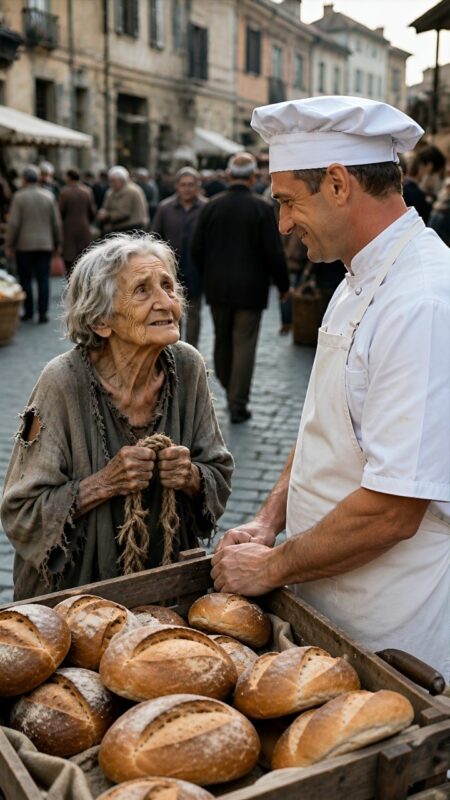
Amid the шум and movement of the busy street market, almost no one noticed the elderly woman wrapped in a worn gray coat. She shivered, a frayed cord tied around her waist in place of a belt, her eyes fixed on the bread as though even its scent deepened her hunger.
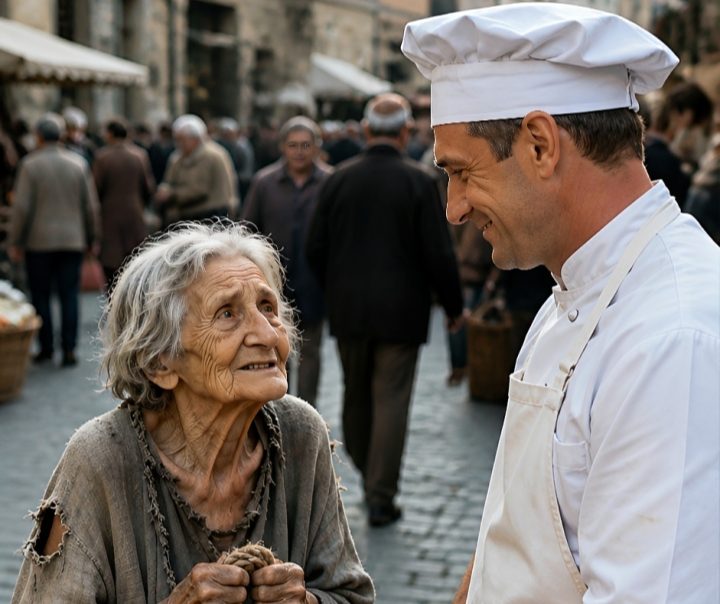
“Please, son… my grandchildren have nothing left to eat,” she said quietly, her voice barely audible.
The baker, dressed in a white apron, met her gaze—and for a brief moment, he seemed lost in thought, as if the world around him had faded. Then, without speaking, he reached for two large loaves from his cart and placed them in her hands.
“Take them,” he said gently. “Today, you owe nothing.”
She clutched the bread tightly, holding it to her chest as though it were something far more precious than food—like a borrowed chance to keep going.
“Thank you… may God watch over you…”
With slow, careful steps, she disappeared into the crowd. The baker remained still, watching her go. After a long pause, he whispered to himself:
“She has no idea who I am.”
His name was Andrei.
A quarter of a century earlier, he had been just another forgotten child of the market—hungry, unwashed, and invisible to the world. That day remained etched in his memory. The cold, the emptiness in his stomach, the dizziness from not eating for nearly two days. He had been too weak to stand, sitting alone behind a corner while people passed by, deliberately avoiding his eyes.
All but one.
A woman had stopped.
She had been poor too—wrapped in an old scarf, her coat worn thin by time. In her hands was a small piece of dark bread, likely the only food she had. Yet she broke it without hesitation and gave half to the boy.
“Eat,” she told him kindly. “As long as there’s goodness in a person’s heart, they won’t be lost.”
That woman… was her.
The same old woman standing at his cart today.
He had never learned her name back then. But her words stayed with him. They shaped him. After that day, he began helping at a nearby bakery—first just to earn food, then gradually building a life. He learned the craft, worked tirelessly, and years later became the owner of his own bread cart. Everything he had started with that single act of kindness—half a piece of bread.
And now, life had brought her back to him.
Leaving his assistant behind, Andrei quietly followed her. She turned away from the crowded street and entered a neglected courtyard at the edge of the market, then stepped into a small, crumbling house. Through a dusty window, he saw two children sitting at a table—a boy and a girl, waiting silently. When their grandmother placed the bread before them, their faces lit up with pure joy, as if she had delivered a treasure beyond measure.
Andrei couldn’t walk away.
He approached and knocked.
The old woman opened the door cautiously, fear flickering in her eyes—she thought he had come to take the bread back. But instead, he stepped inside carrying another sack: flour, grains, butter, milk, and warm clothes for the children.
After setting everything down, he sat quietly and asked her name.
“Maria Ivanovna,” she replied, a little embarrassed. “Since my daughter passed, it’s just me and the grandchildren. I do what I can…”
Andrei’s eyes filled with tears, though he smiled.
“I’m the boy you once fed,” he said softly. “You saved me… you just don’t remember.”
She looked at him for a long moment, searching his face—then tears began to fall. Not loud or dramatic, but the kind that come from years of silent struggle.
From that day forward, Andrei became part of their lives. He made sure the children attended a good school, helped restore their home, and every morning, Maria Ivanovna received fresh, warm bread—not as charity, but as gratitude returned.
Sometimes, it seems like what we give is small.
Half a loaf of bread.
A single kind word.
One simple act of care.
But time passes… and those very things come back, transformed into something far greater—sometimes even into salvation itself.