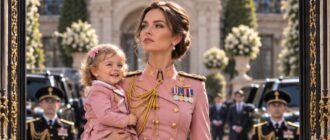
The girl drew her bow across the violin strings—just a few quiet notes—and a wealthy woman froze, recognizing a melody she had once written for her unborn child.
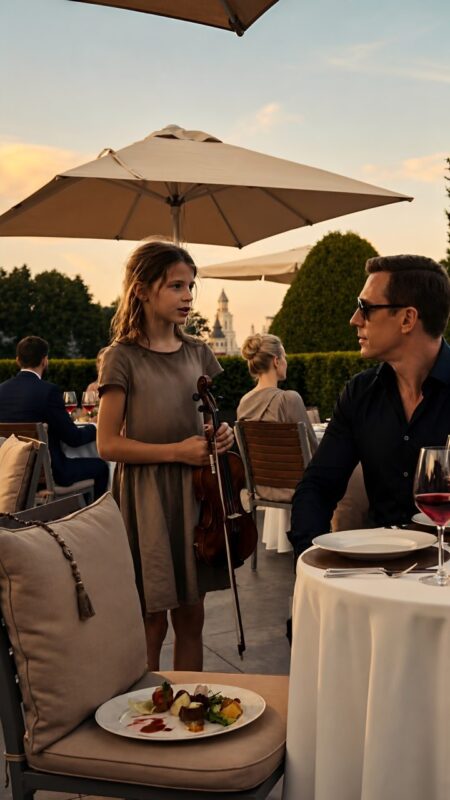
Ksenia Lavrova was seated on the terrace of an elegant villa, sheltered beneath a wide cream umbrella, when a frail-looking girl in a faded dress approached her table, clutching a worn violin.
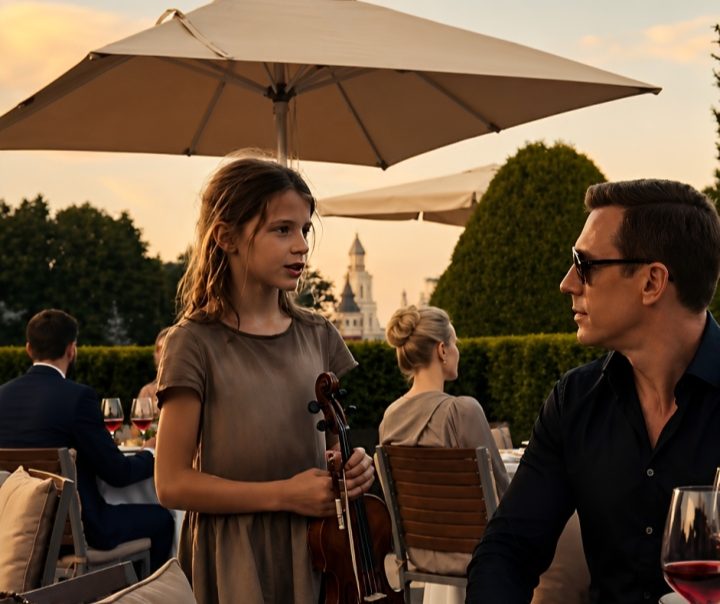
Everything about the evening had been carefully arranged: deep red wine, an exquisite dinner, manicured greenery, and restrained conversation. Across from her sat Igor—self-assured, prosperous, and accustomed to Ksenia’s impeccable composure. But in a single moment, that calm shattered when the girl spoke softly:
“My mother said I should play this only for you.”
Ksenia almost dismissed it as a misunderstanding. Yet as the girl lifted the bow and played the opening notes, the world around her seemed to fade away.
This wasn’t just any tune.
It was a lullaby—one Ksenia had created eight years earlier, when she was expecting a child. Back then, she would play it every night, resting her hand over her belly. It had been her secret ritual, a melody for the daughter she already loved before meeting her.
But she had never been allowed to keep that child.
After a difficult delivery, she was told the baby had died. No body was shown. The documents were rushed through. Igor’s mother—a powerful and distant woman—had said only one cold sentence:
“Better to suffer once than to ruin everything.”
For years, Ksenia carried that emptiness, convincing herself there had been no other outcome.
And now, a young girl stood before her, playing that same lullaby as though it had always belonged to her.
“What is your mother’s name?” Ksenia asked in a trembling whisper.
“Marina,” the girl answered. “She’s waiting outside the gate.”
Marina sat in an old car by the roadside—pale, exhausted, a scarf covering her head. The moment Ksenia saw her, recognition struck. She had been a nurse at that private clinic.
Without tears or excuses, Marina revealed the truth. That night, she had been instructed to hand the newborn over to people who would “resolve the situation.” The child threatened a marriage, an inheritance, the family’s standing. Ksenia was meant to be left with grief, while the baby would vanish from her life forever.
But Marina refused.
She took the infant and raised her as her own, naming her Anya. For years, she lived quietly, far away, never daring to speak the truth. Now she was terminally ill, with little time remaining.
“I couldn’t let your daughter grow up alone,” Marina said quietly. “And I couldn’t let you leave this world without knowing she was alive.”
Ksenia stood beside the car, looking at the girl with the violin—and saw herself in her. The same eyes. The same jawline. Even the nervous way she held the bow.
That evening, Ksenia never returned to the table.
Igor followed her outside and understood everything just by looking at her. He didn’t argue. He didn’t question. He simply asked:
“Is she yours?”
Ksenia nodded.
He stepped aside without hesitation.
“Then go to her.”
A week later, Anya was living with Ksenia. Marina survived just long enough to witness the girl fall asleep in her true mother’s arms for the first time.
Later, in a small sunlit room, Ksenia picked up her violin again. Anya sat close beside her and whispered:
“Mom, play that one.”
And she did.
But this time, it wasn’t for a child she had lost.
It was for the one who had finally found her way home.