The Man Who Had Everything—Until a Silent Girl Changed His World
Every night at exactly 8:10, Jonathan Reed noticed the same quiet pattern.
His dinner at an elite restaurant would end, the check would be signed, and near the entrance—almost invisible against the wall—a young girl would be waiting.
She never asked. Never interrupted. She simply stood there, hands folded, eyes lowered, as if trying to disappear.
When a server handed her a neatly packed box of leftovers, she would step forward, accept it with care, offer a small, hesitant smile, and whisper:
“Thank you, sir.”
Jonathan Reed was a self-made billionaire—owner of luxury hotels, tech firms, and restaurant chains. He donated to charities, attended high-profile events, and often spoke about discipline and success.
Yet this girl unsettled him more than any financial risk ever had.
She looked no older than nine. Her clothes were clean but worn thin, her oversized shoes tied tightly, their frayed laces revealing long use.
But one thing stood out most:
She never ate the food.
She took it… and vanished into the night.
One evening, unable to ignore it any longer, Jonathan followed her.
She walked past glowing storefronts and crowded sidewalks, then drifted into quieter streets—cracked pavement, flickering lights, silence replacing noise.
Eventually, she stopped in front of a fragile, aging house at the edge of the neighborhood.
She knocked.
The door opened—and Jonathan saw a life he had never truly understood.
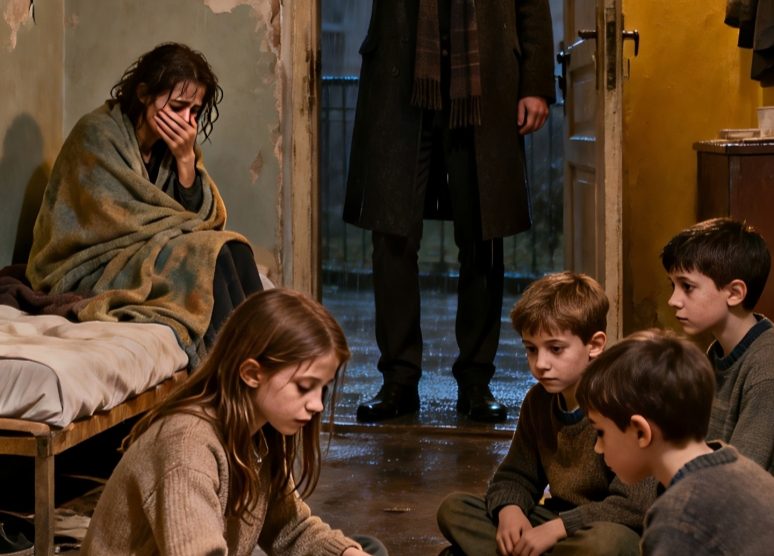
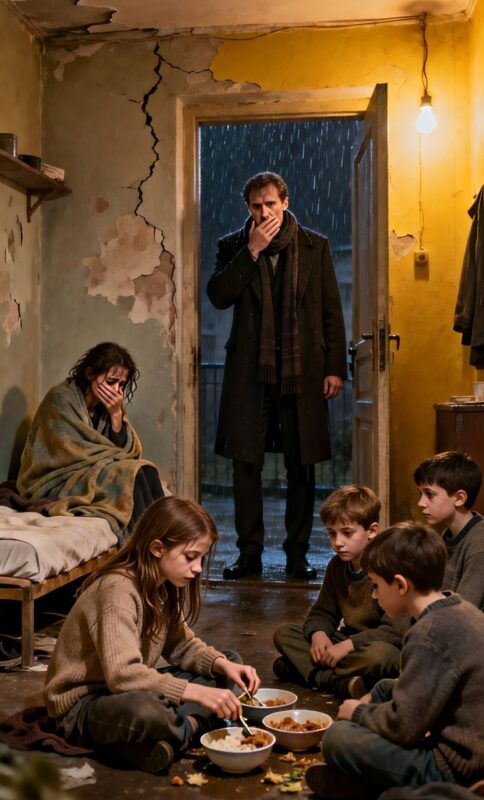
Five children rushed toward her at once.
“Did you bring food?”
“Is there rice?”
“Any chicken?”
The girl—Ana—smiled softly and handed the box to the oldest boy.
“For Mama,” she said.
Jonathan felt his chest tighten.
In the corner lay a pale woman on a thin mattress, coughing weakly while the children moved around her with careful tenderness.
Ana knelt beside her, opened the box, and carefully selected the softest pieces, placing them on a worn plate.
“Please eat, Mama,” she whispered. “I already ate at school.”
Jonathan knew she hadn’t.
He stepped away before they noticed him, his thoughts racing.
The next evening, he arrived early and ordered far more food than he needed.
When Ana appeared, he asked quietly, “Why don’t you eat the food yourself?”
She hesitated. “It’s not mine.”
“Then who is it for?”
She kept her gaze down. “My mama is sick. I have five brothers and sisters. If I don’t bring food… they sleep hungry.”
The words stayed with him.
The following day, he sent groceries to the house.
They came back.
A note was attached, written in trembling handwriting:
*Thank you, but we cannot accept charity. Please give it to someone else.*
Jonathan was puzzled. Their need was obvious.
So he went himself.
Ana’s mother opened the door—tired, but dignified.
“I won’t raise my children to believe they must beg to survive,” she said calmly. “Even when life is unfair.”
That night, Jonathan couldn’t rest.
Days later, Ana stopped coming.
Then another day passed.
Then another.
On the fourth day, he went to the house.
An ambulance stood outside.
Neighbors told him her mother had collapsed—she had delayed treatment, afraid she couldn’t afford it.
At the hospital, Jonathan quietly covered all expenses.
Then, reviewing her records, he noticed her name.
She had once been his classmate in college—the woman who left school after becoming pregnant, while he continued forward.
She recognized him immediately.
“You,” she whispered. “You were always meant to succeed.”
Jonathan shook his head slightly.
“Maybe,” he said. “But you were the strong one.”
When she recovered, he didn’t offer charity.
He offered a way forward.
He helped her build a small catering business—based on her cooking, her skill, her pride. He funded it discreetly. She ran it independently.
Ana no longer waited for leftovers.
Now, she helped prepare meals for others in need.
Years later, when Jonathan was asked about the best investment of his life, he didn’t mention money or companies.
He said:
“A quiet child showed me that dignity is worth more than wealth—and that those who ask for nothing often carry the most.”
And Ana?
She still says thank you.
Only now, the world answers back.