The matching dresses were an accident.
To Emma and Lily, they were magic.
To my sister, they were apparently a declaration of war.
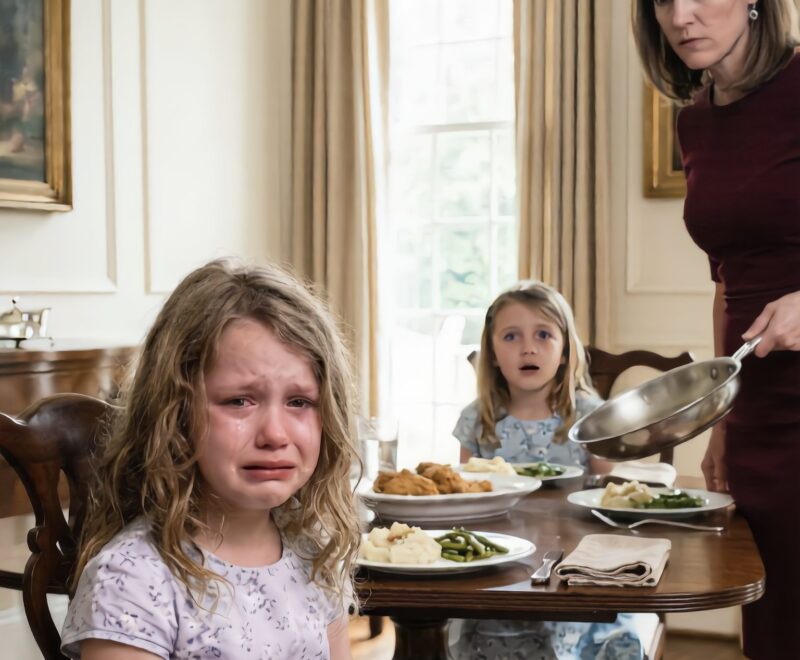
My four-year-old daughter, Emma, had worn a light-blue floral dress to Sunday dinner at my parents’ house. I had bought it from a clearance rack weeks earlier and hadn’t given it another thought.
Then Vanessa arrived with six-year-old Lily.
I almost laughed when I saw her.
Lily was dressed in nearly the same shade of blue, with tiny flowers scattered across the fabric. A white cardigan covered her shoulders, and a matching bow was clipped into her hair.
Emma gasped with delight.
“Mommy, look! We match!”
Lily immediately ran over.
The two girls grabbed each other’s hands and began twirling through the living room, giggling every time their skirts spun outward.
It was completely innocent.
Vanessa’s reaction wasn’t.
She stared at them with a tight expression.
“They aren’t twins.”
Nobody answered.
I assumed that would be the end of it.
I was wrong.
While I was arranging plates in the dining room, Vanessa appeared behind me.
“You need to change Emma.”
I glanced over my shoulder.
“Excuse me?”
“Her dress. Put her in something else.”
“Why would I do that?”
“Because she looks like Lily.”
I actually laughed.
Vanessa didn’t.
“They’re little girls,” I said.
“That isn’t the point.”
Unfortunately, I knew exactly what the point was.
Vanessa had spent years turning ordinary moments between our daughters into competitions.
If Grandma bought both girls similar toys, Vanessa complained that Lily’s gift was no longer special.
If someone praised Emma after praising Lily, Vanessa acted as though a compliment had been stolen.
Matching shoes became a problem.
Similar hairstyles became a problem.
Even photographs could become a problem if Emma received too much attention.
Our mother usually encouraged it.
Vanessa stepped closer.
“You always copy Lily.”
“I bought Emma’s dress weeks ago.”
“You expect me to believe you had no idea what Lily would wear?”
“Yes, because I didn’t.”
“Change her.”
“No.”
Her jaw tightened.
“Then whatever happens next is on you.”
That sentence stayed with me.
Thirty minutes later, we were all seated around the table.
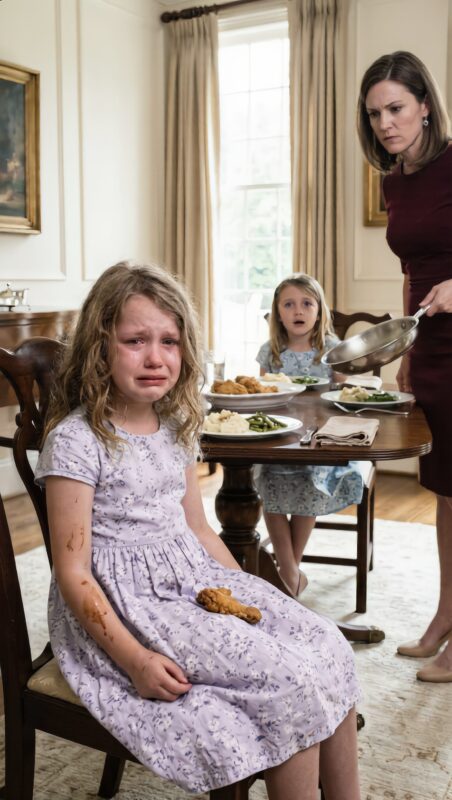
Vanessa brought in a heavy skillet filled with fried chicken covered in sauce and set it down among the serving dishes.
Emma and Lily were sitting near each other.
Lily leaned toward my daughter.
“I think we look like sisters.”
Emma grinned.
“We do!”
My mother heard them.
Instead of smiling, she sighed and looked directly at me.
“Rachel, you could have avoided all this by changing Emma before dinner.”
I put down my fork.
“Avoided what? Two children being happy?”
“You know Vanessa doesn’t like this.”
“And Emma is four. Why should she be responsible for Vanessa’s feelings?”
Mom frowned.
“Rachel, don’t make a scene.”
Vanessa suddenly stood.
“I’m the one making a scene?”
Her chair scraped loudly across the floor.
“This is what Rachel always does. Lily gets something special, and suddenly Emma has to have the same thing.”
I stared at her.
“You’re talking about children wearing dresses.”
“No. I’m talking about you constantly trying to prove Emma is equal to Lily.”
The words hung over the table.
My answer came immediately.
“She is equal to Lily.”
Vanessa’s face changed.
She reached for the skillet.
At first, I thought she intended to move it.
Then I saw both of her hands tighten around the handle.
“Vanessa, what are you doing?”
She flung it toward Emma’s end of the table.
The next few seconds dissolved into chaos.
Food scattered across the table and floor. Sauce splashed across Emma’s clothing and exposed skin.
She screamed and slipped from her chair.
Lily started sobbing.
I rushed to Emma, pulling her into my arms and checking her as quickly as I could.
Then my mother shouted.
Not Vanessa’s name.
Mine.
“Rachel! I warned you to change that dress!”
I looked at her in disbelief.
My sister had just thrown a skillet toward my daughter, yet somehow my mother had decided the real problem was Emma’s clothing.
That was when years of strange comments suddenly made sense.
Vanessa wasn’t the only adult obsessed with comparing the girls.
Mom had helped create the rivalry.
I took Emma to the hospital immediately.
The doctors treated her and told me they expected her to recover.
When staff asked how she had been injured, I didn’t soften the story.
I told them exactly what I had witnessed.
Then my phone buzzed.
Mom had sent me a message.
Say Vanessa accidentally dropped the skillet. She has a daughter to protect. Think about Lily.
I read it twice.
Then I took a screenshot.
Minutes later, another notification appeared.
Mom deleted the message almost immediately, but the preview had already appeared on my screen.
I told Vanessa before dinner that you were doing this on purpose again. I told her she couldn’t keep letting you get away with it.
My hands went cold.
So Mom had spoken to Vanessa before the argument.
She had already convinced her that Emma’s dress was deliberate.
I searched through our previous conversations.
What I found changed the way I remembered years of family gatherings.
There were complaints about Emma and Lily owning similar winter coats.
Complaints about shoes.
Complaints about hairstyles.
Complaints about relatives taking pictures of them together.
Mom had even complained when family members gave the girls equal attention.
Then my aunt called.
“I need you to know what I saw,” she said.
“What did you see?”
“Vanessa didn’t drop anything. She picked up that skillet with both hands and threw it toward Emma.”
My aunt paused.
“There’s something else.”
Before dinner, she had walked past the kitchen and overheard Mom talking to Vanessa.
Mom had said, “Rachel keeps doing this because nobody stops her. You need to stop letting her.”
I felt sick.
The dress had never been the real issue.
My mother had spent years convincing Vanessa that every similarity between the girls was some calculated attempt to take something away from Lily.
Dad called later that night.
I asked him one question.
“Did you see Vanessa throw it?”
Silence.
Then he finally answered.
“Yes.”
“Why didn’t you say that before?”
“Your mother was worried about Lily. She said if Vanessa got into serious trouble, Lily could lose her mother.”
I couldn’t believe what I was hearing.
“So Emma has to lose the truth to protect Vanessa?”
He didn’t answer.
Then he admitted something even worse.
After I left with Emma, Mom had gathered the remaining relatives around the table.
She told them what their version of events would be.
Vanessa lost her grip on the skillet. Emma panicked and fell from her chair.
That was the story everyone was expected to repeat.
My mother had organized the lie before I had even arrived at the hospital.
Later that night, with Emma finally sleeping beside me, I sent Mom one final message.
A four-year-old wearing a blue dress did not create this situation. Vanessa chose what she did. You chose to encourage her, and then you chose to cover for her.
Neither of you will be allowed near Emma.
I didn’t argue after that.
I didn’t negotiate.
I simply stopped answering.
Weeks later, a small envelope arrived with Emma’s name written across the front.
It was from Lily.
Inside was a drawing.
Two girls stood in a garden beneath an enormous yellow sun. Their hands were joined, and both were wearing blue dresses covered in flowers.
Emma studied it for a moment before smiling.
“Lily drew us matching.”
“Yes,” I said.
She carefully placed the picture beside her bed.
Watching her, I realized how unnecessary all of it had been.
Emma had never wanted to take anything from Lily.
Lily had never believed Emma was stealing her place.
To them, matching dresses meant friendship.
The rivalry existed only because adults had invented it and tried to teach it to them.
I couldn’t change what had happened that Sunday.
But I could make sure Emma never learned the lesson my mother and sister had tried to force on her.
She would never be taught that another girl’s happiness required her to have less.
She would never be expected to disappear into the background so someone else could shine.
And she would never have to make herself smaller to keep another person comfortable.
There had always been room for both girls to be loved, celebrated, and special.
Emma and Lily understood that without anyone explaining it to them.
The adults were the ones who had forgotten.