The Millionaire Collector Was Stunned by the Truth Revealed by the Boy Who Repaired His Mercedes
If you arrived here from Facebook, you were likely left wondering what truly happened between that powerful tycoon and the young roadside mechanic. Prepare yourself—the reality behind their meeting is far more striking than you expect, and it may change how you define success forever.
**Pride Confronts Humility**
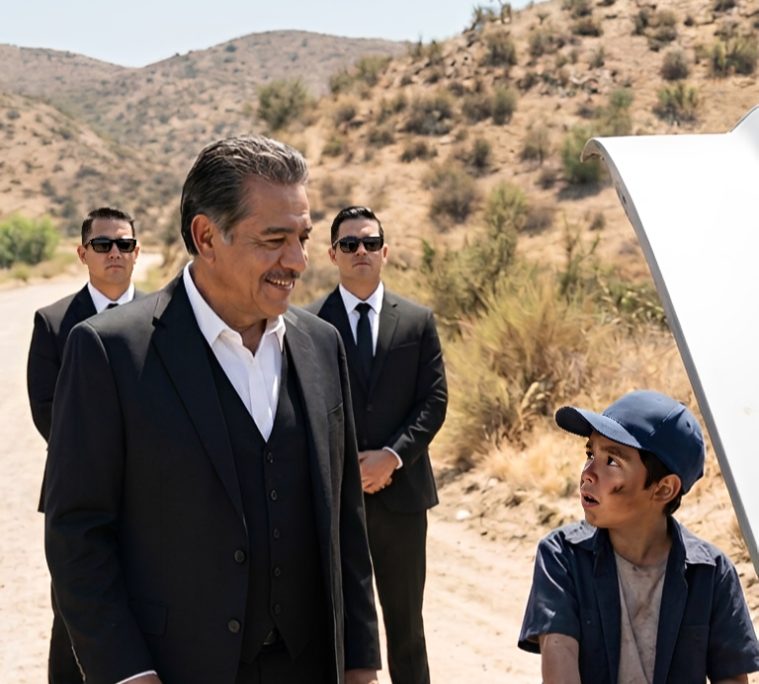
Don Roberto was no ordinary individual. He owned one of the largest logistics empires on the continent—a man whose signature carried millions in value and whose minutes were worth thousands of dollars. That afternoon, the harsh sun of the dry landscape beat down on his finely tailored Italian silk suit, an outfit more expensive than the yearly income of an average worker.
Next to him stood his most treasured possession: a vintage Mercedes-Benz, a rare collector’s masterpiece worth a fortune in elite auctions. Yet the elegant machine sat there—silent and lifeless—stranded on a dusty road surrounded by nothing but cacti and heat.
Frustration overtook Don Roberto as he struck the ground with his ebony cane, its handle crafted from solid gold. His personal engineers—graduates of top German universities and paid fortunes—had spent weeks inspecting the car at his estate. They replaced sensors, computers, and flown-in components, but the issue remained unresolved.
“Pointless!” he snapped at his bodyguards, who stood motionless under the scorching sun. “If those experts with doctorates couldn’t fix it, no one will. Call the helicopter—leave this junk behind.”
**Recommended Article: The Secret Hidden in the Mendoza Mausoleum**
Just then, a small figure emerged through the drifting dust. It was a boy, no older than ten. He wore an oversized work shirt stained with grease, faded blue trousers, and a worn baseball cap that barely revealed his sharp, observant eyes.
Without hesitation, the boy approached the imposing car. As the guards moved to stop him, he simply pointed toward the open hood.
“Looks like the engine is flooded, sir,” he said calmly, his voice cutting through the heat. “What would you give me if I got it running again right now?”
Don Roberto slowly turned. His gaze—used to looking down on powerful officials—swept across the boy’s slight frame. A dry, dismissive laugh followed.
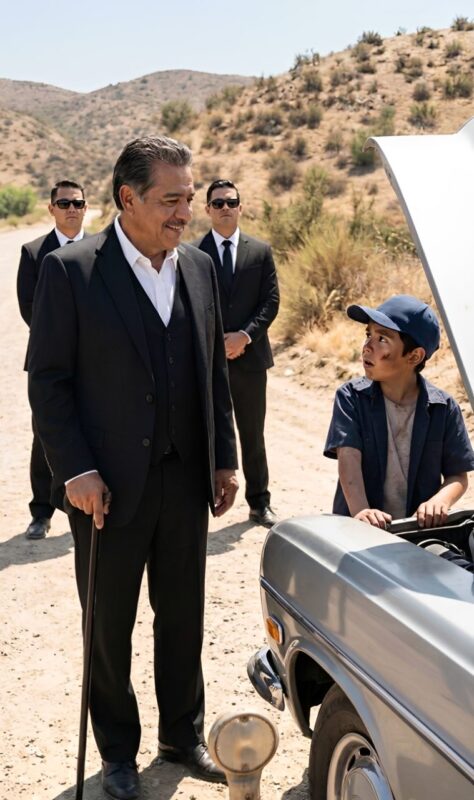
“You’re entertaining, kid,” he replied coldly. “This car has already been handled by the most expensive engineers in the country—people with degrees you can’t even pronounce. None of them found the issue… and you think you can?”
He expected the boy to shrink back in embarrassment. Instead, the child stepped forward, pulled a small rusted wrench from his pocket, and, without even glancing at the magnate, said:
“Degrees don’t fix loose wires, sir… experience does.”
Don Roberto went still. It had been decades since anyone had spoken to him like that. He was about to order the guards to remove the boy when the child made a swift adjustment among the engine’s wiring. A small spark flashed, catching everyone’s attention.
**What Was Hidden Beneath the Hood**
A heavy silence settled over the road. The bodyguards exchanged stunned looks as the boy leaned into the engine as if he belonged there. Despite his outward arrogance, Don Roberto felt a flicker of curiosity. There was something precise in the boy’s movements—a practiced rhythm, almost surgical—that didn’t match his worn appearance.
“Where did you learn to work on engines like this?” Roberto asked, trying to reassert control. “Do you pick up parts from scrap yards?”
The boy chuckled softly without pausing. His small but steady hands worked carefully, untangling a vacuum hose the engineers had missed while relying too heavily on digital diagnostics.
“My grandfather always said machines have a soul, Mr. Roberto,” the boy replied.
The billionaire stiffened. He had never told the boy his name.
“How do you know who I am?” he asked sharply, gripping his cane tighter.
The boy pushed himself upright for a brief moment, brushed the sweat from his forehead with his forearm—leaving behind a dark streak of grease—and fixed his eyes on Roberto. There was nothing childish in that look. It felt heavy, timeless, as though the boy carried truths Roberto had spent a lifetime burying.
“Everyone here knows who you are,” he said quietly. “The man who walked away forty years ago, swearing he would never set foot on this poor land again. The man who chose to forget where he was born.”
A chill ran through Don Roberto. It was all true. He had come into the world in that neglected region, in a humble adobe house not far from where they now stood. Everything he had built—his vast logistics empire—rested on erasing that past, reinventing himself among the elite as a man of refined European lineage.
“I didn’t hire you to lecture me about history,” Roberto snapped, his voice edged with tension. “I asked you about the car.”
The boy turned back without arguing. With a quick, precise motion, he reached behind the engine block and secured a hidden terminal—so deeply tucked away that only small hands and sharp instinct could find it.
“That’s it,” the boy said, giving the silver fender two light taps. “Try it. If it fails, you can keep my cap. But if it runs… then I want something worth more than your money.”
Curious now, and slightly provoked, Roberto slid into the plush leather seat. He placed the platinum key into the ignition and turned it. The engine coughed once—then burst to life, releasing a deep, harmonious roar that echoed across the valley. The vintage Mercedes hummed with a flawless energy, as if it had been reborn.
Roberto stepped out slowly, stunned by what he heard. The engine purred exactly as the boy had promised. He reached for his crocodile-skin wallet, thick with large bills, ready to settle the matter and leave. But the boy lifted his hand, stopping him.
“I don’t want your money, Mr. Roberto. Money won’t buy back what you lost today,” he said, a faint sadness in his voice.
“What do you mean? I offered you a reward,” Roberto replied, puzzled.
Without answering directly, the boy pointed toward a low hill nearby. At its top stood a modest grave, marked only by a weathered wooden cross.
“There was nothing wrong with your car,” the boy said. “It stopped for a reason. Right in front of your mother’s grave—on the tenth anniversary of the day she died waiting for her son to come and say goodbye.”
The words struck harder than any financial collapse Roberto had ever faced. His knees weakened, and he gripped his cane tightly to keep himself from falling onto the dusty ground.
**A Legacy Beyond Wealth**
Something inside Don Roberto shifted. The rigid mask—the pride, the cold ambition, the quiet disdain for people like those he had left behind—fell away in an instant. He looked toward the hill again, and for the first time in decades, tears filled his eyes. Not for lost money—but for the emptiness he could no longer ignore.
“How do you know all this?” he asked softly, his voice trembling. “Who are you?”
The boy removed his blue cap. Beneath it was a face that felt hauntingly familiar—so much like the photographs Roberto had locked away years ago, images of his father as a young man.
“My name is Mateo,” he said. “My grandfather taught me everything about engines before he passed last year. He always told me that one day, a man with a golden cane and a hardened heart would come through here in a silver car—and that he would need to remember that real wealth isn’t displayed on walls or stored in banks.”
Drawn forward by something he could no longer resist, Roberto made his way unsteadily toward the grave. When he reached it, he noticed how carefully it had been kept—fresh wildflowers resting on the soil despite the dry land.
The boy—his own great-nephew, a child he had never even bothered to meet—had been honoring the responsibility Roberto had abandoned.
Overcome, the millionaire sank to his knees on the very ground he had once rejected. In that moment, he understood. His prized car, that perfect piece of engineering, had not failed at all. It had stopped for a reason no mechanic could explain.
Fate had forced it to stall—so that he, at last, would stop running.
“Forgive me, Mother,” he choked out, collapsing to his knees as his fine clothes brushed against the dusty ground.
Mateo stepped forward and lightly placed his small hand on Roberto’s shoulder.
“She’s not angry, Uncle Roberto. She just wanted you to come back home before it became too late.”
Later that day, a rescue helicopter arrived—but Roberto refused to get on board. Instead, he sent his bodyguards back to the city with strict orders to cancel every engagement for the week. He chose to stay in the humble village, sleeping on a simple rope bed, rediscovering the warmth of freshly baked bread, and listening to the stories of his people.
Using his immense wealth, Don Roberto began to rebuild the region. Rather than filling it with loud factories, he funded vocational schools and medical centers, making sure no child would ever go hungry while tending to the memory of those forgotten.
The silver Mercedes remained behind. Roberto handed it over to Mateo, along with official documents proving ownership—but with one clear condition: never forget that a person’s greatest strength lies not in money, but in their own hands and their integrity.
In time, Roberto realized that success without a sense of belonging is nothing more than a beautiful prison. And as the sun sank behind the mountains, he no longer needed his cane to stand tall—the weight he had carried inside was finally gone.
Life tests us in unexpected ways—sometimes through something as simple as a broken engine—to remind us that no matter how far we go, we must always remember our origins and the people we leave behind. In the end, wealth fades from memory, but the way you treated others when you had power is never forgotten.