The Morning Lily Appeared
At 5:30 a.m., my ranch is usually wrapped in quiet.
The sky is pale and gray, the cattle move slowly in their stalls, and the cold air carries the thick scent of hay. That morning I had just finished pouring feed when I noticed a small figure standing near the barn door.
She couldn’t have been older than seven.
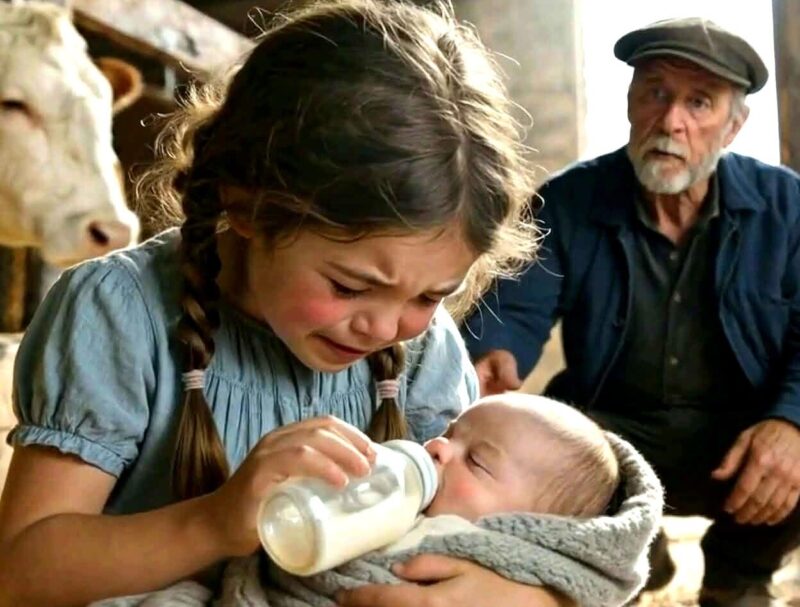
She was thin and pale, wearing worn sandals that were far too big for her feet. Her dark hair hung in a loose braid down her back, and in her small hands she held an empty baby bottle that trembled slightly.
The girl stared at me with wide, frightened eyes.
“I’m sorry, Mister…” she whispered, her voice barely louder than the rustling straw. “I don’t have any money for milk.”
For a moment I thought I had heard wrong.
“What did you say, sweetheart?”
She looked down and gripped the bottle tighter.
“My little brother is hungry.”
Only then did I notice her dress was damp, and her hands were shaking—not just from fear, but from exhaustion.
“Where’s your mother?” I asked gently.
She pressed her lips together and said nothing.
“And your brother?”
She hesitated.
“He’s close,” she finally murmured.
Something inside my chest tightened.
I’ve lived sixty-three years on that ranch. I’ve seen droughts that killed crops, cattle sickness, and storms that tore barns apart. But nothing unsettled me like the fear in that child’s eyes.
“I’ve got milk,” I told her. “You don’t need money.”
Her shoulders relaxed a little, though she didn’t smile.
While I warmed the milk in my kitchen, she stayed near the doorway, standing as if she might run at any moment.
“What’s your name?” I asked.
“Lily.”
“That’s a lovely name.”
She didn’t answer.
When I handed her the bottle, she nodded once. “Thank you, Mister.”
“Earl,” I said softly. “You can call me Earl.”
She turned to leave immediately.
“Wait,” I said carefully. “Let me walk with you.”
Her head snapped toward me, fear flashing across her face.
“I won’t hurt you,” I added quickly. “I just want to make sure you’re safe.”
After a long pause, she gave a small nod.
But she didn’t lead me toward town.
Instead, she walked behind the north pasture, through thick brush most people avoided, straight toward an old equipment shed near the creek.
My stomach dropped.
When she pushed open the crooked wooden door, I saw why she had come.
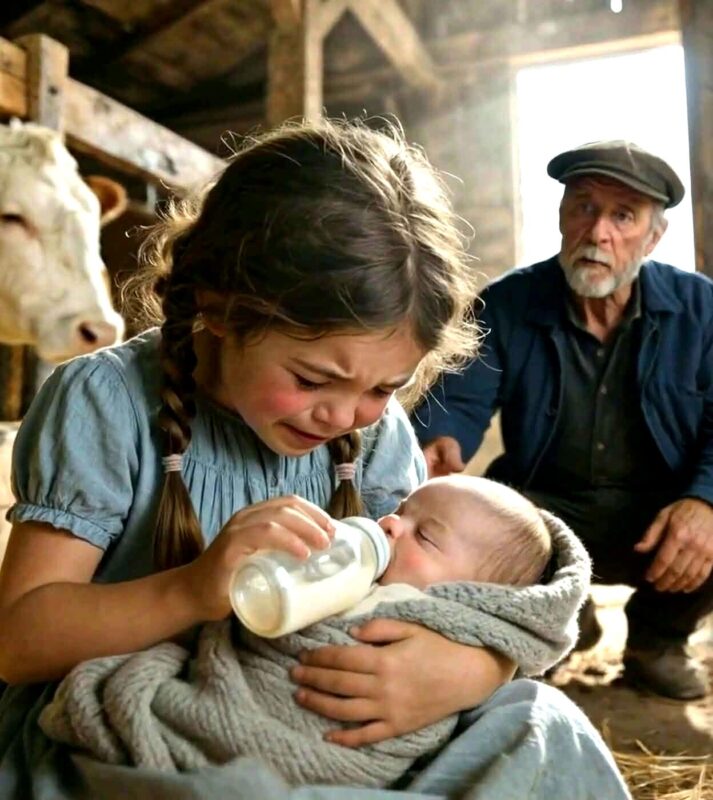
A baby lay on a pile of straw, wrapped in a thin gray blanket. He looked about six months old. His cheeks were hollow, and his tiny arms moved weakly in the air.
Lily rushed to him and gently placed the bottle in his mouth.
The baby drank desperately.
I had to hold the doorframe to steady myself.
“How long have you been here?” I asked quietly.
“Three days,” she answered.
Three days.
“Where are your parents?”
She swallowed.
“They said we were going on a trip. Then they left. They said they’d come back.”
The words hit hard.
“Did they leave you here alone?”
She nodded.
“With food?”
She pointed toward a crumpled fast-food bag in the corner. It was empty.
I knelt beside her.
“What’s your brother’s name?”
“Ben.”
The baby’s eyes fluttered as he drank.
“Why didn’t you go to town for help?”
She shook her head.
“Mama said not to tell anyone where we were. She said if we did, they’d take us away from each other forever.”
That explained the fear.
Not just abandonment—manipulation.
“Did she say when she’d come back?”
“She said when things got better.”
I stood slowly, my mind racing.
“Lily,” I said gently, “I’m going to help you and Ben. But I need to make a phone call.”
Her face turned pale.
“Please don’t let them take him,” she whispered.
I crouched beside her again.
“No one is taking your brother away from you. I promise.”
It took nearly an hour before she trusted me enough to sit in my truck.
I called Sheriff Dalton first. Then Child Protective Services.
By midday the truth began to unfold.
The parents hadn’t gone on a trip—they had disappeared. They had sold their trailer, closed their bank accounts, and left town without telling anyone.
Neighbors believed they had moved away for work.
Instead, they had hidden two children in an abandoned shed.
The sheriff later discovered the parents had been in the middle of a custody dispute with Lily’s grandmother, who had reported them several times for neglect.
Rather than face the investigation, they simply vanished.
That evening Lily and Ben slept safely in my farmhouse.
CPS discussed placing them into emergency foster care, but I refused to send them away.
“They can stay here,” I told them.
“You’re not related,” the social worker said carefully.
“No,” I replied. “But I’m the one who found them.”
That night I overheard Lily whispering to her brother.
“It’s okay, Benny,” she said softly. “The cowboy man is kind.”
I stepped outside so she wouldn’t see the tears in my eyes.
Months later, Lily walked into my barn again at exactly 5:30 in the morning.
“Good morning, Cowboy Man,” she said with a grin.
She handed me a small glass jar.
“What’s this?” I asked.
“Milk money,” she said proudly. “Grandma gave me chores.”
I laughed and gently closed her hand around the jar.
“You don’t owe me anything.”
She tilted her head.
“But you helped us.”
I looked at her—healthy now, sunlight shining in her braid.
“No,” I said softly. “You and Ben helped each other.”
She thought about that for a moment, then ran toward the house where her brother’s laughter floated through the open windows.
And every morning at 5:30, when the ranch is quiet and the sky is gray, I remember the frightened little voice that first spoke to me.
“I’m sorry, Mister… I don’t have any money for milk.”
She had no money.
But she had courage.
And sometimes courage is worth more than anything else.