The Music Box the Boy Brought to the Hospital… and the Secret It Reawakened
A heavy stillness settled over the hospital room—not the usual kind, but one that arrives when everyone present understands something impossible has just occurred.
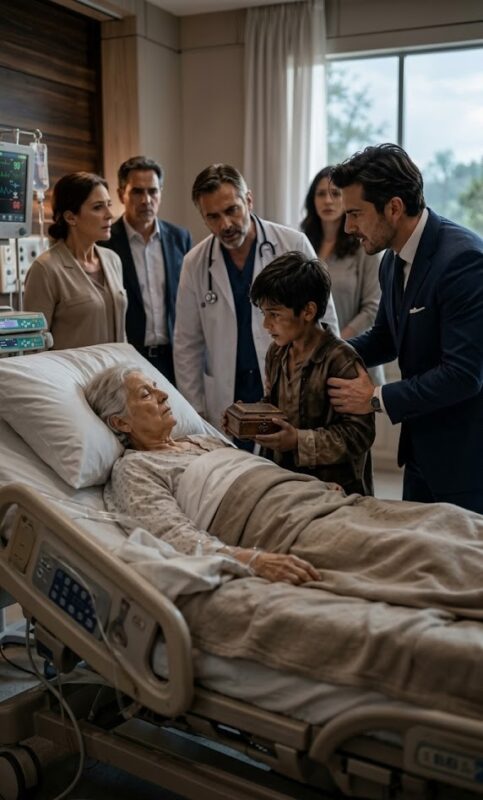
The woman’s finger had moved.
Barely perceptible. Almost nothing.
And yet in that moment, it felt like the entire room had shifted.
The doctor stepped forward immediately.
“Play it again,” he said, urgency tightening his voice.
The boy looked down at the small, worn music box in his hands. Then at the man still gripping his arm.
“You’re hurting me,” he said softly.
The man let go at once—but not gently. More like someone startled into releasing something they shouldn’t have touched.
For months, his mother had not responded to anything. No speech. No movement. No treatment had reached her.
And now, inexplicably, a stranger child with an old music box had stirred what medicine and hope had failed to touch.
“Who are you?” the man asked, voice sharp with disbelief.
The boy hesitated.
“Mateo.”
“And how do you know my mother?”
Mateo’s gaze stayed fixed on the woman in the bed.
“She used to come to the park.”
A few uneasy glances passed between the family members.
“My mother never went to parks,” the man replied flatly.
The boy shook his head once.
“She did.”
A pause.
“Just not with you.”
The sentence struck the room like a sudden drop in temperature.
The youngest daughter stepped forward.
“What are you saying?”
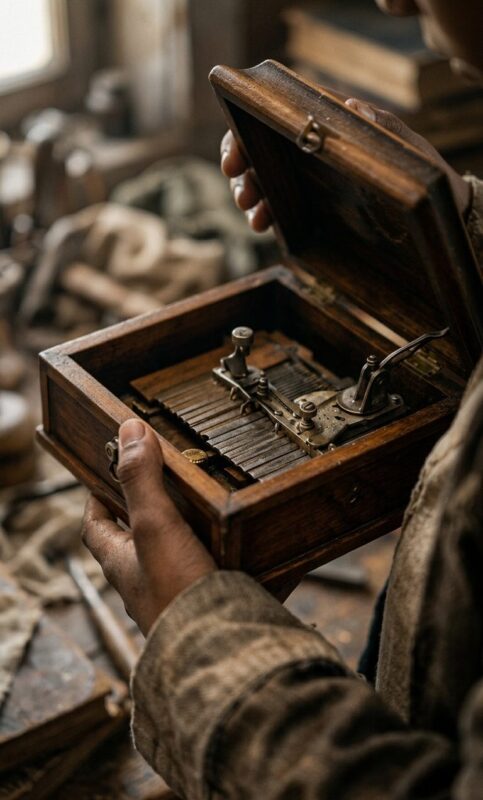
Mateo opened the music box again.
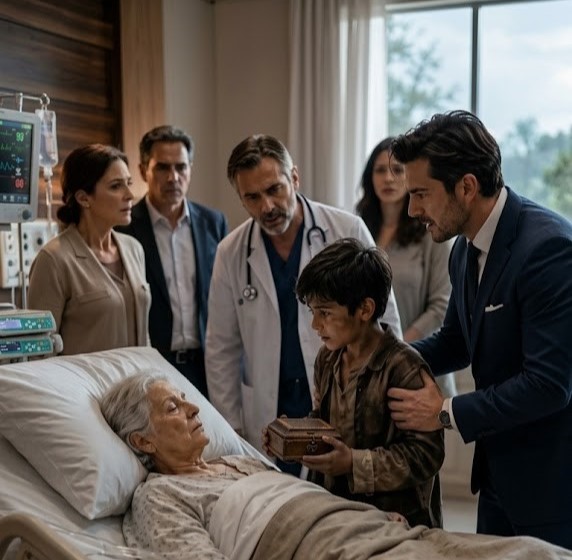
A fragile melody spilled out—soft, aged, almost mournful. Something about it made the air feel heavier, as if it carried memory inside every note.
The monitor beside the bed flickered.
The woman’s breathing shifted.
The nurse leaned in.
“She’s reacting,” she said quickly.
The man’s face hardened.
“This proves nothing.”
Mateo finally looked at him directly.
“She said you only came to her when you needed something signed.”
Silence spread through the room, thick and uncomfortable.
The daughter lowered her eyes.
The son’s jaw tightened.
Even the doctor stopped moving, realizing this was no longer a medical mystery—it was something personal breaking open in real time.
“She sat with me on a blue bench,” Mateo said quietly. “She brought me bread. She taught me new words. She told me she used to feel invisible in her own home when she was young.”
The youngest daughter covered her mouth.
“A blue bench…” she whispered, shaken.
The son turned sharply.
“What did you say?”
“She wrote about it,” she said, voice trembling. “In her journals. Always that bench.”
Mateo lifted the music box slightly.
“She gave this to me before she got sick.”
He swallowed.
“She told me if she didn’t wake up… I was supposed to play it next to her.”
The man let out a short, disbelieving laugh.
“This is nonsense.”
The doctor looked up without hesitation.
“Your mother just responded.”
The man went silent.
Mateo stepped closer to the bed.
“She also told me not to be afraid of you.”
The room seemed to tighten again.
The youngest daughter’s eyes filled.
“Afraid?” she whispered. “Why would she say that?”
Mateo lowered his head.
“Because she said you wouldn’t understand what she was trying to do.”
“Understand what?” she asked urgently.
He took a slow breath.
“That she wanted to leave something behind.”
The son stiffened.
“There it is,” he said coldly. “That’s the real reason you’re here.”
His voice sharpened.
“You want something. Money. An inheritance.”
Mateo stepped back as if the words had physically pushed him.
“No.”
“Don’t pretend.”
“I don’t want anything like that.”
He tightened his grip on the music box.
“I just want her to open her eyes.”
The silence returned—but this time it felt fractured, strained.
Then it happened again.
A small movement. The woman’s finger.
The nurse saw it instantly.
“Again,” she said under her breath.
The doctor leaned closer.
“Mrs. Valeria… if you can hear me, move your hand.”
Nothing followed but the delicate sound of the music box.
Mateo closed his eyes.
And began to sing.
His voice wasn’t strong or steady. It wavered, broke, slipped out of tune—but it carried the melody anyway, imperfect but honest.
The youngest daughter broke down completely.
“That song…” she whispered.
Mateo looked at her.
“She said she sang it when you were children.”
The son went still.
Something inside him shifted—quietly, painfully, like a door opening in a place long sealed.
A memory surfaced he hadn’t touched in years.
A dim room. A young mother sitting at the edge of a bed. That same melody filling the air.
A song he had buried.
A song she had never forgotten.
“No…” she whispered.
Mateo kept singing anyway.
Slowly, the woman’s fingers tightened around the bedsheet. Weak, uncertain—but real. Everyone in the room saw it happen.
“Don’t stop,” the doctor said immediately, his voice sharpened by urgency.
Mateo’s voice wavered, but he pushed through it. Tears streamed down his cheeks now, unchecked, falling into the space between notes.
The son stepped closer to the bed. Something in his posture had changed. The authority, the control—it was gone. What stood there instead was a man stripped down to something younger, almost vulnerable.
“Mom…” he said quietly.
Her eyes stayed closed.
But a tear slipped free and traced down her temple.
That was enough to break the room open.
The youngest daughter dropped to her knees beside the bed.
“Mom, we’re here,” she cried.
The son looked at Mateo.
Not with suspicion anymore.
With something heavier.
Regret.
“What else did she tell you?” he asked softly.
Mateo’s singing faded into silence. The music box continued for a few fragile notes before stopping completely.
He swallowed.
“She said you weren’t cruel.”
A pause.
“Just… far away.”
The words hit harder than accusation ever could.
The man shut his eyes.
Because it was true.
Their mother had lived surrounded by everything money could buy—caregivers, specialists, lawyers, schedules, signatures—but very little human closeness. People came to manage her life, not share it. To organize her, not know her.
And somewhere in that emptiness, she had met a child in a park who gave her what her own family had stopped offering: presence.
“She taught me to read,” Mateo said quietly. “She said people can survive without wealth… but not without love.”
The youngest daughter sobbed openly.
“That sounds exactly like her…”
Mateo stepped forward carefully, as if even the air might reject him.
He placed the music box on the bedside table.
“She told me… if she woke up, she didn’t want me erased from her life.”
His voice lowered.
“But if I’m not wanted here, I’ll leave.”
No one spoke.
The monitor beeped steadily. The nurse stood frozen, wiping her eyes without realizing it.
The youngest daughter stood, crossed the space, and knelt in front of Mateo.
“You’re not leaving.”
Mateo blinked.
“You’re sure?”
She nodded through tears.
“If she brought you into her story… then you’re part of it.”
The son exhaled slowly.
He looked at his mother.
Then at the boy.
And understanding finally settled in—not like a shock, but like something unavoidable.
Mateo hadn’t taken anything from them.
He had carried something back.
“I’m sorry,” the son said.
Mateo didn’t respond. He just studied him quietly.
“I shouldn’t have treated you like that,” the man added.
Mateo gave a small nod.
“She said you struggle with that word.”
A faint, broken laugh escaped the daughter through tears.
Even the son almost smiled.
The air in the room felt different now—less heavy, less frozen.
“Quiet,” the doctor said suddenly.
The woman moved again.
Clearer this time.
Everyone leaned in.
The son took her hand.
“Mom… if you can hear us… we’re here.”
Mateo lifted the music box once more.
And sang.
The melody filled every corner of the room.
And then—
Her eyes opened.
Not fully. Not strongly.
But unmistakably open.
“Mom!” the youngest daughter cried out.
“Slow,” the doctor warned, though his voice trembled too.
The son broke completely, years of restraint collapsing at once.
The woman’s gaze drifted slowly across the room.
Her children.
The monitors.
The light.
And finally—
Mateo.
Her hand moved, searching.
He stepped closer, shaking.
Their fingers met.
And she held on.
Barely.
But deliberately.
The son saw it.
And in that moment, everything he thought he knew about loss shifted.
No legal document, no medical explanation, no family argument could define what he was witnessing.
She hadn’t been gone.
She had simply been alone.
And a child with a battered music box had been the only one who still knew how to reach her.
After that day, the room was no longer a place of waiting.
It became a place of return.
The daughter came every morning.
The son stopped living only in obligations.
Mateo read aloud by the window, his voice slowly growing steadier.
And the music box stayed on the table—always open, always nearby—like a quiet reminder that some people don’t disappear.
They just wait to be found again.