The Photo He Buried
The biker’s hand settled on the photograph as if it had weight beyond paper.
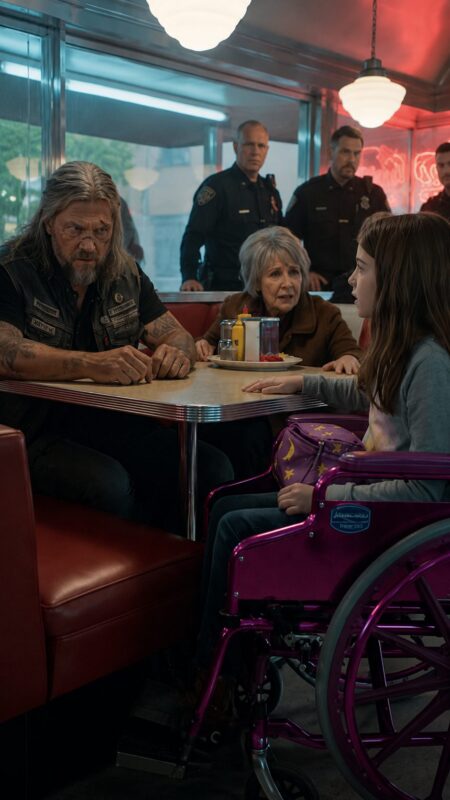
His fingers shook.
Not from age.
From recognition.
His eyes locked onto the image: a baby wrapped in a soft blanket.
A bright purple wheelchair covered in stars and moons.
Then the face of the girl sitting across from him.
The diner had gone completely silent, like the world had stopped listening.
Behind Macy, an old woman was crying without a sound, her shoulders trembling.
An old man stared at the biker with the exhausted look of someone who had carried a secret for far too long—and finally had to release it.
Macy spoke softly:
“…you should ask him why he never came back for me.”
The biker froze.
Even his breath seemed to stop.
No one in the diner moved.
A police officer slowly eased his hand away from his belt.
The waitress by the coffee machine covered her mouth, eyes wide.
The biker looked at the old couple again.
“Who is she?”
The old man’s throat tightened.
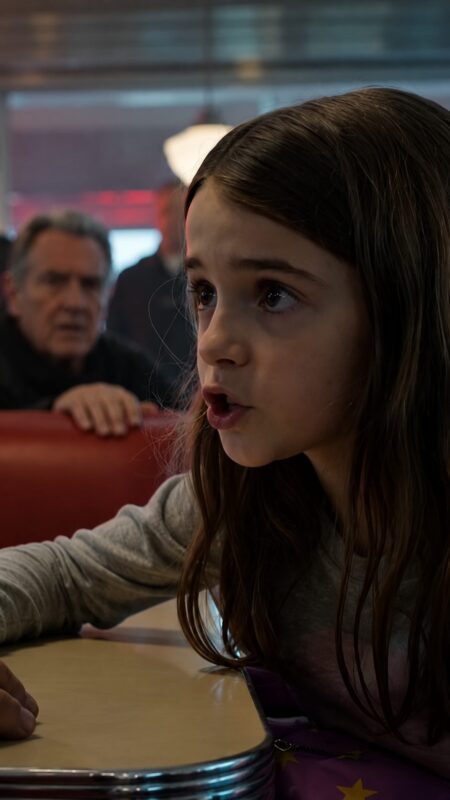
“She’s Anna’s daughter.”
The name hit the air like something physical.
Anna.
The biker went still, as if the world had narrowed down to a single point.
Years ago, Anna had been the only person who could reach him when he came out of prison—when violence followed him like a shadow, when he had nothing left that felt human.
And then she disappeared.
He was told she left willingly.
Told the child wasn’t his.
Told to walk away if he valued what little peace he had left.
So he did.
Because hope hurt more than silence.
Now the past was sitting directly in front of him.
Macy’s voice broke the stillness.
“She died last winter,” she said quietly. “Grandma found your picture hidden inside her Bible.”
The old woman turned away completely, unable to hold herself together.
Something in the biker’s face fractured.
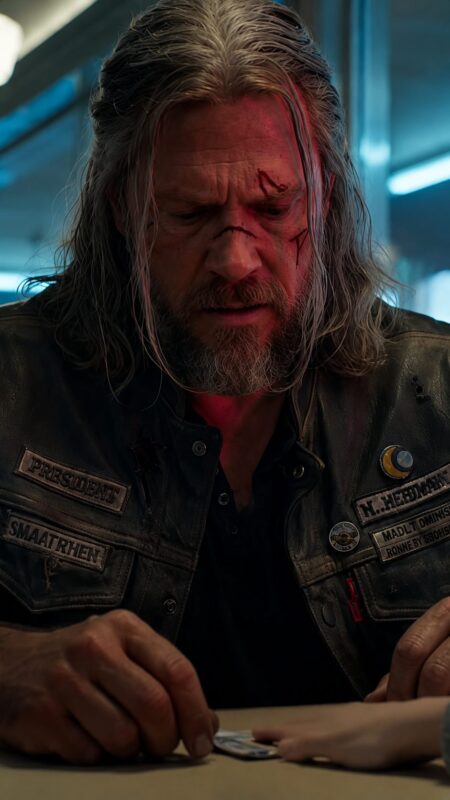
Not toughness.
Not control.
Something deeper.
Loss.
“She told me to remember your scar,” Macy whispered. “She said if I ever saw you… I would be safe.”
The biker studied her now—really studied her.
Anna’s eyes.
His mouth.
The same stubborn strength trying to hide fear.
He looked back at the photograph, then at the purple wheelchair, as if every detail was suddenly rearranging his life.
His voice came out rough, almost unrecognizable.
“Who did this to you?”
Macy’s fingers tightened around the blanket in her lap.
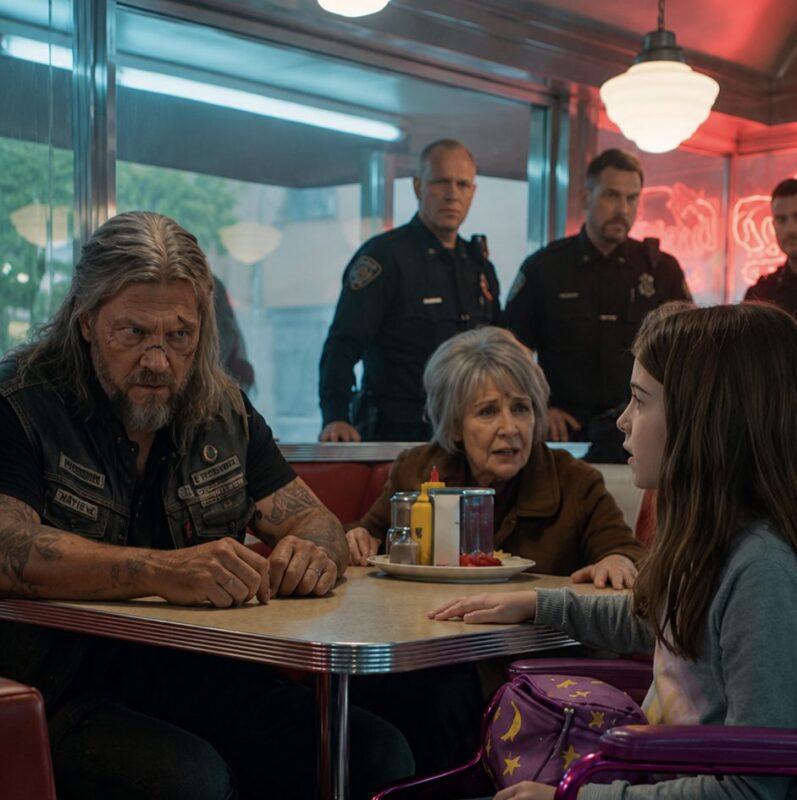
Slowly, she turned her head toward the diner entrance.
The atmosphere shifted.
Something was coming.
The old man stepped forward too late.
The officers reacted a moment too late.
The biker began to rise from the booth too late.
And Macy whispered, almost breaking:
“The man who told you I wasn’t yours…”
Her finger lifted toward the door—
just as it swung open.