The photograph on my mother’s dining table showed a flowering dogwood and a polished granite marker.
I almost walked past it.
Then I saw the name carved into the stone.
ANASTASIA DUNAWAY.
My name.
Underneath were two dates.
1995–2014.
I was twenty-seven years old, standing ten feet away from proof that my family had been telling people I was dead.
And somehow, that still wasn’t the strangest part.
I recognized the tree.
Years earlier, while working at a garden center, I’d sold it to my brother’s girlfriend.
Avery had come in looking for a memorial tree.
“I need something that can survive rough winters,” she’d told me.
“For someone special?”
She nodded.
“My boyfriend’s family lost someone.”
I recommended a dogwood and wrote care instructions on the nursery tag.
Apparently, the dead person had been me.
I stood alone in Mom’s dining room that Easter night, staring at my own handwriting.
Then eight years of bizarre family behavior rearranged itself into one terrible answer.
It had started when my brother Mitch first brought Avery home.
Mom entered my bedroom with a duffel bag.
“You should stay somewhere else this weekend.”
“Why?”
“Avery comes from a very respectable family.”
I waited for the rest of the explanation.
None came.
“What does that have to do with me?”
“Please don’t make this difficult.”
Dad was less delicate.
“Leave until Sunday night.”
Before Avery arrived, Mom removed my photographs from the living room.
She put away my medication.
She locked my bedroom.
I assumed they were ashamed of me.
That explanation hurt, but at least it made sense.
So I obeyed.
Then it happened again.
And again.
Every time Avery visited, I vanished.
Eventually, I bought a yellow notebook and started recording the dates.
At first, I wrote details.
Easter. Avery visiting.
Thanksgiving. Told to leave by noon.
Mitch’s birthday. Not allowed home until Monday.
After a while, explanations felt pointless.
I started writing numbers.
47.
89.
136.
211.
Two hundred and eleven times my family decided I couldn’t exist in my own home.
I was even giving Mom $400 every month toward household expenses.
Apparently, I was alive enough to pay rent.
Just not alive enough to be seen.
Most weekends, I stayed with Ruth Tidwell.
Ruth owned a peach farm and had no interest in whatever strange hierarchy operated inside my family.
If I arrived upset, she didn’t interrogate me.
She handed me gloves.
Ruth taught me how to graft trees, identify disease, prune damaged limbs, and inspect branches after a freeze.
“Don’t trust appearances,” she once told me.
She scraped a branch with her knife.
Brown wood appeared underneath.
“That one’s finished.”
Then she scratched another.
Green.
“This one looks rough, but it’s alive.”
That lesson stayed with me.
Years passed.
Mitch proposed.
Avery became his fiancée.
Then his wife.
I wasn’t invited to the wedding.
Mom said my presence would “complicate things.”
By then, I had learned not to ask which things.
Then came Easter 2022.
Avery’s parents were coming to Mom’s house.
Once again, I was ordered out.
That night, I realized I’d left medication in my locked bedroom.
I drove back after dark.
The house was still full of guests, so I parked farther down the road.
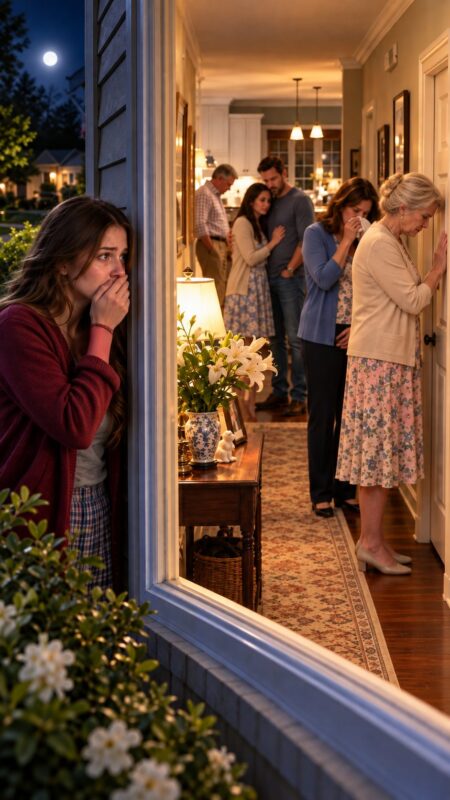
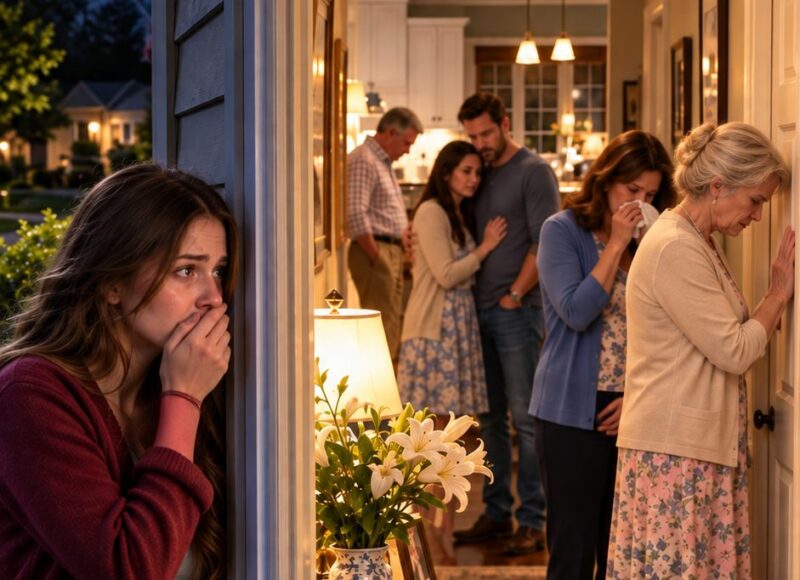
As I approached, I heard Mom crying through an open window.
I stopped.
Avery’s mother, Suzanne, stood outside my bedroom.
Her palm rested against the locked door.
“Could I see it?” she asked.
Mom shook her head.
“I can’t open that room.”
Suzanne’s expression was full of sympathy.
“Even after all this time?”
Mom started crying harder.
Suzanne hugged her.
I stood outside wondering why two women were grieving over my bedroom.
Hours later, after everyone had gone, I entered the house.
That’s when I found the photograph.
My memorial.
My dogwood.
My death.
Suddenly, the missing photographs weren’t strange anymore.
They couldn’t leave pictures of a supposedly dead daughter scattered around while I visibly aged in them.
The locked bedroom had been turned into a shrine Suzanne wasn’t allowed to inspect too closely.
My absence from Mitch’s wedding was obvious.
A dead sister couldn’t attend.
Even Grandma’s obituary finally made sense.
My name had been excluded because printing “survived by granddaughter Anastasia” might have created an awkward conversation.
I went upstairs and packed.
Medication.
Birth certificate.
Clothes.
The yellow notebook.
And the grafting knife Ruth had given me.
Before leaving, I sent my parents one message.
I’m alive. You don’t get to hide me anymore. Don’t follow me.
I drove away before sunrise.
Eventually, I reached Washington.
An orchard near the Columbia River needed seasonal workers.
I knew trees.
That was enough.
For the first time in years, nobody cared about the version of me my family had constructed.
My supervisor didn’t need my history.
He needed to know whether I could graft.
I could.
Seasonal work became permanent work.
I became a grafter.
Then crew leader.
Later, assistant orchard manager.
I built a life in which nobody asked me to disappear before company arrived.
Four years passed before Alabama caught up with me.
The truth emerged because Suzanne decided to honor “my memory” by creating a horticulture scholarship.
A former teacher saw the announcement.
There was one problem.
He knew I wasn’t dead.
He had written me a recommendation letter in 2023.
Apparently, deceased women rarely apply for orchard jobs.
My phone started ringing.
Mom called first.
I answered because some small part of me still expected one sentence.
I’m sorry.
Instead, she said, “We need you to help us explain this.”
I almost admired the audacity.
“Explain what?”
“We can tell Suzanne you disappeared in 2014.”
“You want me to lie?”
“We’ll say we lost contact and didn’t know whether you were alive.”
“You knew exactly where I was for most of those eight years.”
“Anastasia, think about what the truth will do.”
I laughed.
“The truth didn’t do this.”
She went silent.
“You did.”
Then Mitch called.
For the first time, someone finally told me how I’d died.
Years earlier, Avery had spoken to Mitch about losing her brother.
Trying to comfort her, Mitch said, “We lost my sister too.”
He meant emotionally.
I’d been hospitalized, and the period had been frightening for the family.
Avery interpreted his words literally.
She believed I had died.
Mitch realized her mistake.
He was embarrassed.
So he didn’t correct it.
Later, Mom discovered what Avery believed.
Instead of admitting Mitch had said something stupid, she protected him.
One lie required another.
Then another.
Eventually, keeping me hidden became easier than telling Avery the truth.
“I didn’t think it would go this far,” Mitch said.
“You married her.”
“I know.”
“You stood at your wedding knowing your wife thought I was dead.”
He started crying.
“What can I do?”
“Tell her.”
“Anastasia—”
“No. You created the first lie. You tell the last truth.”
I returned to Alabama on Good Friday.
Suzanne agreed to meet me beside the dogwood.
Seeing her was strange.
She had mourned me more sincerely than my own family had missed me.
I handed her the yellow notebook.
“What is this?”
“Eight years.”
She opened it.
The numbers meant nothing initially.
Then I explained.
“Every number is a time they made me leave because you or Avery were coming.”
Suzanne turned pages more slowly.
When she reached 211, she stopped.
Her face changed.
“I know this date.”
“I thought you might.”
She looked toward the house.
“That was the night I stood outside your bedroom.”
“Yes.”
“I prayed there.”
“I heard you.”
Her eyes filled.
“You were outside?”
“Right beneath the window.”
Suzanne closed the notebook.
For several seconds, neither of us spoke.
Then she whispered, “I’m so sorry.”
She had nothing to apologize for.
The next morning, I stood beside the memorial dogwood.
My parents arrived before the Easter gathering.
Mom saw me and stopped.
“What are you doing?”
Once, that question would have made me retreat.
This time, I stayed exactly where I was.
“Being visible.”
During the service, Suzanne read the names of people the family had genuinely lost.
My name was not included.
Afterward, Mom tried one final defense.
“I never actually told Suzanne you died.”
Suzanne looked at her.
“No, you didn’t.”
Mom seemed relieved for half a second.
Then Suzanne continued.
“You did something worse. You watched me grieve someone who was alive.”
I walked away before Mom could answer.
At the dogwood, I remembered Ruth.
I pressed my thumbnail into a small branch and scraped the surface.
Green appeared beneath the bark.
The tree had survived.
So had I.
The memorial stone disappeared several weeks later.
Someone asked if I wanted the dogwood removed too.
I said no.
The tree wasn’t responsible for the lie.
And there was something strangely satisfying about leaving it there.
They had planted it as evidence that my life was over.
Instead, every spring it bloomed.
I returned to Washington.
Mitch calls on Sundays now.
I answer when I want to.
Avery occasionally sends photographs of struggling plants and asks what she’s doing wrong.
Dad has begun admitting that saying nothing made him part of everything that happened.
Mom still circles around the word sorry without ever quite reaching it.
I used to believe I needed that apology before I could move on.
I don’t anymore.
Recently, someone sent me a photograph from Alabama.
Cuttings had been taken from the dogwood.
They were trying to root them.
It was too early to know whether they would survive.
But when I enlarged the photograph, I could see fresh green along the stems.
That night, I opened the yellow notebook.
I turned past 208.
209.
210.
211.
Then the line I’d drawn beneath the final number on the night I left.
For years, those pages had measured how often my family erased me.
I considered throwing the notebook away.
Instead, I picked up a pen.
I didn’t write 212.
There would never be a 212.
Below the line, I wrote:
GREEN.
Then I closed the notebook.
My family had spent eight years pretending I was dead because telling the truth was inconvenient.
For too long, I cooperated by disappearing whenever they asked.
But Ruth had taught me something about living things.
A tree can look ruined after a brutal winter.
Its branches can be bare.
Its bark can be scarred.
That doesn’t tell you whether it’s dead.
You have to look underneath.
I hadn’t vanished when I left my family.
I had finally stopped letting them prune me into the shape their lie required.
They planted a tree to memorialize the life they pretended I’d lost.
I found better soil.
And grew one of my own.