They Mocked the Injured Captain in Court—Until a Famous General Walked Through the Doors
“Easy there, Captain. Wouldn’t want you to fall.”
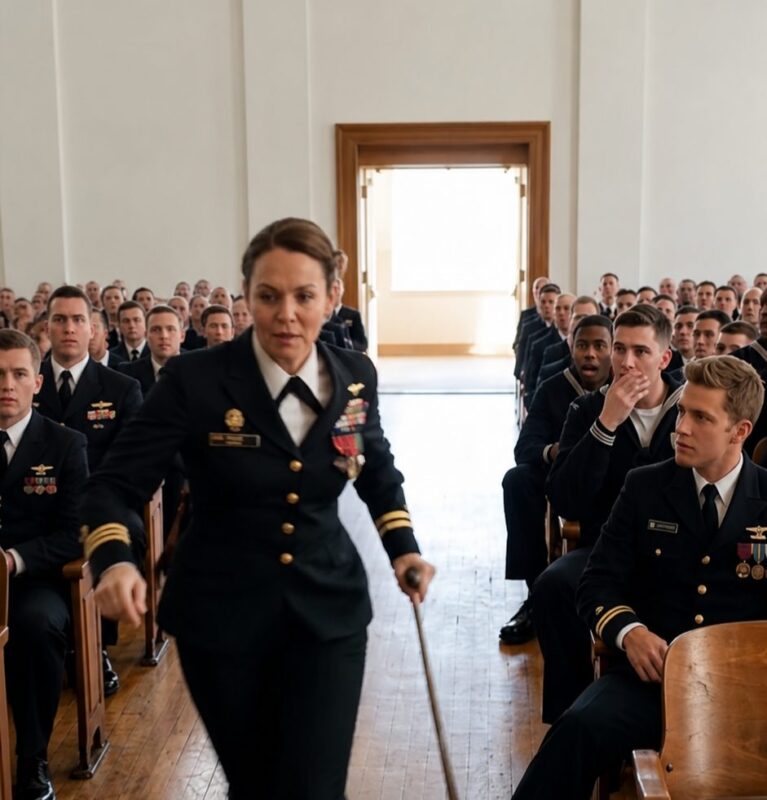
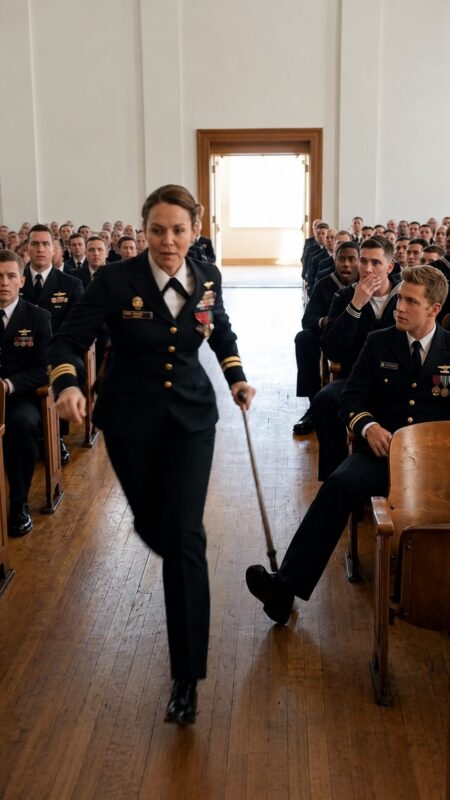
The comment was followed by quiet laughter as Emma Walker made her way into the military courtroom, supporting herself with a single crutch.
One officer even stretched his foot into her path.
Emma stumbled.
For a moment, it looked as though she might collapse onto the floor. She caught herself just in time, tightened her grip on the crutch, and continued walking.
The laughter grew louder.
Emma never looked back.
Every step sent pain through her damaged leg, but she refused to let anyone in the room see how much it hurt.
To the officers watching from their seats, she was an embarrassment—a captain accused of ignoring orders during a critical military operation. Some had already decided she was guilty. Others seemed convinced that her injury was proof of weakness rather than sacrifice.
Not one of them knew what had truly happened.
Emma reached her place and stood silently before the court.
The hearing dragged on for hours.
Witnesses spoke. Reports were examined. Arguments were made.
Yet Emma couldn’t shake the feeling that none of it mattered.
The atmosphere in the room suggested that her future had been decided long before she entered. One unfavorable ruling could end the career she had spent years building and permanently stain her reputation.
As the judge prepared to announce the decision, Emma lowered her eyes.
Then came a sudden noise from the back of the courtroom.
The doors swung open.
Every conversation stopped.
A distinguished general entered.
Recognition spread across the room almost instantly. He was one of the country’s most respected military leaders, a man whose reputation had been built over decades of service.
Officers who had been laughing moments earlier immediately straightened in their seats. Several stood.
The general ignored them.
He walked directly toward the judge, carrying a folder beneath one arm.
“Your Honor,” he said, his voice cutting through the silence, “before this court reaches a decision, there is evidence that must be considered.”
He placed the folder on the table.
The judge looked at him with surprise.
The general turned toward the room.
“Captain Emma Walker has been accused of abandoning her orders during an active operation,” he began. “That description is incomplete.”
No one moved.
“Captain Walker made a decision under extraordinary circumstances. And because she made that decision, a man is alive today.”
The smug expressions disappeared.
The general opened the folder.
Inside were official reports, medical records, witness statements, and operational documents that told a very different story.
During the mission, a soldier had become separated from his unit after suffering critical injuries. Conditions on the ground were rapidly deteriorating, and reaching him meant entering an extremely dangerous area.
Emma had been ordered to continue with her assigned objective.
Instead, when she realized that the wounded soldier had no chance of surviving without immediate help, she went back for him.
Alone.
She reached him and began pulling him toward safety.
During the evacuation, Emma suffered a serious injury to her leg. Despite the pain, she refused to stop until they were both out of immediate danger.
The injury left lasting damage.
The crutch everyone had mocked that morning was not a symbol of failure.
It was evidence of what she had sacrificed.
“Captain Walker had a choice,” the general said. “She could have followed the mission plan without deviation. No one would have questioned her decision.”
He paused.
“But a soldier would have died.”
The courtroom was completely silent.
“She chose the life of another human being over her own safety. If this court intends to judge that decision, then it should first understand what that decision cost her.”
Then the general turned toward the entrance.
A man stepped into the courtroom.
Emma recognized him immediately.
So did several others.
It was the soldier she had rescued.
He walked slowly to the front of the room and faced the judge.
His voice trembled slightly as he spoke.
“Everything the general said is true. I wouldn’t be standing here if Captain Walker hadn’t come back for me.”
Emma stared at him, speechless.
The officers who had ridiculed her only hours earlier suddenly found the floor very interesting.
No one laughed now.
The judge spent several minutes examining the newly presented evidence.
The silence felt endless.
Finally, the ruling came.
All charges against Captain Emma Walker were dismissed.
The court went even further, formally acknowledging that her actions had demonstrated exceptional courage, loyalty, and selflessness under extraordinary circumstances.
When Emma finally turned to leave, she walked down the same aisle she had entered hours earlier.
She still needed her crutch.
Her leg still hurt.
But everything else had changed.
The officers who had mocked her now stood in silence as she passed.
Some lowered their heads in shame.
Others looked at her with newfound respect.
Emma didn’t need their apologies.
She simply kept walking.
That day, everyone in the courtroom learned something they would not soon forget:
Never mistake someone’s wounds for weakness.
The scars you judge from a distance may be the price that person paid for an act of courage you know nothing about.
And sometimes, the person struggling to take the next step is the strongest person in the room.