Which Woman Is the Youngest? Your First Guess May Reveal More Than You Think
At first glance, this seems like a simple challenge. Four women are standing in a row with their backs to you. They are dressed alike, their figures appear remarkably similar, and there are few obvious clues to distinguish one from another.
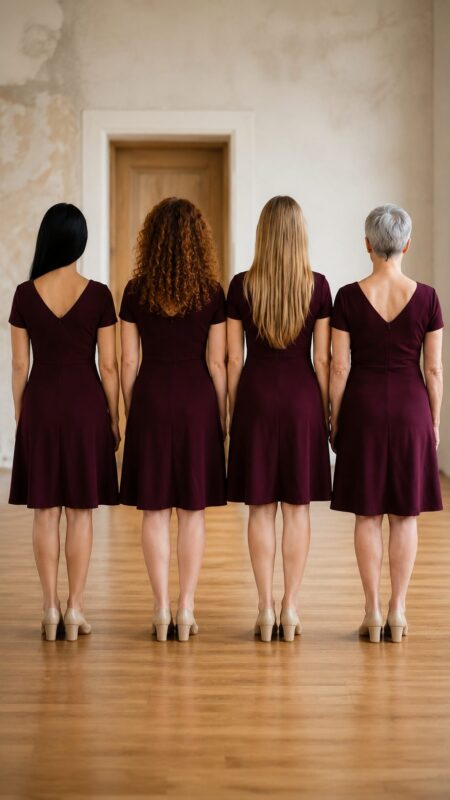
Except for one thing: their hair.
Woman #1 has smooth, jet-black hair. Woman #2 has thick, auburn curls. Woman #3 has long, flowing blonde locks. Woman #4 wears her platinum hair in a short, fashionable cut.
Now, without studying the image for too long, answer one question:
Which woman do you believe is the youngest
Choose #1, #2, #3, or #4.
Got your answer?
Interestingly, the choice you make may have less to do with the women’s actual ages and more to do with the associations your mind automatically makes. We constantly interpret visual information using past experiences, cultural influences, and familiar stereotypes—often without consciously realizing it.
Let’s explore what might have influenced your decision.
If You Chose Woman #1
The sleek black hair of Woman #1 may have immediately suggested health and youthfulness to you. Dark, shiny hair is often associated with vitality, strength, and natural beauty.
If she was your first choice, you may be someone who appreciates simplicity and timeless elegance. Rather than being drawn to dramatic trends, you might prefer things that feel familiar, dependable, and effortlessly classic.
Perhaps your instinct told you that such rich, glossy hair must belong to someone young.
But appearances, as we know, can easily be misleading.
If You Chose Woman #2
Maybe your eyes went straight to Woman #2 and her lively auburn curls.
Curly hair creates an immediate sense of movement. It can appear playful, energetic, and spontaneous—all qualities commonly associated with youth.
If #2 was your choice, you may see youth as something expressed through personality and energy rather than simply physical age. You might appreciate individuality, freedom, and people who are comfortable standing out from the crowd.
To you, those vibrant curls may have seemed full of life, making Woman #2 the obvious answer.
If You Chose Woman #3
Woman #3’s long blonde hair may have seemed like the most natural choice.
For generations, popular culture has connected long, golden hair with youthful beauty. Fairy-tale princesses, movie stars, fashion models, and fictional heroines have all helped reinforce this familiar image.
If you selected #3, your decision may have been influenced by these deeply rooted cultural associations. You may also have a strong appreciation for beauty, imagination, and traditional ideas of elegance.
Perhaps you didn’t consciously analyze your choice at all. Something about her appearance simply seemed “young.”
And that is exactly what makes this puzzle so interesting.
If You Chose Woman #4
Then there is Woman #4.
Her short platinum hairstyle makes her the most deceptive—and perhaps the most intriguing—option.
Some people may immediately interpret the pale color as naturally grey or white hair and assume that she must be older. Others may see something completely different: a stylish platinum pixie cut chosen deliberately as a bold fashion statement.
If #4 was your answer, you may be someone who likes to look beyond first impressions. Instead of automatically connecting light hair with age, you may have noticed the modern haircut and considered the possibility that the color was intentional.
Your instinct might have been telling you that the most obvious answer was probably a trap.
So, Who Is Actually the Youngest?
Here is where things become complicated.
Can someone’s age really be determined by looking at their hair from behind?
Not reliably.
Hair can be colored, bleached, curled, straightened, cut short, extended, or completely covered by a wig. A young person can choose silver hair, while an older person can have naturally dark hair.
Once you remove hair from the equation, the puzzle becomes much harder.
You might start examining posture instead. Perhaps one woman stands more confidently. Maybe another holds her shoulders differently. You may notice tiny variations in the position of their arms and begin wondering whether these details reveal something important.
But what if those clues are misleading too?
Here is the real twist:
All four women could be the exact same age.
In fact, imagine that the picture shows the same 25-year-old model four times, with each version wearing a different wig. The dresses, body proportions, and overall appearance remain virtually identical. Only the hairstyles change.
Yet many viewers will still feel strongly that one woman looks younger than the others.
Why?
Because our brains dislike uncertainty.
When information is missing, the mind tries to fill in the gaps. It searches through memories, experiences, social expectations, and cultural imagery to create an answer that feels logical.
Dark, glossy hair might suggest vitality.
Bouncy curls might represent youthful energy.
Long blonde hair might evoke familiar images of young beauty.
Platinum hair might suggest either age or modern fashion, depending on the person looking at it.
None of these impressions necessarily tells us anything about someone’s true age.
The Answer Isn’t Really the Point
This puzzle is less about finding the youngest woman and more about observing how quickly we make assumptions.
Your first answer wasn’t necessarily right or wrong. It was simply your brain interpreting limited information and trying to reach a conclusion.
That is the real fun of the challenge.
Sometimes, what we think we see is shaped as much by our expectations as by what is actually in front of us.
So think back to your original choice.
Did you choose #1 because of her glossy black hair?
Did #2’s energetic curls convince you?
Did 3 match your mental picture of youthful beauty?
Or did you suspect that #4’s platinum hairstyle was designed to fool you?
Whatever your answer, take another look. You may notice that once you begin questioning your assumptions, the puzzle suddenly becomes much harder.
Now share it with your friends and ask them the same question:
Which woman is the youngest?
Don’t tell them the twist right away.
Their answers—and the reasons behind them—may be far more interesting than the puzzle itself.