THE TAKEAWAY BOXES
I spent $250 on thirty-three pounds of high-quality beef for a Sunday barbecue with my family.
Eight people were coming.
To anyone else, the amount of food might have seemed absurd.
To me, it was simply how I welcomed the people I loved.
For as long as I could remember, nobody left my house hungry. If you sat at my table, you ate until you were satisfied, and when it was time to go home, I usually wrapped up a little something for later.
That was my language of love.
A full plate.
An open door.
A place where everyone knew they belonged.
I was sixty-five years old, and after decades of hosting family gatherings, I thought I understood the difference between generosity and being taken for granted.
That Sunday proved I didn’t.
My husband, Tom, and I lived outside Fort Worth, Texas, in the same comfortable house where our family had celebrated countless birthdays, graduations, holidays, and anniversaries.
Our backyard wasn’t the kind of place you’d see in a magazine.
The wooden table had scratches from years of use. An old pecan tree shaded one corner of the yard, and Tom’s grill had been with us for nearly two decades.
But that backyard held memories.
To me, that made it priceless.
The day before the barbecue, I sat in the kitchen with my morning coffee and wrote out the menu.
Slow-cooked brisket.
Beef ribs.
Marinated skirt steak.
Grilled sausages.
Crispy roasted potatoes.
Fresh garden salad.
Charred onions.
And peach cobbler made from my grandmother’s recipe.
Tom found the list beside my coffee cup.
He picked it up and stared at it.
“Betty, how many people did you invite?”
“Eight.”
He looked at the list again.
“Are you sure you didn’t invite eighty?”
I laughed.
“I like having leftovers.”
“You always have leftovers.”
“Then everything is going according to plan.”
That morning, I visited Mr. Davis at the butcher shop and asked for the best cuts he had.
When he finished weighing everything, the total came to thirty-three pounds.
Two hundred and fifty dollars.
Mr. Davis looked at the enormous order and grinned.
“Big party?”
“Just a family barbecue.”
He shook his head with amusement.
“Family. They’ll empty your refrigerator faster than a house full of strangers.”
I laughed.
At the time, I thought he was joking.
The following afternoon, the smell of smoke, seasoning, and roasting vegetables drifted through the house and into the backyard.
My nieces arrived first, each carrying a homemade dish.
Before I could even ask, they were helping me arrange the table and bring plates outside.
Then my son, Julian, arrived.
With him were his wife, Rachel, and her mother, Stella.
Rachel gave me a quick kiss near my cheek.
Stella smiled politely and commented on the weather.
Everything appeared ordinary.
Then I noticed the tote bags.
Rachel was carrying a large canvas bag that looked unusually full.
Stella had one too.
When Rachel placed hers beside a chair, the top fell open.
I saw stacks of empty plastic containers inside.
Not one or two.
Dozens.
I glanced at Stella’s bag.
More containers.
For a moment, I assumed they had brought food in them and had already emptied the dishes somewhere.
But the containers were clean.
Completely empty.
They had arrived at my barbecue carrying enough boxes to pack half the meal.
Before anyone had even sat down.
I told myself not to overthink it.
A little later, Tom proudly announced how much meat I had prepared.
“Betty bought thirty-three pounds,” he said. “I think she’s trying to feed the entire county.”
Rachel’s eyes immediately moved toward Stella.
They exchanged a look.
Then Rachel laughed.
“Good thing we came prepared.”
She pointed toward her bag.
“For the leftovers.”
My smile faded slightly.
The first plate hadn’t even been served.
She must have noticed my reaction.
“Oh, come on,” she added lightly. “You always cook too much. Someone has to make sure all that food doesn’t get thrown away.”
Someone.
Apparently, that someone had already been decided.
I said nothing.
I wanted to enjoy the afternoon.
But from that moment on, I couldn’t stop noticing things I might once have ignored.
My nieces continued helping.
Rachel and Stella remained seated.
And while they contributed nothing, they seemed to have opinions about everything.
My roses were apparently past their best.
The tablecloth looked dated.
The sausages were a little salty.
Rachel preferred a different kind of salad dressing.
Every comment came wrapped in a smile.
Nothing was openly insulting.
But after enough small remarks, even a smile can begin to feel sharp.
I looked at Julian several times.
My son heard them.
He knew how hard I had worked.
Yet he never said a word.
That was the part that stayed with me.
Finally, Tom carried the meat from the grill.
For a moment, every unpleasant thought disappeared.
The table looked beautiful.
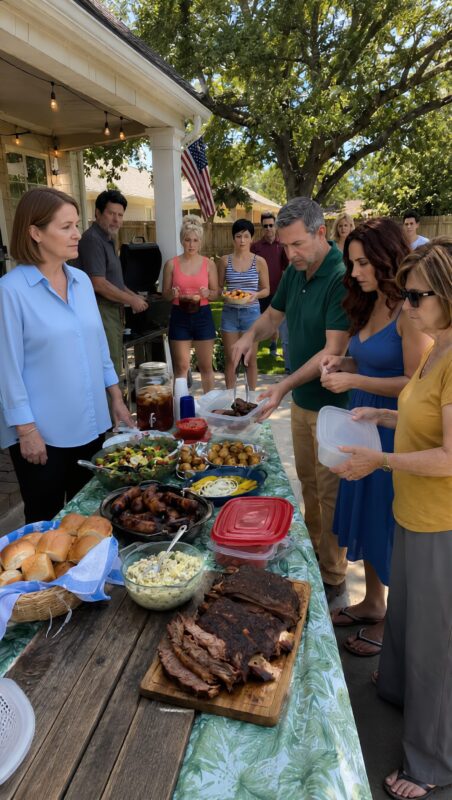
Brisket sliced perfectly across the grain.
Glazed ribs.
Juicy strips of steak.
Grilled sausages.
Bowls of potatoes, salad, and onions surrounded the platters.
I looked at the meal and felt the familiar satisfaction I had experienced after countless family gatherings.
This was why I did it.
Then Rachel reached for her phone.
She photographed the brisket.
The ribs.
The steak.
The side dishes.
She didn’t ask anyone to gather for a family picture.
She didn’t photograph Tom standing proudly beside his grill.
She didn’t take a picture of Julian with his parents.
Just the food.
After everyone had eaten, conversation slowed and people relaxed in their chairs.
That was when Rachel looked across the table.
“Wow. There’s still so much left.”
Stella leaned forward.
“It would be criminal to waste all of that.”
My stomach tightened.
I knew exactly what would happen next.
Rachel turned to Julian.
“Honey, bring me the bags.”
He got up immediately.
No question.
No hesitation.
He returned with both canvas totes.
Rachel opened hers.
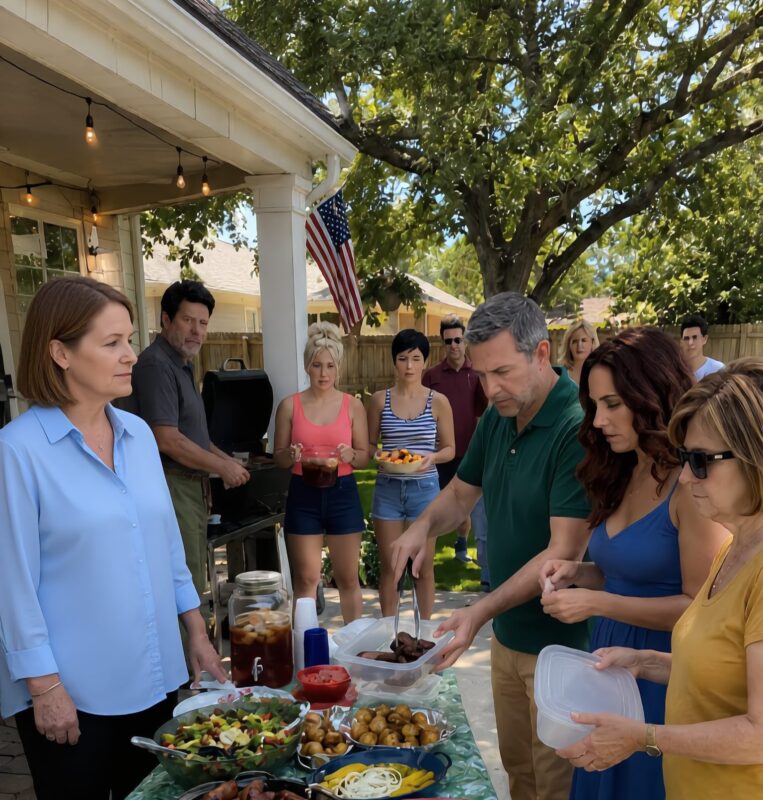
Plastic containers began appearing across my table.
Small ones.
Large ones.
Deep ones.
Flat ones.
Stella started arranging hers beside them.
Suddenly, my patio looked less like the end of a family barbecue and more like the packing station of a catering company.
Rachel pointed at the meat.
“Let’s do the brisket first.”
Julian reached for the platter.
“Get the softer slices,” she added. “And save us plenty of ribs.”
My son picked up the serving tongs.
And began packing.
I waited.
For him to look at me.
For Rachel to ask.
For Stella to say thank you.
For anyone to acknowledge that perhaps the woman who had purchased and prepared the food should have some say in where it went.
Nothing.
Container after container filled with meat.
The best brisket.
The ribs.
The steak.
Food I had bought with my money and spent two days preparing.
And my own son was helping carry it away as if it had already been promised to them.
That was when something inside me quietly changed.
It wasn’t about the $250.
It wasn’t even about the thirty-three pounds of beef.
I had always been happy to share.
What hurt was realizing that my generosity was no longer being received as kindness.
It had become an expectation.
Rachel and Stella hadn’t brought containers because I had offered them leftovers.
They had brought them because they had already decided there would be leftovers for them.
Before arriving.
Before eating.
Before asking me.
And Julian, my own son, saw absolutely nothing wrong with it.
I watched him snap the lid onto another container of brisket.
For years, I had believed that feeding my family was one of the ways I showed them how much I loved them.
But sitting there that afternoon, I finally understood something I should have realized much sooner.
When kindness is given freely, it is a gift.
When people begin to expect it, demand it, and claim it without asking, it becomes something entirely different.
I looked at the growing stack of containers.
My food.
My money.
My time.
My effort.
My home.
And for the first time in my life, I wondered whether the people sitting at my table came because they valued being with me…
Or because they had grown accustomed to taking whatever I gave.