They Whispered When My Son Walked Onstage Carrying a Newborn—But What He Said Next Brought the Room to Silence
I was thirty-five the night my son crossed the stage.
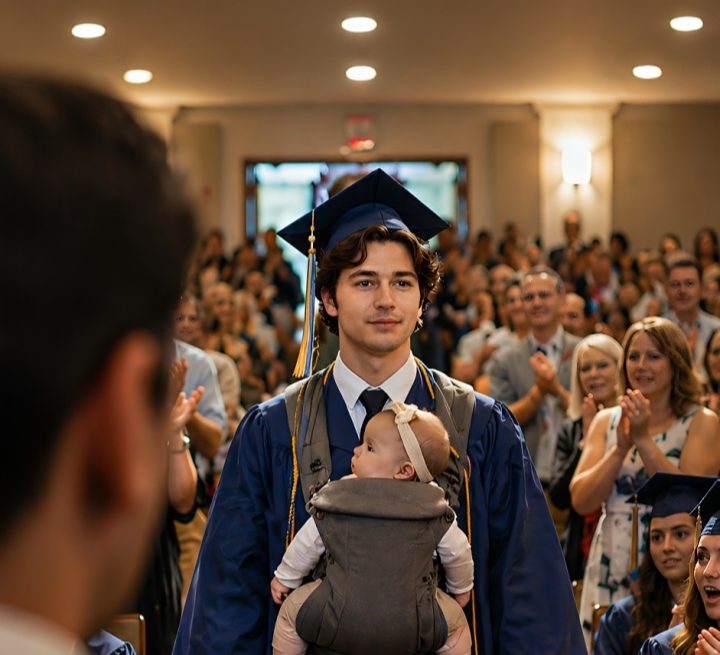
The auditorium shimmered with celebration—bouquets in every direction, cameras flashing nonstop, families beaming as though the hardest years were finally behind them.
I sat alone in the third row.
My outfit was modest. My shoes ached. And resting beside my purse, at my feet, was a diaper bag—completely out of place in the moment everyone else had imagined.
For eighteen years, my life had been about endurance.
I had Adrian at seventeen. His father, Caleb, didn’t slowly drift away—he disappeared overnight. One morning, his closet was empty, his phone unreachable, and every promise he had made vanished with him.
From then on, it was just us.
Adrian grew up in the spaces between my exhaustion—between long shifts, unpaid bills, and quiet prayers over simple meals. He never asked for much. He didn’t complain. But he saw everything.
He saw when I went without eating.
He knew when I cried in private.
He understood what it meant to stay.
By his final year of high school, I thought we had finally made it past the hardest part.
His grades were excellent. Scholarships were waiting. For the first time, his future felt solid.
Then something shifted.
He started coming home late.
Working extra hours.
Keeping his phone turned over.
Some nights, fear showed in his eyes. Other nights, there was a strange calm—like someone holding onto something too heavy to share.
Three nights before graduation, he stood in the kitchen doorway, nervously pulling at his sleeve.
“Mom,” he said softly, “please hear everything before you decide how disappointed you are.”
My heart sank.
Then he told me the truth.
About Hannah.
About the pregnancy.
About the baby girl who had been born less than two weeks earlier.
About the hospital visits he had hidden from me.
And about the promise he made to himself—
that no matter how afraid he felt, he would never walk away the way his father did.
Then he asked me something I wasn’t ready to face.
“If I bring her to graduation… will you still be there?”
I didn’t sleep that night.
And still, I wasn’t ready.
The ceremony unfolded like any other.
Names. Applause. Speeches.
Then Adrian stepped out of line.
He walked straight toward me.
“Mom,” he whispered, holding out his arms, “give her to me.”
I reacted before I could think.
I placed the tiny baby girl into his arms.
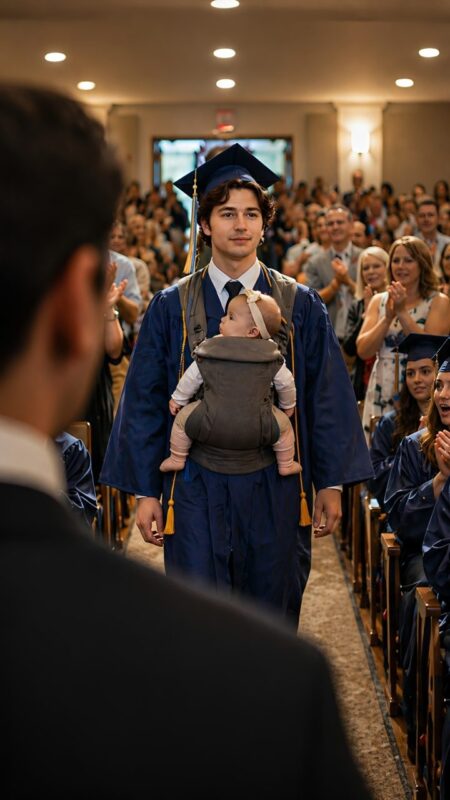
He held her close against his chest beneath his gown, her small face peeking out from a soft pink blanket.
Then he turned and headed toward the stage.
The murmurs began instantly.
Then came the laughter.
Quiet at first, then spreading.
“Is he serious?”
“Wow…”
And then, just behind me, a woman muttered loud enough for me to hear—
“Just like his mother.”
The words hit me hard.
For a moment, I couldn’t breathe.
I wanted to vanish.
To turn back time.
To erase every mistake that brought us here.
But Adrian didn’t stop.
He didn’t look down.
He didn’t hesitate.
He climbed the steps with steady confidence, holding his daughter as if she belonged there—because she did.
He received his diploma.
And then he stayed.
Instead of walking off, he stepped up to the microphone.
The room shifted.
The laughter faded into confusion.
Then into silence.
With one hand, he adjusted the mic. With the other, he held his daughter close.
And then he spoke:
“My mom showed me what it means to stay.”
The entire room went still.
“All my life,” he continued, his voice steady but raw, “people looked at us and saw what we didn’t have: a father who left, a mom who had me too young, a future that didn’t look like much.”
He paused, glancing down at the baby in his arms.
“But that’s not what I saw.”
Then he looked up.
“I saw a woman who worked until her hands ached and still showed up for me. I saw someone who chose me every single day—even when it was hard, especially when it was hard.”
Tears filled my eyes.
“A few months ago, I found out I was going to be a father,” he said. “And yes, I was scared. I still am. But there’s one thing I know for sure…”
His voice trembled for a moment.
“I’m not going to leave her.”
The room sank into complete silence.
“Some of you laughed,” he said, his voice steady—no anger, just truth. “Maybe you think this baby means I’ve already failed.”
He carefully straightened the blanket wrapped around her.
“But she isn’t my failure.”
“She’s my responsibility.”
“And she will never have to question whether her father stayed.”
A quiet sob echoed somewhere in the crowd.
Adrian’s gaze locked onto mine.
“My mom was seventeen when she had me. To most people, I was a mistake.”
He paused, swallowing the emotion rising in his throat.
“To me, she was a miracle.”
Something deep inside me cracked wide open.
“If I can be even half the parent she was… my daughter will be more than okay.”
For a second, nothing moved.
Then one person rose.
Then another.
And another.
Until the entire auditorium was standing—
clapping,
crying,
overwhelmed.
The same people who had laughed earlier now couldn’t even meet our eyes.
After the ceremony, everything felt like a blur.
Teachers wrapped him in hugs.
Other parents avoided looking at me.
One woman—perhaps the same one who had whispered before—hurried past with her head lowered.
But none of it mattered.
Because my son stepped down from that stage holding his daughter close—
his head lifted with quiet pride.
That night, we went straight to the hospital.
Hannah looked drained, fragile, and terrified.
“I’ve ruined everything,” she whispered when she saw us.
Adrian crossed the room without hesitation.
“You haven’t ruined anything,” he told her gently.
Then she looked at me—bracing for judgment.
I simply asked, softly,
“Have you eaten?”
That’s when she broke down completely.
A few days later, she came home with us.
Not because we had everything figured out,
but because no one under our roof would face life alone.
We made room.
We adapted.
We struggled.
But we stayed.
A year later, our home is louder, messier, and more demanding—
and more alive than I ever imagined.
Sometimes, I think back to that night:
the laughter,
the woman who muttered, “just like his mother.”
She wasn’t wrong.
He is just like me.
He chose love when running away would have been easier.
He was scared—and stayed anyway.
And in that moment, standing in that auditorium, I finally understood something I had carried for eighteen years:
Our story was never meant for those who judged us.
It belongs to us.
And my son made sure—
the final word wasn’t laughter.
It was truth.