Three months after I turned eighteen, my parents told me to leave their house.
It wasn’t because I drank or got into trouble.
It wasn’t because I had broken any rules.
It was because I refused to become a doctor.
Both of my parents are surgeons. In our home, medicine wasn’t simply a profession—it was a family legacy. From the time I was a child, my future had already been decided for me.
My father used to say the same thing over and over:
“Our family saves lives. That’s our purpose.”
But deep down, I knew that path wasn’t mine. I never imagined myself holding a scalpel.
I wanted to hold a guitar.
Music was the one place where I truly felt free. Whenever I played, the pressure vanished. The expectations disappeared, and for a few moments I could simply breathe.
The night I finally told my parents I planned to pursue music instead of medical school, the entire dinner table fell silent.
My mother stared at me as if I had betrayed the family.
My father didn’t yell. In some ways that was worse. He carefully folded his napkin, looked straight at me, and spoke in a calm voice.
“If you refuse the future we prepared for you,” he said, “then you’ll have to build your own.”
I thought he was bluffing.
He wasn’t.
By that evening, my house key had already been deactivated.
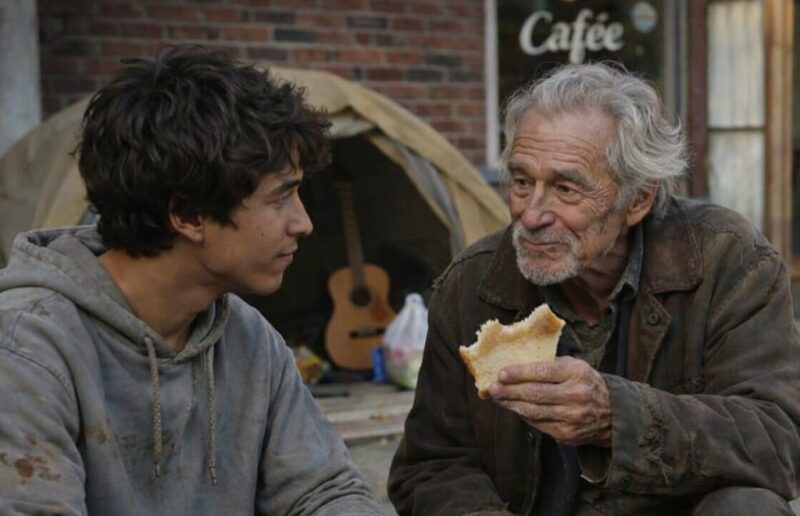
Three months later, I was living under a bridge beside an abandoned warehouse. My “home” was a cheap camping tent. It wasn’t comfortable, but it stayed dry when it rained, and no one bothered me there.
During the day, I worked part-time at a small café downtown. My job was simple—washing dishes, wiping tables, and hauling trash outside. It wasn’t glamorous, but it paid just enough for cheap food and, every now and then, a new set of guitar strings.
Most days I survived on spare coins and leftover tips.
One quiet afternoon, right before closing, my manager handed me a sandwich from the display case.
“Take it, Mike,” she said. “We’re throwing it away anyway.”
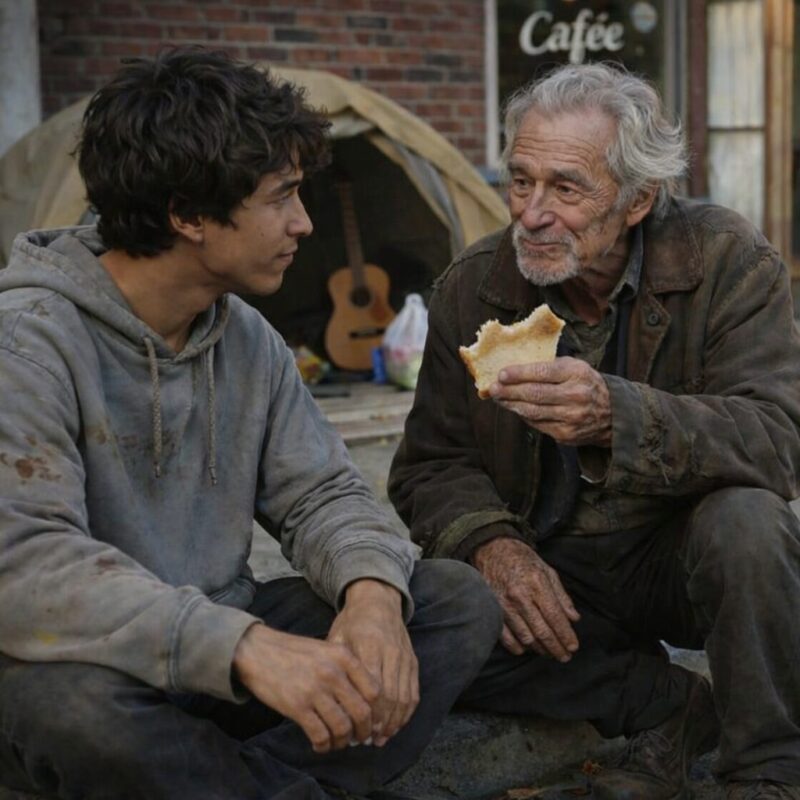
I went behind the café and sat near the dumpsters, leaning against the brick wall. I ate slowly, trying to make the sandwich last as long as possible.
From the alley, I could see the sidewalk.
That’s when I noticed an older man moving from one person to another, politely asking if anyone had something to eat.
His coat was torn, and his shoes looked like they had survived too many winters.
Most people ignored him.
One woman waved him away without even looking up from her phone. A man in a business suit brushed him off impatiently.
After several people rejected him, he slowly turned toward the alley.
When he reached the entrance, I called out.
“Hey.”
He looked at me.
“You hungry?”
For a moment, he stared as if he wasn’t used to hearing kindness anymore.
I lifted my sandwich and tore it into two pieces.
“It’s not much,” I said, “but you can share it.”
He walked over and sat beside me on the curb.
“Thank you,” he said quietly.
We ate without speaking. He took careful bites, almost as if he didn’t want the food to disappear too quickly.
After a moment, he glanced at me.
“What’s your name?”
“Mike.”
“And where do you live, Mike?”
I shrugged. “Under the bridge. Got a tent there.”
He studied me for a long moment.
“You’re very young to be living like that.”
I let out a small laugh. “Life has a strange sense of humor.”
When he finished eating, he stood up slowly. Before leaving, he looked back at me.
“You shouldn’t have to live like this,” he said softly.
I smiled a little.
“Well… neither should you.”
For a brief moment he smiled too, but his expression didn’t look tired anymore.
Then he walked away.
I didn’t give it much thought afterward.
But the next morning, everything changed.
I woke up to the sound of an engine nearby. At first I assumed it was a truck passing over the bridge. But the engine kept running.
I unzipped my tent and stepped outside.
A long black limousine was parked a short distance away.
Beside it stood a driver wearing a dark suit.
When he saw me, he walked over.
“Are you Michael Carter?” he asked politely.
I blinked. “Yeah… that’s me.”
He nodded and opened the back door of the limousine.
“Mr. Whitmore would like to speak with you.”
The name meant nothing to me.
But when I looked inside the car, my heart nearly stopped.
Sitting comfortably in the back seat was the same man from the alley.
Except now he looked completely different.
His suit was perfectly tailored. His shoes were polished. His hair was neatly styled.
He looked like someone important.
When he saw my shocked expression, he smiled warmly.
“Good morning, Mike.”
I stared at him in disbelief.
“You… weren’t homeless.”
He chuckled.
“No.”
“Then why were you asking people for food yesterday?”
He gestured toward the seat.
“Please, sit.”
Once I climbed inside, he explained calmly.
“Once a year, I like to see the world from the street. Yesterday I asked more than twenty people for help.”
“How many helped you?” I asked.
He looked at me.
“Only one.”
I shifted awkwardly. “It was just half a sandwich.”
“But it was everything you had,” he replied.
Then he introduced himself.
“My name is Charles Whitmore. I’m the founder of Whitmore Development Group.”
I still didn’t recognize the name, but the driver’s respectful posture told me it was significant.
Whitmore continued, “I grew up poor. At nineteen, I slept in my car. I built my company from nothing. So when I see someone young who is struggling but still chooses kindness, I notice.”
I swallowed.
“Why did you bring me here?”
“Because I want to help you.”
“With what?”
“What do you want to do with your life?”
“Music,” I said instantly.
“What instrument?”
“Guitar.”
He smiled.
A few minutes later, the limousine stopped in front of a large brick building downtown.
The sign outside read:
Whitmore Arts Foundation
Inside were rehearsal rooms, recording equipment, and a small performance stage.
An hour later I sat on that stage with my old guitar while Whitmore watched from the front row.
“Whenever you’re ready,” he said.
My hands trembled as I started to play. The song I performed was one I had written under the bridge—a song about anger, loneliness, and the fragile hope that things might still change.
When the last chord faded, the room fell silent.
Whitmore slowly stood up.
Then he applauded.
“Well,” he said with a smile, “that answers my question.”
My voice felt tight.
“Was it good?”
He shook his head gently.
“It was genuine.”
Then he handed me a folder.
Inside were official documents.
“A full scholarship to the Whitmore Music Conservatory,” he said. “Tuition, housing, lessons, instruments—everything is covered.”
My hands trembled as I looked at the papers.
“Why me?” I asked.
Whitmore met my eyes.
“Because when you had almost nothing,” he said calmly, “you still chose kindness.”
Three months earlier, I had been sleeping under a bridge.
The day before, I had shared half a sandwich with a stranger.
And somehow, that small act changed the direction of my entire life.