Three years after Michael passed away, routine became the only thing holding my life together.
Every weekday, I rode the same overcrowded bus through Boston to the dental office where I worked as a receptionist. Every morning, I walked past the old downtown library. And every single morning, beneath the fading sycamore tree near the entrance, the same man sat on the same weathered bench.
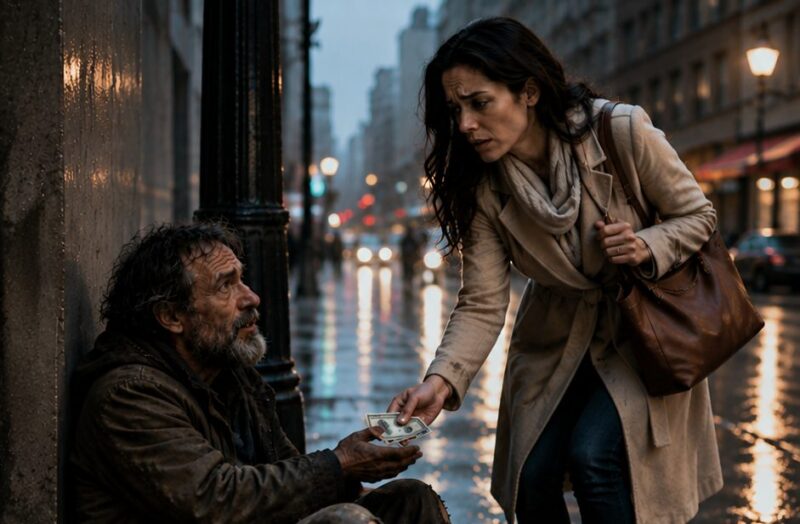
Walter.
It didn’t matter if the city was buried in snow, soaked in rain, or frozen by bitter wind—he was always there. An old backpack rested near his feet, and a worn piece of cardboard lay across his knees.
I’M STILL FIGHTING.
He never begged people for money.
Never shouted at passersby.
Never tried to hold anyone’s attention for more than a second.
He simply sat there quietly, like someone stubbornly refusing to disappear.
At first, he was just another face in the city.
Then I started slowing down when I passed him.
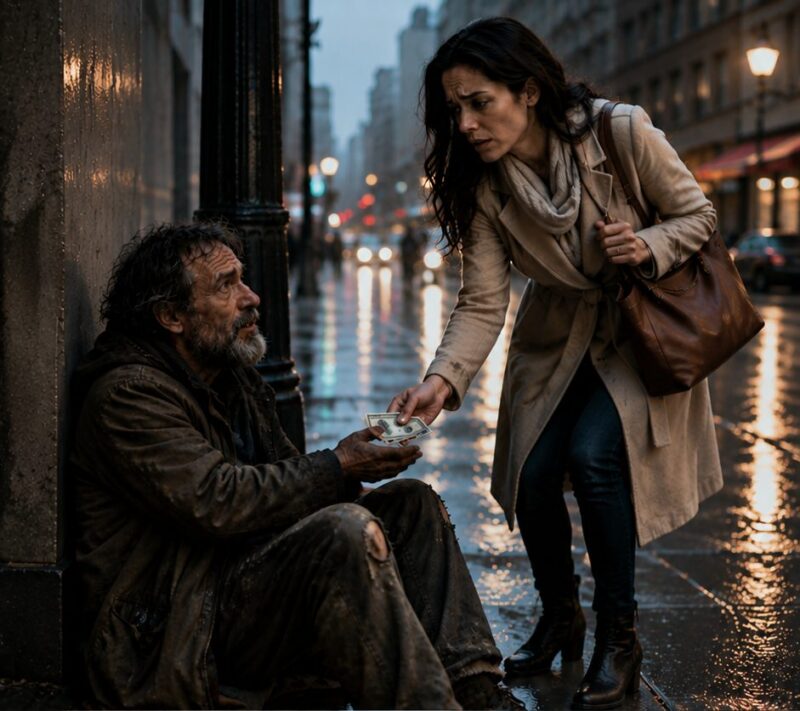
Eventually, I began leaving a few dollars beside him after work.
Walter always answered with the same small nod—quiet, respectful, almost grateful without wanting to show it.
Over time, that silent exchange became part of my life.
We weren’t exactly friends.
But we were no longer strangers either.
Then came the night that changed everything.
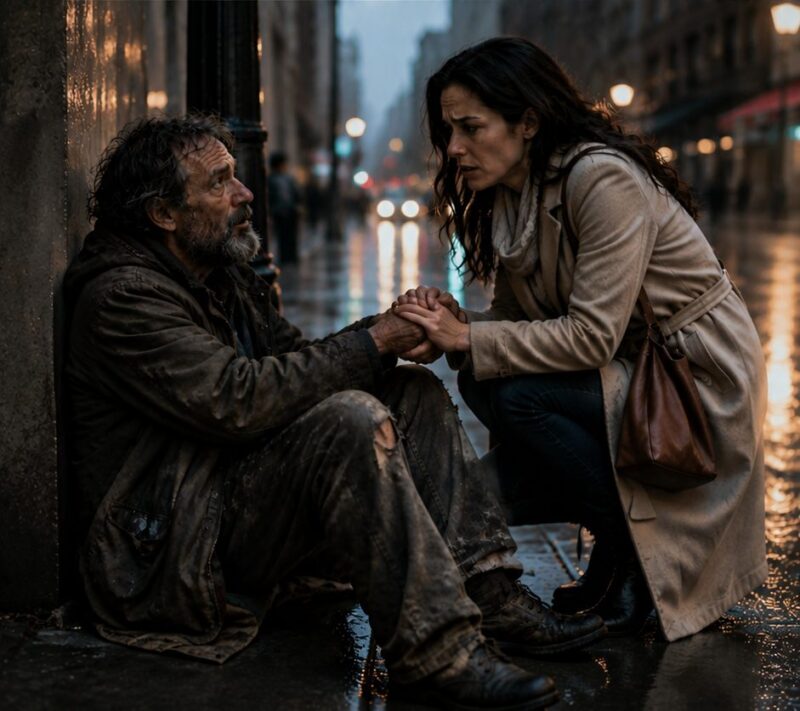
It was early November, cold and wet. I had stayed late at work, and by the time I stepped outside, Boston was already wrapped in darkness. Rain shimmered across the sidewalks while sharp wind cut through my coat.
I approached Walter’s bench, reaching into my pocket for the money I’d brought him.
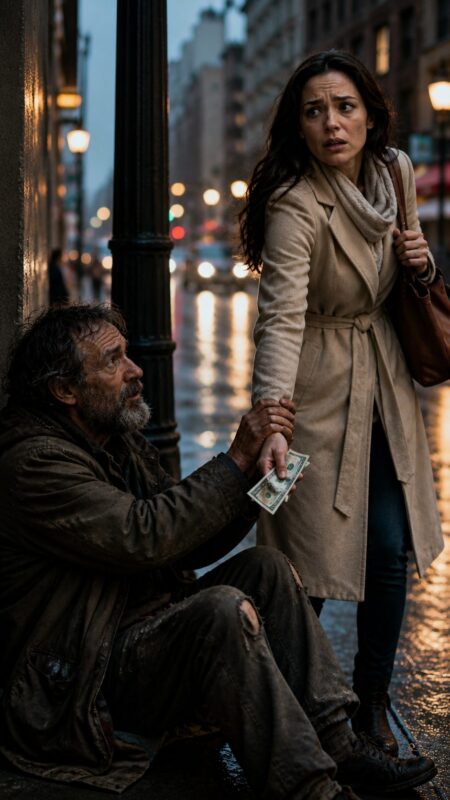
Before I could set it down, he suddenly grabbed my wrist.
Not painfully.
Not aggressively.
Desperately.
“Ma’am,” he said in a rough, quiet voice, “you’ve been too kind to me for me to keep this to myself. Don’t go home tonight.”
I stared at him, certain I had misunderstood.
“What?”
He released my arm immediately and glanced nervously toward the library steps.
“Do not sleep in your house tonight,” he repeated. “Stay somewhere else. Tomorrow… I’ll explain everything.”
Around us, the city continued moving as if nothing had happened.
Cars splashed through puddles.
People hurried by beneath umbrellas.
Someone laughed in the distance.
But suddenly, I felt uneasy.
“Walter,” I asked carefully, “what are you talking about?”
His hand pressed tightly against his coat, hiding something beneath the fabric.
“If I explain it here,” he whispered, “I could make things worse. Just trust me this once.”
And for the first time since I’d known him, I saw real fear in his eyes.
I should have ignored him.
Instead, twenty minutes later, I stood outside my house gripping my keys, unable to unlock the front door.
Everything looked normal.
The porch light glowed softly.
The curtains were still.
The street was quiet.
But Walter’s warning wouldn’t leave my mind.
Don’t go home tonight.
So I turned around.
A few blocks away, above a noisy little bar, I rented a cheap motel room I could barely afford.
I hardly slept.
Every sound in the hallway made my heart race.
By morning, I felt ridiculous.
I convinced myself I’d panicked over nothing.
Until I saw Walter waiting outside the motel.
“You listened,” he said, relief filling his tired face.
I folded my arms.
“Now you tell me what’s going on.”
Without a word, he pulled a plastic sleeve from inside his coat.
Inside was a photograph and an old newspaper clipping.
The moment I saw the photo, my stomach dropped.
Michael stood beside a younger Walter outside a brick apartment building. My husband wore the same crooked smile I hadn’t seen in three years.
Then I looked at the article.
Attempted break-in on my street.
My address.
A suspect searching for documents instead of valuables.
I had never seen the article before.
Walter lowered his voice.
“I used to work maintenance in one of Thomas Greer’s apartment buildings. Your husband was reviewing repair records there. He discovered things he wasn’t supposed to uncover.”
A cold feeling spread through my chest.
“Greer’s company was creating fake safety violations to force people out of their homes,” Walter continued. “When they needed someone to blame, they chose me. Michael protected me.”
I swallowed hard.
“And last night?”
Walter’s face darkened.
“I saw one of Greer’s men outside your house. Same man from years ago. He wasn’t passing through—he was waiting.”
Fear tightened in my chest.
“What does he want?”
Walter looked directly at me.
“Whatever Michael hid before he died.”
He guided me behind the library to an abandoned storage shed hidden between two alleyways.
From beneath a broken shelf, Walter pulled out a small metal box and handed it to me carefully.
“Michael trusted me with this,” he said softly. “He told me that if anything happened to him, I had to make sure it reached you.”
My hands trembled as I opened it.
Inside were folders filled with records.
Lists of names.
Financial files.
A flash drive.
And resting on top of everything… a handwritten note.
Michael’s handwriting.
If you’re reading this, don’t trust the local police.
Go straight to Financial Crimes.
And trust the man who gives you this.
Tears blurred my vision as the truth finally hit me.
Michael’s death had never been an accident.
Someone had wanted him silenced forever.
From that moment on, his death no longer seemed accidental.
What followed happened fast.
As soon as the detectives at headquarters examined the contents of the case, the entire atmosphere changed. Archived reports were pulled from storage. Evidence was rechecked. Surveillance teams were deployed without hesitation.
Walter revealed everything he knew.
No excuses.
No attempts to defend himself.
Just the truth, laid out plainly.
“You made the right call,” the lieutenant told him.
The words were simple.
But after spending three years buried beneath grief and unanswered questions, they felt powerful enough to crack something open inside me.
When we walked back outside into the freezing night air, the city looked unchanged.
The traffic still moved.
The lights still glowed.
People still hurried past without noticing us.
Yet nothing felt familiar anymore.
Walter stood beside me in silence, his shoulders heavy beneath his worn coat.
“I should’ve come to you earlier,” he admitted quietly.
I turned toward him.
The man people avoided looking at.
The man the world had learned to overlook.
“You came when it mattered,” I told him.
He gave a small nod.
For a long time, I believed kindness was made up of tiny things.
A few spare bills.
A passing conversation.
A silent gesture between strangers.
But I understand now that kindness can be far greater than that.
Sometimes it is the hand that pulls you away from danger before it’s too late.
Sometimes it is the forgotten person carrying the truth everyone else ignored, waiting for the right moment to speak.
And as we left the station together, I realized something inside me had begun to change.
It wasn’t peace.
Not completely.
But it was close enough to feel like hope.
And for the first time in years, I no longer felt like I had to carry everything alone.
From that moment on, his death no longer seemed accidental.
What followed happened fast.
As soon as the detectives at headquarters examined the contents of the case, the entire atmosphere changed. Archived reports were pulled from storage. Evidence was rechecked. Surveillance teams were deployed without hesitation.
Walter revealed everything he knew.
No excuses.
No attempts to defend himself.
Just the truth, laid out plainly.
“You made the right call,” the lieutenant told him.
The words were simple.
But after spending three years buried beneath grief and unanswered questions, they felt powerful enough to crack something open inside me.
When we walked back outside into the freezing night air, the city looked unchanged.
The traffic still moved.
The lights still glowed.
People still hurried past without noticing us.
Yet nothing felt familiar anymore.
Walter stood beside me in silence, his shoulders heavy beneath his worn coat.
“I should’ve come to you earlier,” he admitted quietly.
I turned toward him.
The man people avoided looking at.
The man the world had learned to overlook.
“You came when it mattered,” I told him.
He gave a small nod.
For a long time, I believed kindness was made up of tiny things.
A few spare bills.
A passing conversation.
A silent gesture between strangers.
But I understand now that kindness can be far greater than that.
Sometimes it is the hand that pulls you away from danger before it’s too late.
Sometimes it is the forgotten person carrying the truth everyone else ignored, waiting for the right moment to speak.
And as we left the station together, I realized something inside me had begun to change.
It wasn’t peace.
Not completely.
But it was close enough to feel like hope.
And for the first time in years, I no longer felt like I had to carry everything alone.