WHAT HE LEFT BEHIND
Loss doesn’t only take a person—it reshapes the world around them. After Ethan died, our house didn’t just grow quiet; it felt emptied, as if something essential had been pulled out of it. For months, even ordinary sounds seemed distant, while the silence settled heavily in every room.
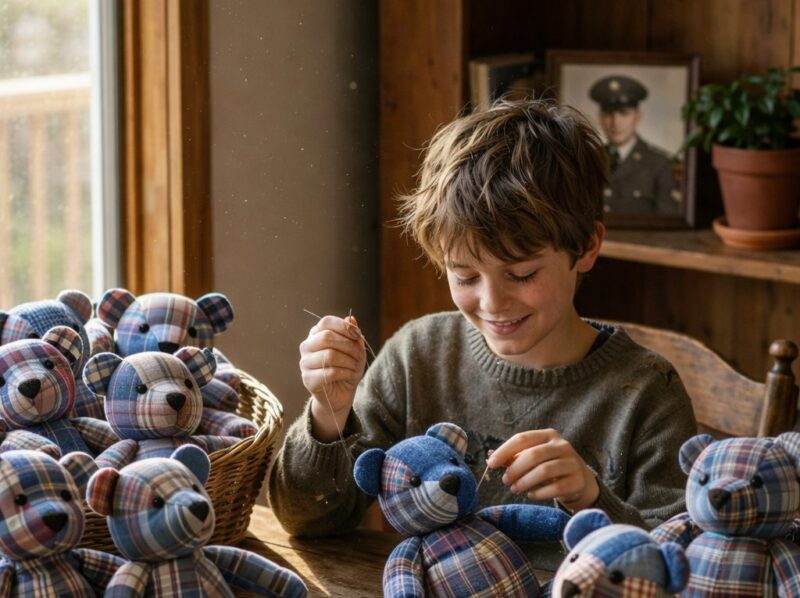
Ethan had worn a badge, but to him it was never about authority—it was about responsibility. He died in the line of duty, protecting others, just as he always had. I once believed the funeral would be the hardest part—the folded flag, the final honors. But the real pain came later, when the visitors left, the food stopped coming, and I was alone with his things and the fading trace of his scent.
From that point on, it was just Mason and me.
At fifteen, Mason had his father’s quiet steadiness but none of his bold presence. While other teenagers immersed themselves in games or sports, Mason turned inward, finding comfort in sewing—a skill I had taught him long ago without much thought.
Others teased him for it. He never argued or defended himself. He simply continued, patient and focused.
A few weeks after Ethan’s passing, I began to notice his clothes disappearing. Shirts, uniforms, pieces he had worn for years. One evening, I found Mason bent over the table, carefully stitching, his face drawn but determined.
“I want him to keep helping people,” he told me quietly.
All winter long, the soft rhythm of the sewing machine filled the house. Slowly, Mason turned those clothes into something new—twenty handmade teddy bears. Each one carried a piece of Ethan: familiar fabrics, worn textures, even the buttons from his shirts. Inside each bear, Mason tucked a small note: “Made with love. You are not alone.”
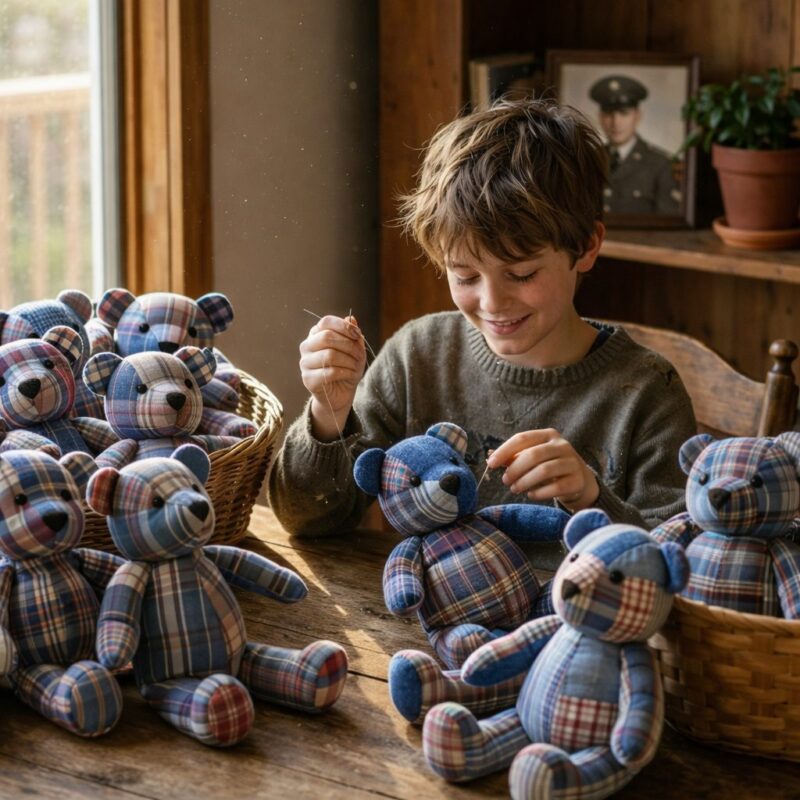
He called them his “Rescue Squad.”
We brought them to a shelter. I watched as Mason handed one to a small girl who had lost everything. In that moment, it became clear—he was continuing his father’s purpose in his own way.
Then, one morning, everything shifted.
Before sunrise, loud knocking echoed through the house. Outside stood deputies and unfamiliar cars. Fear tightened in my chest as I stepped out, bracing for bad news.
But instead of questions or accusations, they opened a trunk.
Inside were sewing machines, fabrics, tools—everything Mason could have dreamed of.
Then a man named Henry stepped forward.
Years earlier, Ethan had saved him from a burning car. Henry had carried that debt ever since, never finding the right moment to repay it. When he saw Mason’s bears at the shelter, he understood—Ethan’s kindness hadn’t ended. It had been passed on.
Henry had created a program in their honor—the *Ethan and Mason Comfort Project*—a space where children in difficult situations could learn to create, to heal, to rebuild. And he wanted Mason to lead it.
He placed a silver thimble in Mason’s hand, engraved with the words: For hands that heal.
That day, the house felt different. Not full of absence, but of purpose. Mason sat at his new machine with a confidence I had never seen before.
As I watched him, I realized something I hadn’t understood until then: Ethan wasn’t gone in the way I had feared.
He lived on—in every act of kindness, in every child comforted, in every stitch Mason made.
Grief hadn’t ended our story. It had simply become the thread that wove something new—stronger, gentler, and full of meaning.
And for the first time, I didn’t just see what we had lost.
I saw who my son was becoming.