When Silence Finally Broke
Light from dozens of crystal chandeliers spilled across the polished marble floor of the Harrington mansion. Soft music played while guests in elegant gowns and black tuxedos filled the enormous ballroom.
Leaders of industry, famous surgeons, politicians, and celebrities had gathered for the same reason: Daniel Harrington’s fortieth birthday. Outside, luxury cars stretched along the driveway like a private exhibition.
The evening was meant to celebrate success.
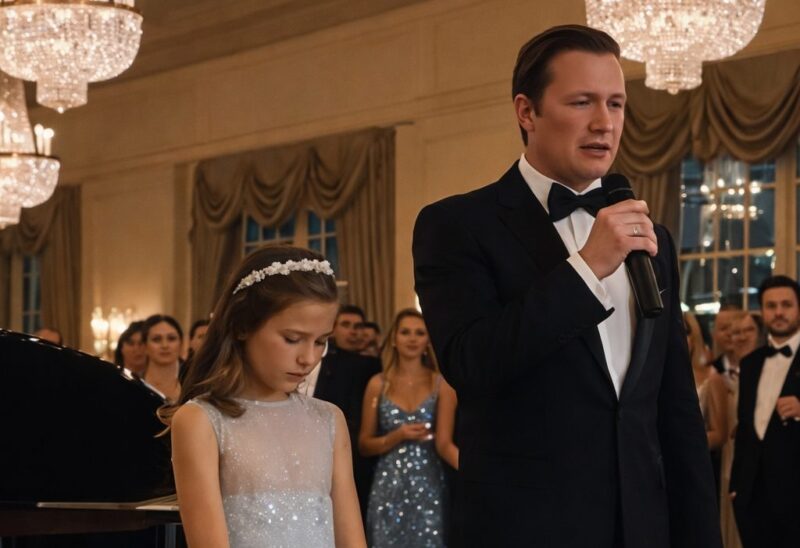
Yet the man at the center of it all looked anything but joyful.
Daniel stood near the stage with a microphone in his hand. His shoulders were tense. At forty years old he had created one of the most powerful technology companies in the country. His fortune was enormous, his reputation global.
But none of that could fix the one thing that mattered most.
Next to him stood his daughter, Emily.
Emily was eight, dressed in a simple white dress decorated with silver stitching. Her curly hair framed a delicate face, and her small hand gripped her father’s tightly. Her eyes were bright and thoughtful.
But her voice had been silent for three years.
When Daniel lifted the microphone, the music stopped and the crowd gradually quieted.
“I know many of you came here tonight expecting a celebration,” he began, his voice unsteady. “But the truth is… I asked you here because I need help.”
People exchanged confused glances.
Daniel looked down at Emily before continuing.
“My daughter hasn’t spoken in three years,” he said. “We’ve visited doctors across the country. Specialists, therapists, every treatment imaginable.” He paused, fighting emotion. “If anyone here can help her speak again, I will pay them one million dollars.”
The announcement sent whispers through the room.
Emily tightened her grip on his hand.
Three years earlier she had been sitting in the back seat of a car when her mother died in a terrible accident. Emily survived without injuries—but from that moment forward, she stopped speaking.
Doctors called it trauma-related selective mutism. Daniel called it grief that had stolen his daughter’s voice.
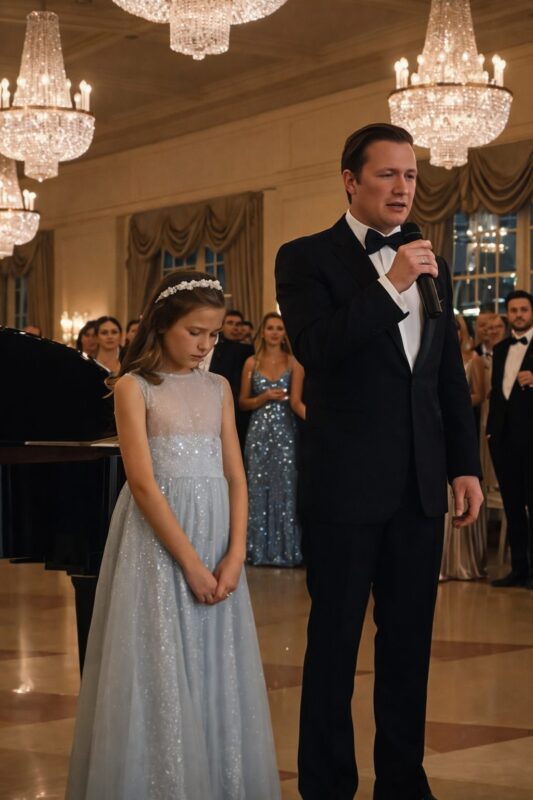
Experts had tried everything. Therapy sessions, medications, creative exercises. Nothing reached her.
Emily communicated with gestures and writing, but the sound of her voice had vanished.
Daniel lowered the microphone.
Silence filled the ballroom.
Then, unexpectedly, a young voice spoke from the back of the room.
“I think I can help her.”
Everyone turned.
Near the entrance stood a skinny boy, perhaps nine years old. His clothes were worn and dusty, and his sneakers were nearly falling apart. He looked completely out of place among the glittering guests.
Security guards quickly approached him.
“Son, you shouldn’t be here,” one said quietly.
But the boy stood his ground.
“I can help her,” he repeated.
Several guests chuckled.
Daniel frowned. “Who allowed this child inside?”
Before anyone could remove him, the boy walked forward.
“I heard what you said,” he told Daniel calmly. “I know how to help her speak.”
Daniel’s patience snapped. “This isn’t the place for jokes.”
But the boy wasn’t looking at Daniel.
He was watching Emily.
Emily was watching him too.
The boy slowly approached until he stood a few steps away. He crouched down so they were eye to eye.
“What’s your name?” he asked softly.
Emily stayed silent.
Daniel sighed. “She hasn’t spoken in years.”
“That’s okay,” the boy replied gently. “She doesn’t have to.”
Emily blinked.
The boy reached into his pocket and pulled out a small toy car, scratched and faded from years of use.
“My mom gave this to me,” he said quietly. “She told me to keep it whenever I felt scared.”
He placed the toy on the floor between them.
“She died two years ago,” he continued. “After that, I stopped talking for a long time. Not because I couldn’t… but because it felt like if I stayed quiet, everything might stay the same.”
The ballroom had grown completely silent.
Emily stared at the toy car.
The boy spoke again, his voice barely louder than a whisper.
“But staying silent doesn’t bring them back. It just keeps us trapped.”
Emily’s fingers tightened around her father’s hand.
“If you say even one word,” the boy said, “it doesn’t mean you forgot your mom. It just means you’re strong enough to keep living.”
Tears filled Daniel’s eyes.
Emily looked at the toy car… then at the boy… then at her father.
Her lips trembled.
For a moment nothing happened.
Then a fragile sound broke the silence.
“Papa.”
Daniel froze.
“Papa.”
This time it was clearer.
Gasps and quiet sobs swept across the ballroom.
Daniel dropped to his knees.
“Emily…” he whispered.
She threw her arms around him.
“Papa.”
When Daniel finally looked up, the boy had stepped back toward the entrance.
“Wait,” Daniel called.
The boy stopped.
“How did you do that?” Daniel asked.
The boy shrugged.
“I just knew how she felt.”
“What’s your name?” Daniel asked.
“Arjun.”
Emily stepped closer and looked at him.
“Friend,” she said softly.
It was the second word she had spoken in three years.
For the first time, Arjun smiled.
Later that night Daniel sat with Emily on the balcony while she quietly tested her voice again.
“Papa.”
“Yes?”
“Mama… proud?”
Daniel kissed her forehead.
“Yes,” he said gently. “She would be very proud.”
That night a billionaire offered a million dollars for a miracle.
But the miracle didn’t come from wealth or medicine.
It came from a child who understood what silence feels like.
And that was worth far more than money.