**When the World Became Too Loud**
Cedar Hollow, Indiana, was the sort of place people passed on the highway without ever learning its name. Years ago, the town had lived and breathed through its paper mill, where steady shifts meant steady lives. Those days were long gone. Now Cedar Hollow was better known for discount stores on every corner and a community clinic that could never quite keep up with the line at its reception desk.
My name is Marissa Cole. I’m forty-three years old, a licensed practical nurse, and I’ve spent almost fifteen years working at Cedar Hollow Community Health. But the most important role in my life is being the mother of my nine-year-old son, Bennett.
Bennett is autistic.
Some days he talks in short, careful sentences. Other days he doesn’t speak at all. What people rarely understand is that he notices everything. He feels deeply, processes the world intensely, and hears sounds most of us barely register. A faint buzz to you or me can feel overwhelming to him.
That Wednesday afternoon in early November, the clinic was packed from wall to wall. Two medical assistants had called in sick, the phones kept ringing, and every chair in the waiting room was filled with exhausted patients.
I hadn’t planned to bring Bennett with me. His therapy appointment had been canceled that morning, and my neighbor—who usually watched him—had car trouble. Canceling my patients would have created weeks of delays, so I packed a small bag: his tablet, his noise-canceling headphones, his weighted vest, and the little rubber dinosaur he carried everywhere.
For the first hour, things went well.
Bennett stayed in the supply room behind the exam halls, curled up in a beanbag chair while watching the same train video he had watched hundreds of times before. Between appointments, I checked on him, brushing the hair from his forehead.
“You’re doing great, buddy,” I told him quietly. “Just a little longer.”
He tapped the dinosaur twice against his knee—his way of saying he heard me.
Then the fluorescent lights flickered.
It was a brief electrical dip, the kind older buildings experience during strong wind. The lights blinked and returned with a sharper buzzing sound.
Most people barely noticed.
Bennett did.
His scream echoed down the hallway before I even saw him. It wasn’t anger. It was fear bursting into sound.
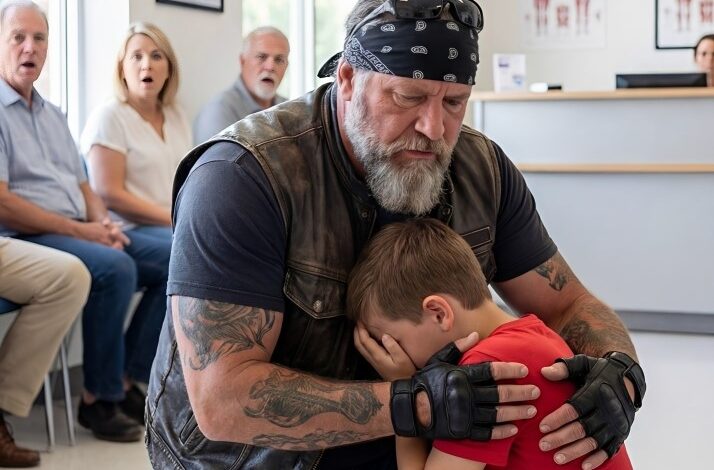
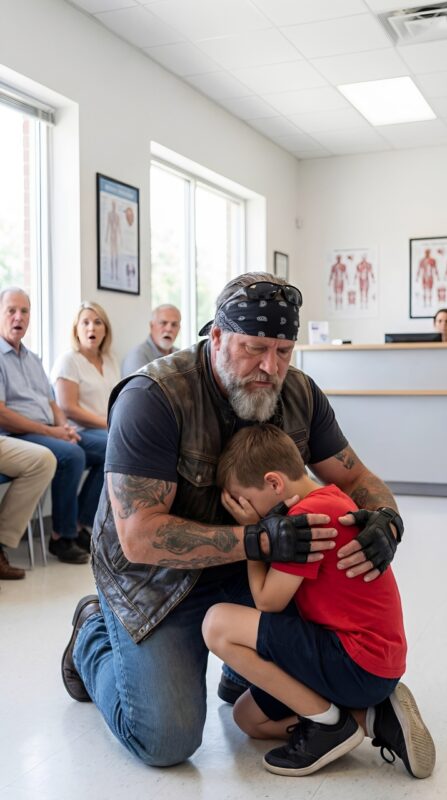
He ran into the waiting room with his hands clamped over his ears. His eyes were unfocused, searching for escape. In the middle of the room he dropped to the floor, curling tightly as his heels struck the tile.
“Bennett!” I rushed to him, dropping my clipboard. “It’s Mom. I’m here. You’re okay.”
But the room was full of noise. The lights hummed. A phone chimed somewhere. A restless toddler began crying.
I tried placing the headphones over his ears. He pushed them away. I laid the weighted vest across his back, but his body twisted harder against the floor.
Then the whispers started.
“Can’t she take him outside?”
“This is ridiculous.”
A man near the window muttered, “Kids like that just need discipline.”
My face burned. I deal with medical emergencies every day without shaking—but nothing prepares you for strangers judging your child while he struggles.
“I’m sorry,” I told the room, though I shouldn’t have needed to apologize.
Across the chairs, a teenager lifted his phone and pointed the camera at us.
Bennett cried again, his small body trembling as he tried to block out the noise surrounding him.
Then the clinic door opened.
The sound that followed was slow and steady—the heavy steps of boots crossing the worn tile floor.
Through blurred eyes I saw an older man standing in the doorway. He looked to be in his late sixties, tall despite a slight curve in his back. His gray hair was tied into a short ponytail, and a weathered leather jacket hung over his shoulders, decorated with carefully stitched patches.
Later I would learn his name was Harold “Hal” Whitaker. A retired Army veteran. A widower. A man living with constant knee pain.
At that moment he simply took in the scene—my son curled on the floor, me kneeling beside him, and a room full of uncomfortable silence.
The office manager hurried over.
“Sir, I’m sorry for the delay. We’re experiencing—”
He gently lifted a hand.
“That boy’s autistic.”
It wasn’t a question.
“Yes,” I said quietly. “I’m sorry for the disturbance.”
He looked directly at me.
“Don’t ever apologize for your child.”
The teenager with the phone scoffed. “Some of us have been waiting.”
Hal ignored him completely. Instead, he walked closer with slow, careful steps, like someone approaching a frightened animal. He leaned his cane against a chair and gave me a small glance that seemed to ask permission.
Then he lowered himself onto the floor beside Bennett.
Flat on his back.
The entire room fell silent.
“What is he doing?” someone whispered.
“Just watch,” Hal murmured.
He began breathing slowly—deep inhale, long exhale. After a moment he started humming softly. It wasn’t quite a melody, just a low, steady vibration.
Bennett’s frantic rocking paused.
Hal kept humming.
Without lifting his head, he said quietly, “Sometimes the best way to help someone is to meet them exactly where they are.”
Bennett turned slightly, his eyes settling on the leather sleeve near his face. His fingers brushed across a stitched flag on the jacket.
Hal spoke gently. “My granddaughter Ruby is ten. The world is too loud for her too.”
My throat tightened. “How did you know what to do?”
“At first I didn’t,” he said calmly. “I kept trying to fix everything. A therapist finally told me something important—kids borrow our calm when they can’t find their own.”
Slowly, Bennett’s breathing softened. His fists loosened. He rolled onto his side, mirroring Hal’s position.
“There you go, buddy,” Hal whispered. “Just let it pass.”
Minutes drifted by quietly.
The teenager lowered his phone.
The man near the window stared at the floor.
Finally Bennett released one last trembling sob and lay still, his cheek resting on the cool tile.
When he sat up, the tension in the room dissolved.
Hal slowly pushed himself to his feet, wincing slightly.
“Thank you,” I said.
He shrugged lightly.
“Everyone carries something heavy,” he replied. “Some of us just carry it louder.”