After spending nine months deployed overseas, I came home expecting peace, a hot shower, and my own bed.
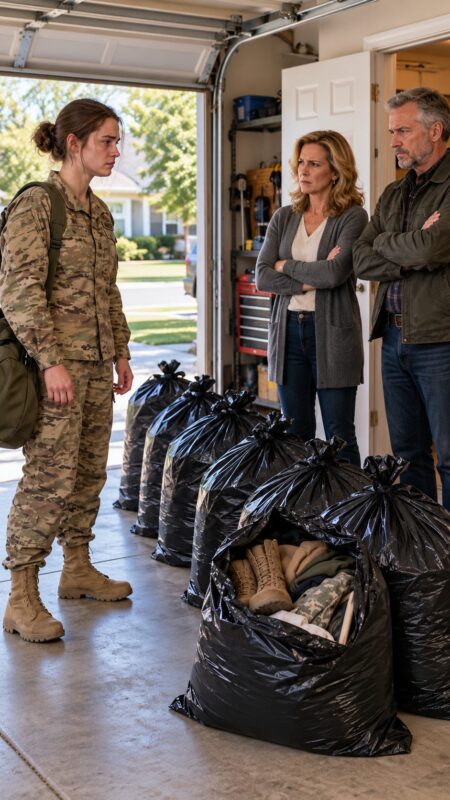
Instead, I found my life packed into black trash bags.
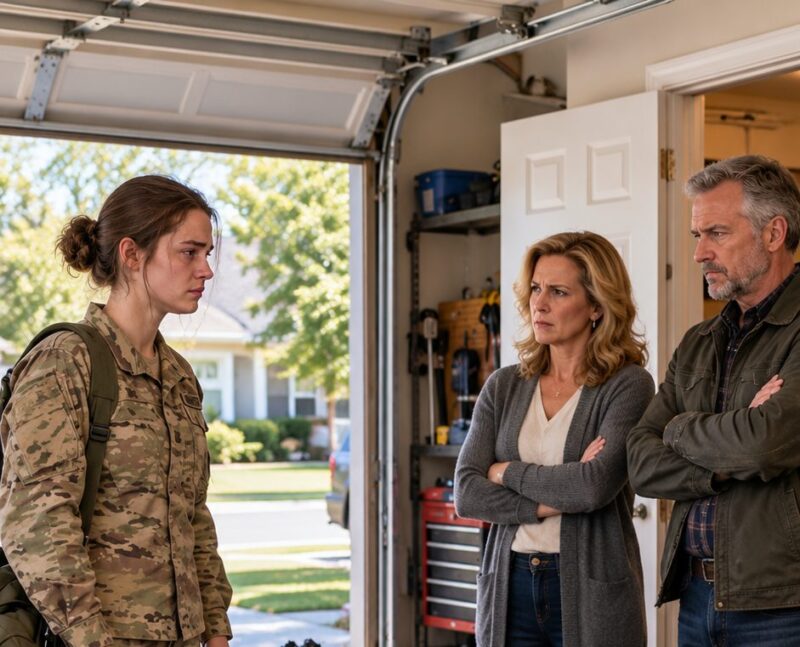
They were stacked along the hallway like someone had been preparing for a move.
Mine.
I turned toward my mother.
Evelyn barely reacted.
“You weren’t supposed to be back yet.”
“I sent you my return date weeks ago.”
She avoided my eyes.
“Plans changed.”
I soon discovered just how much.
My sister Chloe and her husband, Vance, were living in my house.
Not visiting.
Living there.
Chloe had taken over my bedroom, filled my closets with her clothes, and rearranged rooms as though she had owned the property for years.
My parents had even decided where I would sleep.
The unfinished basement.
“If you don’t like it,” Mom said, “you can stay at the barracks.”
I stared at her.
“This is my house.”
“You’re single, sweetheart. What do you need all this space for? Chloe and Vance are trying to build a life together. You should help your sister.”
There was a time when those words would have worked.
I would have argued for ten minutes, felt guilty for twenty, and eventually surrendered.
Not this time.
“Fine,” I said.
Mom smiled, apparently believing she had won.
I carried one of my bags downstairs.
Then I waited until I was alone.
Beneath a concealed section of flooring was a small safe.
I opened it.
The original property documents were exactly where I had left them.
My grandfather had placed the house in a trust for me years earlier. There was no ambiguity about ownership.
The house was mine.
My family had apparently forgotten that.
Or perhaps they were counting on me never reminding them.
Then I opened my banking app.
My stomach dropped.
Forty-five thousand dollars was missing.
Deployment bonuses.
Hazardous-duty pay.
Money I had spent months earning thousands of miles from home.
Gone.
I began following the transactions.
The trail led directly to accounts controlled by my mother.
That discovery was bad enough.
The next one was worse.
Someone had filed a power of attorney granting Evelyn authority over my finances.
My supposed signature appeared at the bottom.
It looked convincing.
But I knew immediately that it was fake.
I had never signed that document.
I kept digging.
Eventually, I found where much of the money had gone.
Vance.
My brother-in-law was an active-duty lieutenant with serious financial problems.
I could have stormed upstairs.
I could have demanded explanations.
Instead, I photographed every page, downloaded every transaction, and made copies.
They had mistaken my silence for weakness before.
I decided to let them make that mistake one more time.
That evening, my backyard was filled with people.
My family had organized a barbecue and invited several officers.
Chloe greeted guests like the lady of the house. Vance stood beside the grill laughing with colleagues. My mother served drinks on my patio.
I watched the performance without interrupting it.
Eventually, Dad approached me.
“We need to talk.”
He led me away from the others.
“There are documents you need to sign tomorrow.”
“What documents?”
“The property transfer.”
I looked at him.
“What property transfer?”
He frowned as though I were being deliberately difficult.
“The house is going to Chloe.”
I almost admired the confidence it took to say that.
“You mean my house?”
“You’re hardly ever here. Chloe needs somewhere permanent to live.”
“And if I say no?”
His expression hardened.
Then his voice dropped.
“You’re up for major soon.”
I waited.
“I still know people in the right places. Careers can become complicated very quickly.”
So that was their plan.
Take my money.
Take my house.
And threaten my career if I objected.
Dad watched me carefully, waiting for fear.
I gave him a smile instead.
“You’re right. The paperwork should be dealt with.”
His shoulders relaxed.
He had no idea what I meant.
The next morning, I walked into JAG carrying a folder thick enough to change several lives.
Captain Morales reviewed the questionable power of attorney, bank statements, transfer records, and copies of the signatures.
Her expression became more serious with every page.
When she finished, she closed the folder.
“This isn’t a private family dispute anymore.”
I already knew that.
A civilian property attorney named Dalton examined the house records next.
Within an hour, he discovered something I hadn’t.
My family wasn’t merely planning to transfer my house.
They were already trying to sell it.
A developer had agreed to pay $650,000.
The agreement contained my signature.
Or rather, an imitation of it.
Someone had forged my name on documents involving my own home.
Dalton acted immediately.
He filed documents challenging the transaction and recorded the trust establishing my ownership.
The sale stopped.
The developer backed away.
That afternoon, Dad called.
He didn’t bother saying hello.
“What have you done?”
I leaned back in my chair.
“Exactly what you asked. I took care of the paperwork.”
When I arrived home, the entire family was waiting.
Mom.
Dad.
Chloe.
Vance.
Apparently, they had already developed another plan.
Since the sale had collapsed, they expected me to use my deployment earnings to cover the financial consequences.
After that, I was still supposed to hand the house over to Chloe.
I listened until Vance stepped toward me.
“This doesn’t need to become a big situation,” he said. “We can keep it between us.”
“Between us?”
“That would be best for everybody.”
I studied him.
“Especially before your command hears about it?”
His face changed instantly.
Nobody spoke.
My mother was the first to recover.
“If you destroy this family over money and a house, then you are no daughter of mine.”
I reached into my pocket.
Her eyes followed my hand.
I raised my phone.
“I hope you meant that.”
Mom stared at the screen.
I had recorded the conversation.
Then I looked around the room.
“You have seven days to get out of my house.”
Dad stepped forward.
“You wouldn’t dare.”
“Six days and twenty-three hours.”
I left before anyone could answer.
The official report was filed shortly afterward.
Vance’s chain of command was notified, and his security clearance was suspended while the allegations were investigated.
Then I opened my banking records again.
For years, I had been quietly paying expenses for my family.
Insurance.
Repairs.
Emergency bills.
Loans that were never repaid.
Those payments stopped.
Every single one.
They wanted independence from me?
They could have it completely.
The next confrontation happened at the brigade ball.
My mother arrived with Dad, Chloe, and Vance.
She apparently believed a public setting would protect them.
Instead, she began telling people that I had abandoned my own family after returning from deployment.
People turned to look.
I could have defended myself.
I could have argued.
Instead, I walked over to the commander and handed him a folder.
The evidence spoke far more clearly than I could.
Bank statements showing the missing $45,000.
The forged power of attorney.
The property documents bearing a false signature.
Records of the attempted $650,000 sale.
And paperwork confirming the investigation.
The commander read in silence.
Then he closed the folder.
Not long afterward, military police approached Vance.
The room became completely quiet as they escorted him out.
Exactly one week after I had returned home, my family arrived at the house again.
This time, they found six black garbage bags arranged neatly on the lawn.
Their belongings were inside.
A sheriff stood nearby with the necessary eviction paperwork.
Dad headed straight for the front door.
“This is my property.”
The sheriff blocked his path.
“No, sir. According to these documents, it isn’t.”
Dad stopped.
My mother looked at me, and for the first time, there was no confidence in her expression.
“We’re family,” she whispered. “Surely we can work something out.”
The irony almost made me laugh.
A week earlier, being family had apparently meant packing my possessions into garbage bags and stealing from me.
Now it meant forgiveness.
“I told you that you had seven days.”
Chloe started crying.
“But where are we supposed to live?”
I looked at my sister.
For most of my life, that question would have immediately become my problem.
I would have searched for apartments.
Found money.
Made phone calls.
Sacrificed something.
Fixed it.
But not anymore.
“I don’t know.”
She stared at me.
And I realized how liberating those three words could be.
I walked into my house and closed the door.
Then I locked it.
That night, I sat alone in the living room.
The rooms were quiet.
For the first time since returning from deployment, the house actually felt like home.
That was when I understood something I should have recognized years earlier.
The betrayal hadn’t begun when $45,000 disappeared from my account.
It hadn’t begun with a forged signature.
And it hadn’t begun when my family tried to sell a house that didn’t belong to them.
It had started much earlier.
It started every time I solved a problem simply because everyone expected me to.
Every time I paid someone else’s bill to avoid an argument.
Every time I changed my plans to make someone else’s life easier.
Every time I swallowed my anger because I thought keeping the family together mattered more than being treated with respect.
Without realizing it, I had created a pattern.
They created the problems.
I absorbed the consequences.
Eventually, they stopped seeing my generosity as generosity.
They saw it as an obligation.
And I had allowed that to happen.
For years, I thought being the person everyone depended on meant I mattered to them.
Coming home taught me otherwise.
Being useful to someone does not automatically mean they value you.
Being related to someone does not give them unlimited access to your money, your property, or your life.
And loving people does not require protecting them from every consequence of their own choices.
I couldn’t decide whether my family would ever understand that.
But I could decide what happened next.
Nine months overseas had tested me in countless ways.
Yet the lesson that changed me most was waiting at home.
It was sitting in my hallway inside a pile of black garbage bags.
That was the day I stopped being my family’s solution to every problem.
I stopped paying for peace with pieces of my own life.
I stopped confusing sacrifice with love.
And when I finally stood up for what belonged to me, I realized I was protecting more than a bank account or a house.
For the first time in years, I was protecting myself.