Exactly one week after I laid my husband to rest, my son arrived at my house with an unexpected favor.
Except he didn’t present it as a favor.
He presented it as a decision already made.
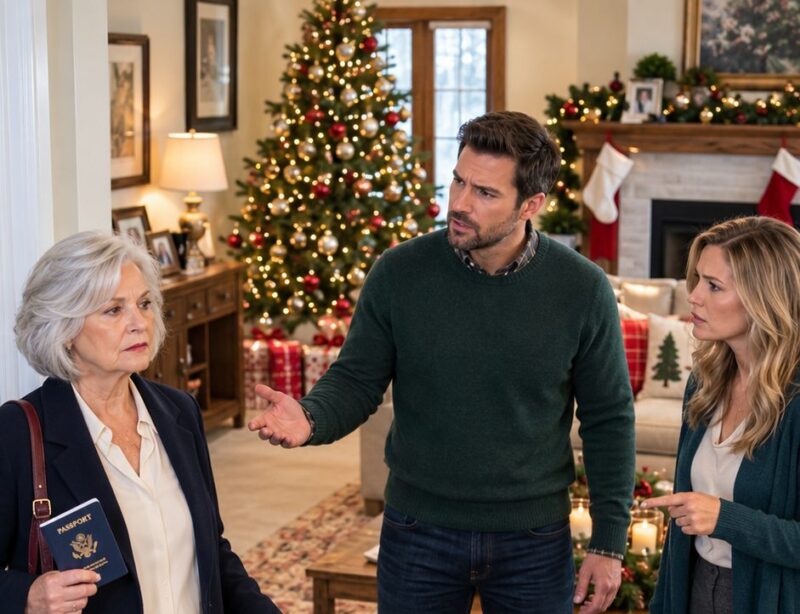
While Austin and his wife, Chloe, escaped to the Bahamas, I would be responsible for their pets.
What neither of them knew was that I had already planned an escape of my own.
And mine involved an ocean liner.
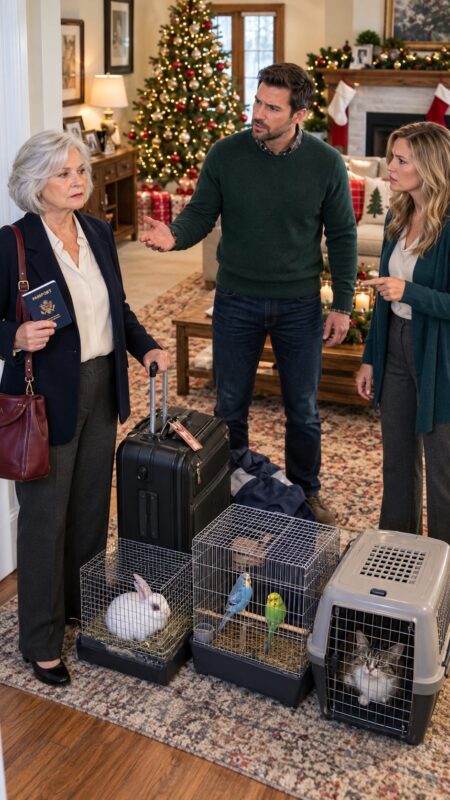
The house still carried the heavy fragrance of flowers left behind after Ernest’s funeral when Austin and Chloe walked in. Chloe offered little more than a distracted hello before placing the animals near the table holding my husband’s photograph.
Two parakeets, a rabbit, and a nervous cat.
Then she handed me a page covered with instructions.
“The birds need fresh water morning and evening. Don’t feed lettuce to the rabbit. The cat stays inside. And please keep everything clean.”
I looked from the paper to her face.
“You do remember that Ernest died seven days ago?”
Chloe’s expression barely changed.
“We all have things we’re dealing with, Theresa.”
Austin leaned against the doorway.
“Besides, Mom, you’re going to be here by yourself. They’ll keep you busy.”
I expected anger to rise inside me.
Instead, I felt an extraordinary sense of clarity.
For most of my adult life, I had been the person everyone depended on.
Need money? Call Theresa.
Need a babysitter? Call Theresa.
Need dinner, a ride, a nurse, or someone to clean up a disaster?
Call Theresa.
When Austin was unemployed, I helped keep him afloat. When Chloe became a mother, I rearranged my life to help with their baby.
Even while Ernest’s health was failing, my family continued treating my time and energy as unlimited resources.
And at my husband’s funeral, Austin hadn’t asked whether I was sleeping or eating or managing to get through the day.
He had asked what I planned to do with the property.
That memory made my decision surprisingly easy.
“Fine,” I said. “Leave the pets.”
Austin smiled and kissed my forehead.
“That’s why we can always depend on you.”
I watched them drive away.
Then I walked upstairs and opened my closet.
My blue suitcase was already waiting.
Before sunrise the next morning, I arranged for a neighbor’s nephew to take the animals and care for them properly.
Then I finished packing.
Passport.
Clothes.
Ernest’s photograph.
And one very important folder from my attorney.
On the kitchen table, I left Austin a short message.
“When you come back, don’t waste your time calling me. Call your lawyer.”
At 5:30 a.m., I was headed for the Port of Miami.
The calls started before I arrived.
First Chloe.
Then Austin.
Then Chloe again.
I ignored them all.
A text finally appeared.
“Mom, what is going on? Someone from the court came here. They’re saying we have no claim to the house.”
I stared at the message and smiled.
Austin had spent years imagining the house as his future property.
He had never bothered to ask whether Ernest and I had other plans.
Three years earlier, while my husband was still well enough to make important decisions, we had placed the house and several other assets in a protected trust.
Ernest had seen what I kept making excuses for.
Our son had begun looking at us less like parents and more like an inheritance waiting to happen.
When Austin called again, I finally answered.
“Where are you?” he snapped.
“On my way to a vacation.”
“What? You can’t disappear now! What are we supposed to do?”
For a second, I almost laughed.
A week after I buried my husband, they had walked into my home, handed me their responsibilities, and flown away without the slightest concern for how I was coping.
Yet somehow, I was the one abandoning them.
“The house wasn’t taken away from you, Austin,” I said. “It was never yours in the first place.”
Silence.
Then his voice softened.
“Mom, please.”
Please.
Such a small word.
And one I had heard far too rarely.
But it no longer had the power to make me abandon myself.
“I have to go.”
I ended the call.
An hour later, I stepped aboard the ship, carrying a single suitcase.
Then I switched off my phone.
When I turned it back on three days later, forty-three missed calls appeared on the screen.
My attorney had also contacted me.
Everything was exactly as Ernest and I had arranged it. Austin and Chloe had no ownership rights to the house.
For once, someone else’s emergency did not automatically become mine.
So I kept traveling.
The Caribbean passed outside my window, followed eventually by Europe.
I painted terrible watercolors and loved every minute of it. I took dance lessons on deck despite having two left feet. I learned that eating breakfast alone could feel peaceful rather than sad.
I also met strangers who asked me questions I hadn’t heard in years.
What did I enjoy?
Where did I want to go?
What made me happy?
Nobody asked what I could do for them.
Two months later, Austin called again.
His voice sounded different.
“I went to Dad’s grave yesterday.”
I waited.
“I told him I was sorry.”
Another pause.
“And I’m sorry for how I treated you. Somewhere along the way, I started acting like being my mother meant you were supposed to solve every problem I had.”
There had been a time when I desperately wanted to hear him admit that.
But apologies, I had learned, mattered most when behavior changed with them.
“I hope you truly understand that,” I said.
“I think I finally do.”
Then he asked the question I knew was coming.
“When are you coming home?”
I looked across the water.
“I’m not ready yet.”
“Mom…”
“I love you. That hasn’t changed. But my love for you cannot require me to disappear from my own life.”
Six months after leaving Miami, I returned.
But I didn’t return to my old existence.
I sold the house.
Then I bought a modest cottage close to the water, with a small garden, a sunny porch, and a special place for Ernest’s photograph.
It felt like mine.
Not because of paperwork.
Because I had chosen it.
One Sunday, there was a knock at the door.
Austin stood on the porch alone, holding a small box.
Inside was a pair of earrings that looked almost identical to a pair I had sold years before when Ernest’s medical expenses became overwhelming.
Austin lowered his eyes.
“I know these don’t replace what you gave up,” he said. “Nothing can. But I want you to know something.”
I waited.
“I don’t expect you to carry me anymore.”
For several seconds, neither of us spoke.
Then I opened the door wider.
“Would you like to stay for dinner?”
His face brightened.
“You mean it?”
“I do.”
I pointed toward the kitchen.
“But the dishes are yours.”
Austin laughed.
So did I.
That night, after he had gone, I sat on my porch beneath a sky scattered with stars.
Ernest’s photograph rested on the little table beside me.
For years, I had believed that being indispensable meant being loved.
I knew better now.
Love doesn’t consume everything you have.
It respects boundaries.
It allows you to rest without making you feel guilty.
And it never requires you to erase yourself for someone else’s comfort.
Sometimes love means helping.
Sometimes it means forgiving.
And sometimes it means finally saying, “No.”
People assumed losing Ernest had taken away the center of my life.
In a way, it had.
But grief had also forced me to see something I had ignored for decades.
I was still here.
I still had dreams.
I still had choices.
And after spending most of my life making sure everyone else had what they needed, I finally understood that choosing myself wasn’t selfish.
It was long overdue.
My life had always belonged to me.
I had simply forgotten.
Now I remembered.