“So my seven-year-old daughter can’t come to your wedding because you’re afraid she won’t look good in the photos?”
Alyssa laughed as if I had asked something ridiculous.

Beside me, Lily stood silently in her blue dress, holding my hand tighter than usual.
That small squeeze kept me from saying everything I wanted to say.
Instead, I looked at my sister.
“You know, weddings reveal a lot more about people than photographs ever will.”
Alyssa rolled her eyes.
But this hadn’t started that day.
Weeks earlier, Mom had called to tell me that Alyssa and her fiancé, Blake, were planning an elegant, adults-only ceremony.
“No children,” she explained. “Alyssa wants everything sophisticated.”
I could respect a child-free wedding.
What I couldn’t respect was the truth that came out later.
After enough questions, Mom finally admitted it.
“It’s mostly about Lily. Alyssa is worried she might look awkward in the pictures.”
I thought I had heard her wrong.
“Lily?”
Mom went quiet.
That was answer enough.
So I contacted Alyssa myself.
“Just to be clear, is this really a child-free wedding, or is Lily specifically the problem?”
Her reply arrived almost instantly.
“I don’t need a moody kid making faces and ruining expensive photos. Stop taking everything personally.”
I read the message twice.
Then I put my phone down.
Forty-eight hours later, Alyssa suddenly remembered that I was her brother.
Apparently, the wedding of her dreams had one major problem.
Money.
She and Blake were about $80,000 short.
Her solution?
I should co-sign the loan.
I didn’t give her a speech.
I didn’t mention Lily.
I simply replied:
“No.”
That one word triggered an entire family campaign.
My phone filled with messages.
“Alyssa is your sister.”
“You should support her.”
“Family doesn’t abandon family.”
“It’s only paperwork, Jordan.”
Interesting.
When Lily was excluded, nobody had much to say about family loyalty.
But when Alyssa needed my financial history and signature, suddenly family became sacred.
A few days later, Mom invited Lily and me to a “family dinner.”
I should have known better.
The moment we walked inside, I saw a decorated box on the table.
Relatives were dropping checks into it.
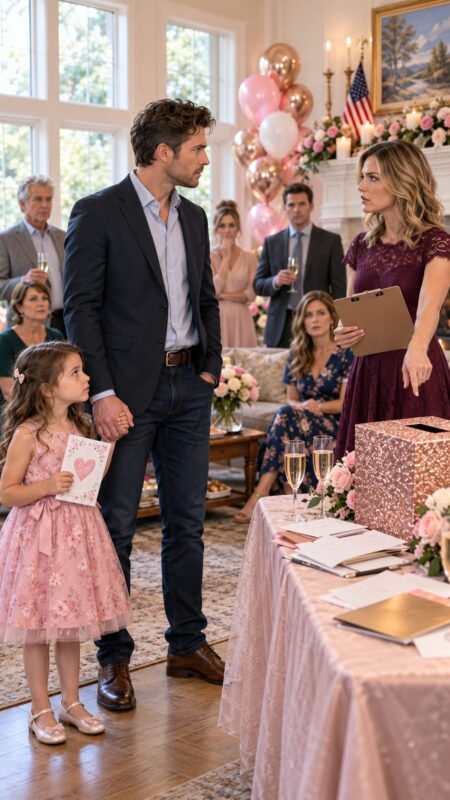
This wasn’t dinner.
It was a fundraising event disguised as one.
Alyssa walked over as though my contribution had already been decided.
“Dad said we could count on you for ten.”
“Ten?”
“Ten thousand.”
She said it as casually as if she were asking me to pass the salt.
Then I noticed Lily watching us.
Something became very clear.
For years, I had overlooked Alyssa’s behavior because confronting her always created drama. I had convinced myself that silence was the mature choice.
But Lily was learning from everything I tolerated.
If I stayed, she would learn that people could insult her and still expect her father to reward them afterward.
I wasn’t going to teach her that.
I bent down.
“Want to go get out of here?”
She nodded immediately.
Mom hurried toward us.
“Jordan, please don’t humiliate your sister in front of everyone.”
I straightened.
“I’m not the person who should be worried about humiliation.”
Then Lily and I walked out.
By breakfast the next morning, my mother had apparently become the family press secretary.
Her version was simple:
Jordan refused to help his sister.
Jordan was bitter.
Jordan had chosen not to attend the wedding.
Missing from the story were the $80,000 loan, the additional $10,000 request, and the fact that my daughter had been deliberately excluded.
Then Alyssa crossed another line.
She posted Lily’s photograph online.
The caption implied that Lily had a father who didn’t believe in happy endings.
That was when I stopped explaining myself.
People determined to misunderstand you rarely become reasonable because you provide them with more words.
So I watched instead.
Alyssa posted nearly every detail of her wedding preparations online.
Flowers.
Menus.
Photographers.
Decorations.
The venue.
Deposits.
And, without realizing it, payment deadlines.
The picture she presented online was flawless.
The finances behind it weren’t.
Vendors were still waiting for payments. Extensions had already been granted. The entire celebration seemed to depend on money Alyssa didn’t actually have.
Then Mom and Dad stepped in again.
They gave her $80,000 despite being in no position to comfortably lose that kind of money.
Alyssa proudly posted a photograph of the check.
Her caption read:
“Guess family came through after all.”
I stared at those words for a long time.
Then I finally understood why nothing ever changed with my sister.
Consequences had never been permanent for Alyssa.
Someone always stepped in.
Someone paid.
Someone apologized first.
Someone cleaned up the mess.
She had spent years learning that if she waited long enough, somebody else would absorb the cost of her choices.
This time, I refused to be that person.
I contacted Rockville Gardens and spoke with the wedding coordinator.
I didn’t ask them to cancel anything.
I didn’t threaten anyone.
I simply suggested that they verify the financial documents connected to the reservation.
The rest was between Alyssa and the venue.
Three weeks before the ceremony, I received an email.
Several required payments had not been made.
The account had undergone review.
The reservation had been canceled.
Minutes later, my phone started vibrating across the kitchen table.
Alyssa.
Mom.
Dad.
Alyssa again.
I let it ring.
Across from me, Lily was decorating her lunchbox with glow-in-the-dark stars.
She carefully pressed the final one into place and smiled.
“Perfect.”
I looked at her.
Perfect.
That was the word Alyssa had built her entire wedding around.
The perfect venue.
The perfect flowers.
The perfect dress.
The perfect photographs.
And somehow, achieving that perfection required removing a seven-year-old child from the frame.
Lily glanced at my buzzing phone.
“Is Aunt Alyssa angry?”
“I imagine she is.”
“Because we’re not coming?”
I paused.
“The wedding isn’t happening at that place anymore.”
Her smile disappeared.
“Did I make that happen?”
I was beside her before she could look away.
“No.”
“But Aunt Alyssa said I mess up pictures.”
There are sentences children say that stay with you forever.
That was one of them.
I opened the photo gallery on my phone.
First, I showed her a picture of herself grinning with two missing front teeth.
Then one where pancake batter covered her nose and cheeks.
Another showed her asleep sideways on the couch with her hair tangled everywhere.
In another, she had paired a princess dress with bright rain boots.
I handed her the phone.
“Which of these did you ruin?”
She scrolled slowly.
“None of them.”
“Correct.”
Then I found the photograph I loved most.
It was from a day at the beach.
The wind had destroyed Lily’s hair. My shirt was wrinkled. Neither of us was facing the camera properly.
We were laughing too hard to care.
“This one is my favorite.”
Lily looked confused.
“But it’s messy.”
“That’s why I love it.”
“Why?”
“Because when I look at it, I don’t remember whether our clothes looked good. I remember how happy we were.”
She leaned against me.
That was enough.
A few weeks later, Alyssa and Blake got married at the courthouse.
Lily and I stayed home.
I wasn’t trying to punish my sister.
I simply no longer believed that an apology—or a family connection—automatically entitled someone to return to exactly the same place in your life.
Forgiveness and trust are not identical.
My parents eventually understood that too.
They apologized for focusing so much on saving Alyssa from disappointment that they had ignored what their granddaughter was feeling.
I accepted their apology.
But trust returned slowly.
Alyssa took even longer.
Several months later, a letter arrived for Lily.
It was from her aunt.
I told Lily she could read it if she wanted to.
She did.
When she finished, she folded the letter, placed it on the table, and looked at me.
“Can we go get ice cream?”
“Definitely.”
We were halfway to the door when she reached for my hand.
“Dad?”
“What?”
“If I get married when I’m grown up, can children come?”
“Absolutely.”
“All of them?”
“As many as you want.”
She grinned.
“What if they make silly faces when someone takes pictures?”
I squeezed her hand.
“Then those will probably be the best pictures.”
Lily laughed as we walked outside.
And suddenly, the whole mess seemed strangely simple.
Alyssa had spent thousands of dollars trying to manufacture a flawless day.
But perfection had never been the thing worth protecting.
People were.
Photographs eventually fade.
Flowers wilt.
Expensive decorations get packed away.
But children remember how adults made them feel.
And no child should ever be taught that they need to become quieter, prettier, easier, or smaller just to deserve a place beside the people who claim to love them.
The best family photograph isn’t the one where everyone looks perfect.
It’s the one where nobody had to wonder whether they belonged.