After Seven Months on a Classified Military Assignment, I Returned to Find My Wife in Intensive Care. Her Mother’s Strange Behavior Raised My Suspicions—Until a Detective Revealed the Terrifying Truth About Her Family.
“Captain Mercer, you need to be extremely careful. Around here, the Dawson family has more influence than you can imagine.”
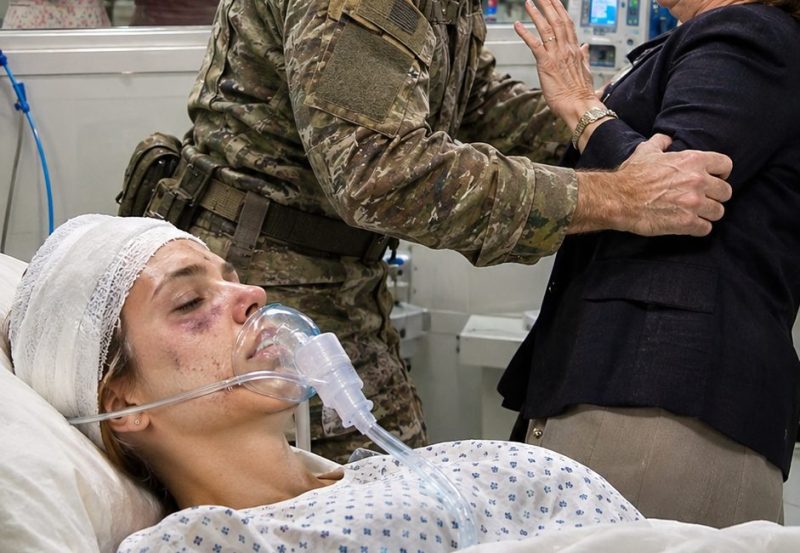
Detective Craig Dalton’s warning was the last thing I expected to hear upon returning home.
For seven months, I had dreamed about reuniting with my wife, Tessa. Instead, an emergency phone call sent me rushing to Mercy Crest Medical Center.
She had been seriously injured in an attack, and doctors were fighting to stabilize her condition.
Dr. Gallagher explained that Tessa remained unconscious and required intensive medical support.
As I approached her room, I encountered a scene that immediately unsettled me.
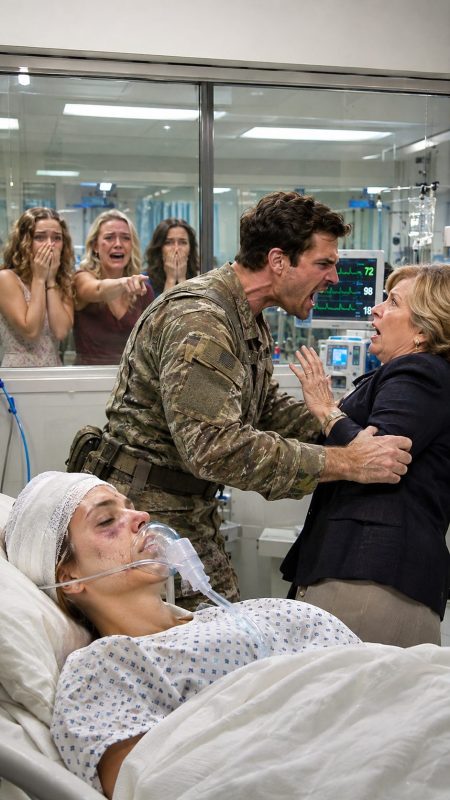
Her mother, Margaret Dawson, and her six sisters had gathered outside the ICU. Yet several of them appeared remarkably unconcerned about Tessa’s condition.
Margaret was no ordinary businesswoman. As the head of Dawson Aviation Systems, a prominent military defense contractor, she possessed considerable wealth and influential connections across Virginia.
Detective Dalton explained that the authorities were treating the incident as a suspected burglary.
“Was anything taken from our house?” I asked.
He avoided answering directly.
Instead, he shared an unusual discovery: Tessa’s relatives had arrived at the medical center before the ambulance.
Before I could question him further, Margaret interrupted.
“Wyatt, I’ll be taking responsibility for Tessa’s medical affairs.”
“That’s not a decision you get to make on your own,” I replied.
Standing behind her was Molly, the youngest of Tessa’s sisters. She looked uncomfortable and refused to meet my eyes.
I couldn’t shake the feeling that she knew something.
That evening, a nurse discreetly informed me that Margaret was attempting to transfer Tessa to a private healthcare facility affiliated with the Dawson Foundation.
Concerned about my wife’s welfare, I immediately contacted an attorney.
Later, I returned to our farmhouse, where my neighbor, Hank Miller, approached me with an unexpected revelation.
“Your wife left something with me before all this happened.”
He explained that he had noticed suspicious activity around our property on the night of the attack and that Molly had subsequently called for emergency assistance.
Then he handed me an envelope Tessa had entrusted to him several weeks earlier.
It contained a safe-deposit box key, a photograph of a helicopter component, and a handwritten message expressing concerns about her family’s company.
Clearly, my wife had been keeping a significant secret.
The following morning, federal agent Bryce Campbell confirmed my suspicions.
“Tessa has been assisting our investigation for four months,” he told me.
Dawson Aviation Systems was suspected of falsifying safety certification records for military aircraft.
Investigators had also established a connection between defective equipment and a devastating training accident that had claimed the lives of four soldiers from my unit.
The revelation left me speechless.
While I had been serving overseas, my wife had been working to expose misconduct within one of the country’s influential defense contractors.
And the person potentially responsible was someone she had trusted for most of her life.
When I returned to the hospital, Margaret presented documents claiming that Tessa had filed for divorce and authorized her mother to oversee her medical treatment.
Fortunately, my friend Garrett Shaw, an experienced military prosecutor, helped identify discrepancies in the documents. My attorney immediately challenged their validity.
Following a subsequent security concern at the medical center, federal authorities arranged protection for Tessa.
Several evenings later, an unexpected visitor arrived at my farmhouse.
It was Molly.
“I can’t live with this anymore,” she confessed, struggling to compose herself. “Margaret was behind what happened to Tessa.”
Then she disclosed something even more astonishing.
Margaret was actually Tessa’s stepmother.
Her biological mother, Evelyn Ross, had been one of the founding figures behind Dawson Aviation Systems.
After Evelyn’s death, Margaret married Tessa’s father and gradually established control over the business.
However, Tessa’s father had included an extraordinary condition in his will.
On her thirty-fifth birthday, Tessa would inherit fifty-one percent of the company’s voting shares, giving her majority control of Dawson Aviation.
That birthday was just nine days away.
Margaret was about to lose the authority she had spent decades accumulating. Tessa’s investigation also threatened to expose the company’s history of misconduct.
Molly agreed to provide a formal statement and cooperate fully with federal authorities.
Meanwhile, investigators gained lawful access to the evidence Tessa had preserved in her safe-deposit box.
The documents included confidential engineering reports, corporate correspondence, and records implicating Margaret in the company’s falsified safety certifications.
As the investigation intensified, Margaret contacted me and proposed a private meeting.
Her offer was astonishing.
“Twenty million dollars, Wyatt. Walk away from this, surrender the evidence, and you’ll never have to worry about money again.”
I looked at the woman who believed every problem could be solved with a financial transaction.
“What about the soldiers who never returned to their families? What price have you placed on their lives?”
Her response confirmed how little she understood the consequences of her actions.
Not long afterward, federal agents arrested her.
Another of Tessa’s sisters, Brooke, had independently agreed to assist the investigation.
Over the following months, Margaret, several company executives, and others implicated in the attack faced criminal charges.
The affected aircraft components were removed from service, and federal authorities implemented measures to address the company’s safety violations.
For the families affected by Dawson Aviation’s misconduct, accountability was finally within reach.
But my attention remained focused on a single hospital room.
Two weeks after Margaret’s arrest, I was sitting beside Tessa when I noticed her eyes opening.
She looked around before recognizing me.
“Wyatt?”
I took her hand.
“I’m here. You’re safe.”
Hearing her voice again meant more to me than any announcement about the investigation.
The months that followed were filled with medical appointments, rehabilitation, and gradual progress.
Tessa approached her recovery with remarkable determination, celebrating each milestone as she regained her independence.
After recovering sufficiently, she assumed leadership of Dawson Aviation Systems.
Under her direction, the company introduced independent safety audits, stronger accountability measures, and comprehensive reforms designed to protect military personnel.
She also established assistance programs for injured veterans and families affected by military accidents.
A year after returning from overseas, I retired from the Army.
Tessa and I began appreciating the ordinary moments we had once taken for granted: breakfast together, peaceful evenings on the porch, and long conversations about the future.
Margaret had devoted her life to accumulating wealth and influence, convinced that money could protect her from the consequences of her decisions.
She had underestimated Tessa’s integrity and her determination to defend the truth.
My wife could have inherited a fortune and remained silent about the company’s misconduct. Instead, she chose accountability, compassion, and responsibility.
People sometimes ask whether bringing down one of Virginia’s most influential families was my greatest accomplishment.
My answer never changes.
The most meaningful moment of my life wasn’t watching Margaret face justice or seeing her corporate empire undergo reform.
It was standing beside our farmhouse door as Tessa returned home, ready to begin a new chapter.
After years of military service, I finally understood that the victories that matter most aren’t always celebrated with medals or public recognition.
Sometimes, the greatest victory is simply having another tomorrow with the person you love.