My Daughter’s Boyfriend Disappeared During Her Cancer Treatment. Weeks Later, He Walked Into Prom Wearing a Purple Gown With His Head Shaved—and Left Everyone Speechless.
“What kind of person would do something like this?”
My husband, Mark, stared furiously toward the entrance of the school ballroom.
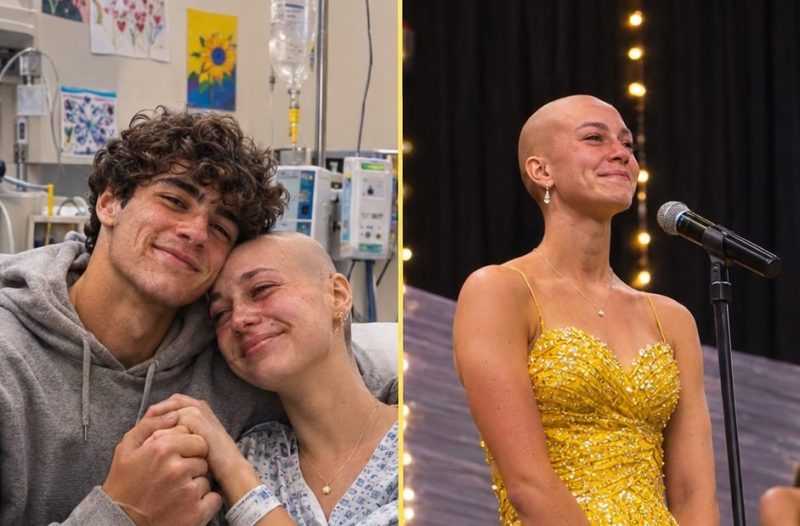
Standing beneath the decorative lights was Nate, the boy we believed had broken our seventeen-year-old daughter’s heart.
He was wearing a shimmering purple dress, and his once-thick hair was completely gone.
Several students burst into laughter. Others immediately reached for their phones.
I glanced at Olivia, desperately wondering how she would react.
After everything she had endured, the last thing she needed was another humiliating experience.
Before either of us could intervene, Nate approached the stage and picked up the microphone.
“I know what everyone’s been saying about me,” he announced. “You think I walked away because Olivia got cancer.”
He swallowed nervously.
“But you’ve only heard one side of the story.”
Olivia stiffened.
“Please, Nate. Don’t do this!”
He lowered his eyes briefly.
“I didn’t leave her. Olivia ended things with me, and I promised to keep her reasons private.”
An uncomfortable silence swept through the ballroom.
Until three months earlier, our daughter had been counting down the days until graduation. She and Nate had been inseparable for nearly two years, and their upcoming prom was supposed to be one of their favorite memories.
Olivia had already purchased a blue evening gown when a medical appointment turned our family’s world upside down.
She was diagnosed with lymphoma.
Suddenly, conversations about graduation parties and summer vacations were replaced by hospital appointments and treatment schedules.
Chemotherapy left Olivia exhausted, and eventually, she lost her hair.
Throughout those difficult weeks, Nate rarely left her side.
He helped her keep up with schoolwork, brought her favorite treats, and found countless ways to brighten her afternoons.
Unfortunately, his determination to protect her gradually became overwhelming.
He stopped attending social gatherings, abandoned his hobbies, and rearranged his entire schedule around Olivia’s treatment.
Even when she felt well enough to go outside, he discouraged her from doing anything he considered exhausting.
Eventually, she confronted him.
“I need you to remember that I’m still a person, Nate. My illness doesn’t give you the right to decide everything for me.”
Their disagreements became increasingly frequent until their relationship finally ended.
When Olivia told us that Nate had given up on her, Mark and I felt betrayed. We couldn’t understand how someone who had once seemed so devoted could disappear during such a difficult chapter of her life.
Then, several days before prom, Olivia entered the kitchen with an unexpected announcement.
“I’ve decided I’m going,” she said. “I’m wearing my blue dress, and I’m leaving the wig at home.”
I supported her decision without hesitation.
On prom night, she walked into the ballroom determined to enjoy herself.
Then Nate arrived, bringing with him a truth none of us had anticipated.
After hearing his announcement, Olivia rushed into the corridor. I found her sitting on a bench near the entrance, wiping away tears.
“I couldn’t watch him lose himself anymore, Mom,” she confessed.
“He was missing out on everything because he was so worried about me. I wanted him to have his own life again.”
She admitted that she had lied about her feelings, telling Nate she no longer wanted to be with him.
She thought pushing him away would free him from the pressure he had placed upon himself.
Instead, his absence left her feeling lonely and confused.
“I thought I was doing the right thing,” she whispered. “But I never expected saying goodbye to hurt so much.”
A few minutes later, Nate appeared in the hallway.
He immediately apologized for sharing their private story without Olivia’s permission.
She listened quietly before pointing toward his sparkling outfit.
“Would you mind explaining the dress?”
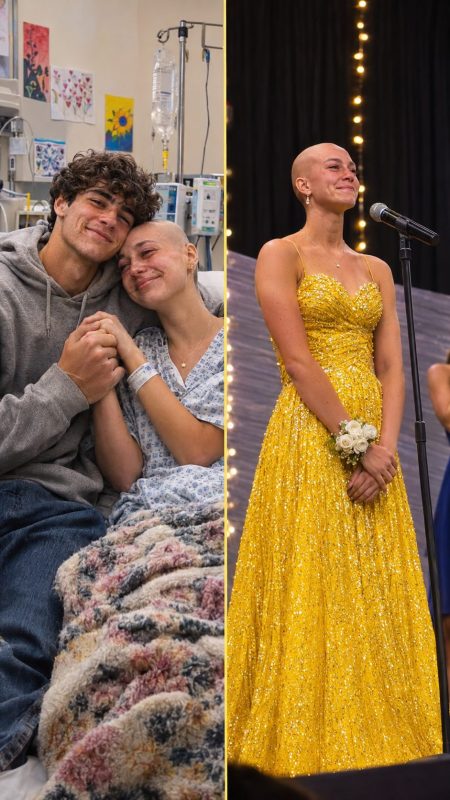
A faint smile crossed his face.
“It was a promise, remember?”
Long before her diagnosis, they had been joking about prom outfits when Olivia challenged him to wear a purple sequin gown if she ever needed a reason to laugh.
Nate had accepted the challenge, promising to dance with her in front of everyone.
Olivia had nearly forgotten their playful agreement.
He hadn’t.
“And your hair?” she asked.
“I thought I could take some of the attention off you. But I probably should have asked what you actually wanted.”
Olivia nodded.
“I never needed you to change yourself because of me.”
“I know,” he answered. “I just didn’t know how to help. I was scared, and I stopped listening.”
For the next several minutes, they discussed everything they had been too afraid to say.
Nate acknowledged that his constant worrying had prevented him from recognizing Olivia’s need for independence.
Olivia explained that she appreciated his support but wanted to remain in control of her own choices.
They also recognized that neither of them could repair weeks of misunderstanding with a single conversation.
Eventually, Nate stood up, preparing to give Olivia some space.
Before he could leave, she called after him.
“Hold on. You can’t wear that dress and leave without keeping your promise.”
He looked back at her.
“One dance?”
“One dance,” she confirmed.
They returned to the ballroom as another song began.
This time, the laughter surrounding them felt different. Olivia was laughing, too, enjoying the unexpected absurdity of the evening.
For a few precious minutes, there were no hospital corridors, treatment schedules, or difficult conversations.
There was simply music, friendship, and a promise finally fulfilled.
On our journey home, Olivia explained that she and Nate had decided against immediately restarting their relationship.
“We both have things to figure out,” she told us. “But we can start by being honest with each other.”
The following weekend, Nate stopped by our house.
They spent the afternoon sitting on the porch, discussing school, graduation, and their plans for the future.
There were no elaborate gestures or impossible promises. Just two teenagers learning how to communicate without allowing fear to dictate their decisions.
Olivia’s treatment was far from over. Difficult days still lay ahead, and there were questions none of us could answer.
But when I noticed her blue gown hanging neatly inside her wardrobe, I understood why that evening would always matter.
People would undoubtedly remember the young man who attended prom in a glittering purple dress with a shaved head.
I would remember something else entirely.
I would remember my daughter choosing to attend a celebration despite everything she was experiencing.
I would remember her defending her independence, expressing her feelings, and allowing herself to enjoy an unforgettable evening.
Her diagnosis had interrupted her plans, but it had not erased her identity.
Olivia was more than a patient undergoing treatment. She was a teenager with aspirations, friendships, opinions, and countless possibilities ahead of her.
She deserved happiness without having to prove her strength to anyone.
And that evening reminded our entire family that meaningful support is not about making decisions for someone we care about.
Sometimes, it means listening, respecting their choices, and giving them the freedom to live their own life.