I had given birth to twin boys just three days earlier.
My C-section incision still hurt every time I moved, and I could barely get out of the hospital bed without assistance.

That was when Julian walked into my room.
My husband hadn’t come alone.
Sienna, the woman he had been seeing behind my back, walked beside him.
More than twenty members of the Vance family followed them inside.
Not one of them asked about my recovery.
No one leaned over the bassinets to welcome Leo and Oliver.
They had come for something else.
Julian approached my bed and dropped a heavy leather folder onto the table.
“I’ll give you $200,000,” he said. “Sign these papers, give me custody of the boys, and stay out of our lives.”
Sienna stood beside him with a satisfied smile.
Eleanor, my mother-in-law, didn’t bother hiding her contempt.
“Leo and Oliver are Vances,” she said. “They should be raised by their family, where they’ll have stability.”
I knew what everyone in that room expected.
They thought I would panic.
They thought I would cry.
Maybe they expected me to beg Julian to reconsider.
Instead, I reached for the folder.
Then I started reading.
Page after page covered the divorce, money, property, and custody.
Nothing surprised me until I reached a paragraph buried deep in the agreement.
I read it once.
Then again.
If I signed, I would waive any future right to examine or challenge specific financial accounts associated with the Vance family’s real estate company.
Suddenly, the entire scene made sense.
The twenty relatives.
The rushed divorce.
The custody demand.
The money.
This wasn’t only an attempt to end our marriage.
They wanted me quiet.
I reached for the pen.
Julian shifted impatiently.
“Stop dragging this out and sign.”
I did.
One page after another.
By the time I finished, Sienna looked triumphant.
Eleanor seemed relieved.
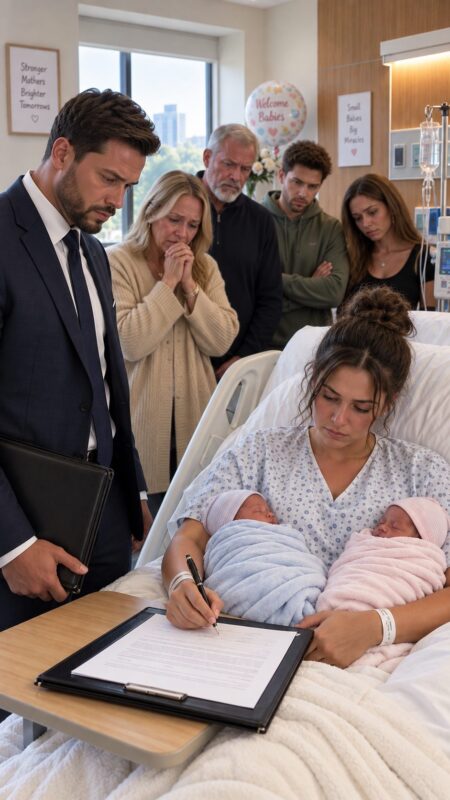
Julian apparently believed he had just bought my silence for $200,000.
What none of them knew was that I had been preparing for this moment for half a year.
Long before I became Julian Vance’s wife, I had built a career in forensic accounting.
I knew how to trace money through complicated transactions.
More importantly, I knew what to do when someone desperately wanted money not to be traced.
Six months earlier, I had been reviewing our household accounts when a transaction caught my attention.
There was nothing spectacular about it.
It simply didn’t belong.
Instead of asking Julian about it, I followed it.
One transaction led to another.
Then another.
Eventually, the trail reached the Vance family’s real estate company.
The deeper I looked, the more troubling the records became.
Properties appeared to have been valued far above reasonable levels.
Money moved through layers of transactions.
Certain transfers led through entities that seemed to exist mainly on paper.
Financial reports contained information that appeared inconsistent with the underlying records.
And the same names kept appearing.
Julian.
Eleanor.
Several members of the extended Vance family.
So I stopped looking at the situation as a wife.
I started examining it as an accountant.
For six months, I documented what I could verify.
I did it while carrying twins.
I did it while Julian began spending more and more evenings away from home.
Eventually, I learned that some of those “business meetings” were actually time spent with Sienna.
Meanwhile, the Vance family became increasingly distant toward me.
I didn’t challenge them.
I didn’t reveal what I knew.
I kept records.
And I prepared.
Copies of important documents were secured somewhere they couldn’t reach.
I opened personal bank accounts.
I rented a small apartment.
Then I quietly sought professional advice from a family-law attorney, a lawyer familiar with forensic financial matters, and an investigator experienced in financial crimes.
I hoped I would never need all of it.
Then Julian entered my hospital room with his family.
And handed me something far more valuable than he realized.
Written evidence of exactly what they wanted from me.
They were asking a woman three days removed from major surgery to surrender custody of her newborn children.
They had surrounded me with members of Julian’s family.
I had no independent lawyer beside me.
And the entire confrontation took place in a hospital where staff members, security systems, and other records could help establish the circumstances.
Julian thought my signature ended the problem.
My attorney, Ruth Okafor, saw it differently.
When she reviewed the documents, she looked at me and said, “They didn’t make you disappear. They documented what they were trying to do.”
The custody agreement was challenged.
The circumstances under which I had signed it became central to the dispute.
Ultimately, the agreement did not stand, and custody of Leo and Oliver returned to me.
But the custody battle was only one part of what followed.
The financial records I had collected went to investigators.
During one court proceeding, Ruth focused attention on the unusual provision buried in Julian’s agreement.
Then she asked the question the Vances apparently hadn’t prepared for.
“Why does a custody agreement need to prevent a forensic accountant from examining this family’s business accounts?”
The courtroom became quiet.
Julian had no convincing explanation.
Neither did Eleanor.
Then Julian noticed who was sitting toward the back of the room.
Financial-crimes investigators.
I watched his expression change.
That was the moment he realized the woman he had dismissed as quiet and powerless had spent six months documenting what was happening around her.
The investigation continued for roughly another year.
Julian, Eleanor, and several relatives eventually faced allegations related to financial crimes.
The Vance real estate company, once the foundation of the family’s wealth and reputation, began to crumble as investigators examined its records.
And Sienna?
Once the money and prestige started disappearing, so did she.
I left with the only two things from the Vance family that truly mattered to me.
Leo and Oliver.
They’re three years old now.
They have no memory of that hospital room.
They don’t remember the crowd surrounding my bed or the folder Julian placed beside me.
They don’t know that people once stood only a few feet away from their bassinets believing their mother could be pressured into walking away.
Someday, when they’re old enough, I’ll decide how much of that story they need to hear.
For now, they get to be children.
As for me, I returned to the profession I had once stepped away from.
Eventually, I opened my own forensic accounting practice.
Today, I work with people who believe someone close to them—a spouse, relative, or business partner—may be concealing assets or manipulating financial records.
The experience taught me lessons I now repeat constantly.
When a number doesn’t make sense, don’t invent an explanation for it.
Follow it.
When you suspect something serious, don’t rush into a confrontation simply because you’re angry.
Document what you can verify.
If evidence might disappear, don’t announce what you know before you’ve protected it.
Prepare carefully.
And when the other side finally makes a mistake, don’t interrupt them.
Sometimes the strongest evidence isn’t something you uncover.
Sometimes it’s something they willingly hand you because they’re convinced they’ve already won.
Julian looked at my signature and saw defeat.
He believed I had surrendered my children, my marriage, and my right to ask questions.
He was wrong.
That signature wasn’t the moment I gave up.
It was the moment his plan became evidence.