Corvin had expected the Apache warriors to arrive looking for him.
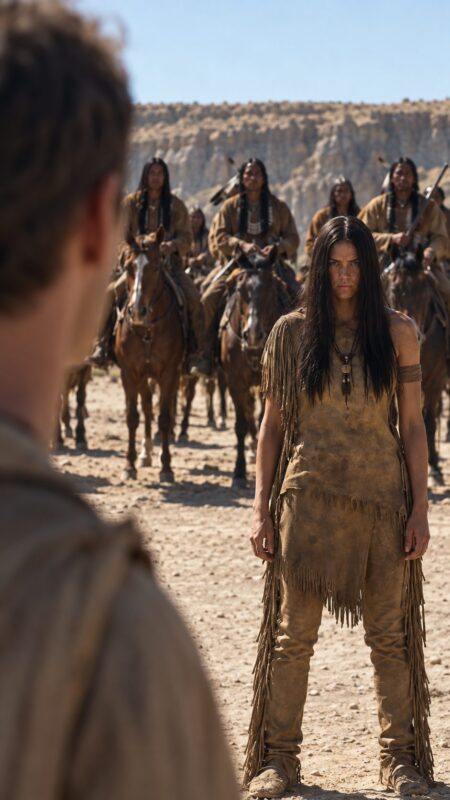
Three hundred riders had gathered outside his ranch.
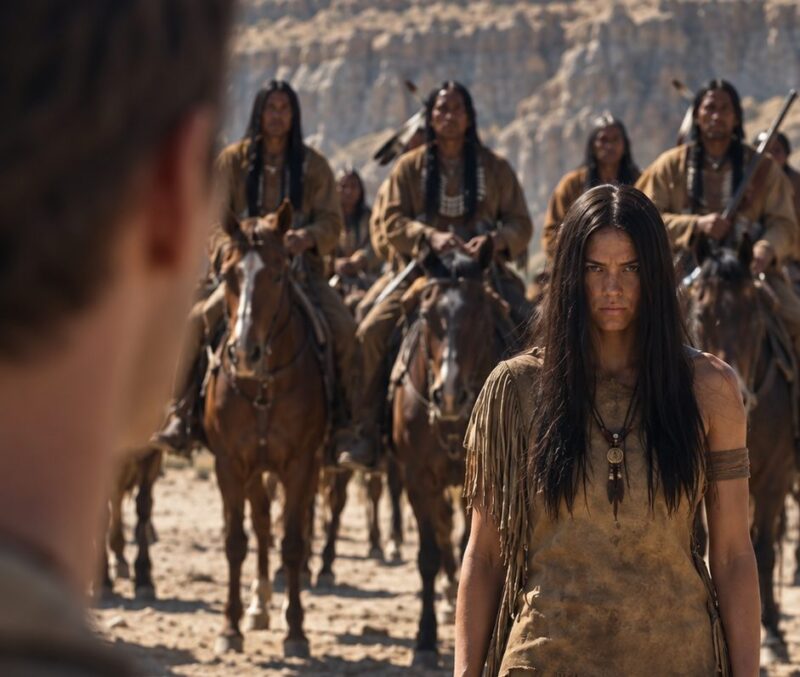
But he soon realized he had misunderstood the reason for their visit.
They had come for his well.
An older warrior stepped forward and pointed toward a woman making her way through the silent crowd.
“She says you gave her water.”
“Only one ladle,” Corvin replied.
“She was wounded?”
“Yes.”
“And you asked nothing in exchange?”
“Nothing.”
The old man held Corvin’s gaze for a long moment.
“That is why you are standing here today.”
The woman stopped in front of them.
Her name was Naya.
A fresh bandage wrapped her shoulder, and dust covered the lower part of her dress. Her face, however, showed neither fear nor anger.
She extended a torn document.
Dark stains covered one corner.
Corvin unfolded it carefully.
It contained property boundaries, survey marks, water routes, and a name he recognized immediately:
Bellrose Cattle & Land Company.
Everyone in the valley knew Bellrose.
For years, the company had been acquiring failing ranches, grazing rights, and access to wells and springs that other families depended on.
But the map revealed something Bellrose apparently didn’t want anyone to see.
A subterranean spring passed beneath Corvin’s property, traveled through Apache territory, and continued toward land controlled by Bellrose.
“They claim the entire water supply belongs to them now,” Naya said.
Corvin studied the map.
“They can’t make an underground spring theirs simply by drawing a boundary around it.”
Naya then told him what had happened four days earlier.
Two Apache scouts had entered the valley.
Neither returned.
Their bodies were later discovered beside a Bellrose fence.
Bellrose riders claimed the scouts had attacked them.
Corvin immediately recognized the danger.
If no one challenged that story, two deaths could become the excuse for a much larger confrontation.
Naya admitted she had taken the survey from a Bellrose camp.
She had been watching the company because she suspected its men were hiding evidence.
“They took the water before they tried to take the land,” she said.
Corvin agreed to let the group draw whatever water his well could safely provide.
Taza, Naya’s uncle and a respected elder, requested only twenty barrels.
Hundreds of people stood behind him.
“We will not let you die tomorrow simply because we are thirsty today,” Taza said.
The words stayed with Corvin.
The next afternoon, Bellrose foreman Owen Pike rode up to the ranch with an official notice.
According to the document, Corvin was allowing armed trespassers to use water belonging to Bellrose.
Corvin said nothing.
He opened his ranch ledger.
For years, he had recorded ordinary details: rainfall, livestock, repairs, deliveries, visitors, and supplies.
Then he turned to one particular entry.
7:42 p.m. — Injured Apache woman arrived at the well. Gave her water. She traveled north.
Pike’s accusation suddenly had a problem.
Corvin had written the entry before anyone had accused him of anything.
Then Pike delivered the real threat.
At first light, sixty armed men would arrive to “clear the valley.”
Corvin understood what Bellrose wanted.
If violence erupted, the company could describe it as an Apache attack, demand military intervention, and use the disorder to take control of the disputed water routes.
Corvin refused to give them that opportunity.
He chose witnesses instead of weapons.
He contacted neighboring ranchers, a mission priest, county officials, and Territorial Marshal Daniel Reed.
Taza moved his people away from the ranch.
They remained visible but kept enough distance to make it clear they were not preparing for an attack.
At sunrise, Gideon Bellrose arrived with sixty armed men, a deputy, and county clerk Henry Pell.
He presented an injunction ordering Corvin to stop using Bellrose water.
Corvin examined the paperwork.
Then he looked at the date.
The injunction claimed to have been issued three days earlier.
That was impossible.
The Apache woman hadn’t even arrived at his ranch yet.
And Corvin’s ledger showed that he had been alone.
A neighboring rancher backed him up.
Marshal Reed questioned Clerk Pell.
The questions continued until Pell finally broke.
He admitted that the order had actually been entered the previous day.
Bellrose had told him to backdate it.
That discovery opened the door to a much larger investigation.
Surveyor Amos Vale was found at a Bellrose camp.
Under questioning, he admitted that Bellrose officials had pressured him to alter a water survey.
The authentic survey showed several connected underground water routes.
The altered version falsely gave Bellrose exclusive control.
The foundation of Bellrose’s entire claim began to collapse.
The armed guards slowly lowered their rifles.
They had been hired to protect property.
They hadn’t signed up to start a war.
Then investigators uncovered additional evidence.
Money had changed hands.
Records had been forged.
People had been threatened.
And a killing had been staged to make military intervention appear necessary.
But the investigation also exposed an uncomfortable truth.
An Apache man admitted that he had killed a Bellrose rider in retaliation for the death of his cousin.
Taza did not attempt to hide what had happened.
He turned the man over through a witnessed legal process.
“Truth does not become truth only when it helps our side,” Taza said.
Months later, the valley reached a formal agreement over the water.
Bellrose’s attempt to claim exclusive control failed.
Ranchers and Apache communities received defined access rights, including emergency provisions.
Years passed.
The story grew into a legend.
People said three hundred Apache warriors had surrounded Corvin’s ranch because he had given water to an injured woman.
Whenever Corvin heard the story, he corrected the most important detail.
“Naya had a name.”
The warriors had not come simply because of a single ladle of water.
They had come because powerful men had begun turning water, land, fear, and official documents into tools of control.
Corvin had expected that ladle to cost him something.
It didn’t.
He received no promise of protection.
No favor.
No debt.
He had simply given water to someone who was hurt.
But Naya remembered.
And when forged documents and armed men threatened to turn the valley into a battlefield, that small act of kindness gave people enough reason to stop, investigate, and listen before the first shot was fired.
Corvin preserved the original ledger for the rest of his life.
The entry never changed:
7:42 p.m. — Injured Apache woman arrived at the well. Gave her water. She traveled north.
Everything that followed had to be proven.
Names.
Claims.
Documents.
Deaths.
Every accusation.
In the end, evidence—not fear, rumors, or weapons—was what saved the valley.