The clock on the dashboard read 2:13 a.m. when my father pulled onto the shoulder of Highway 95 outside Tonopah, Nevada.
Minutes later, my six-year-old son and I would be standing alone in the freezing desert while my parents disappeared into the night.
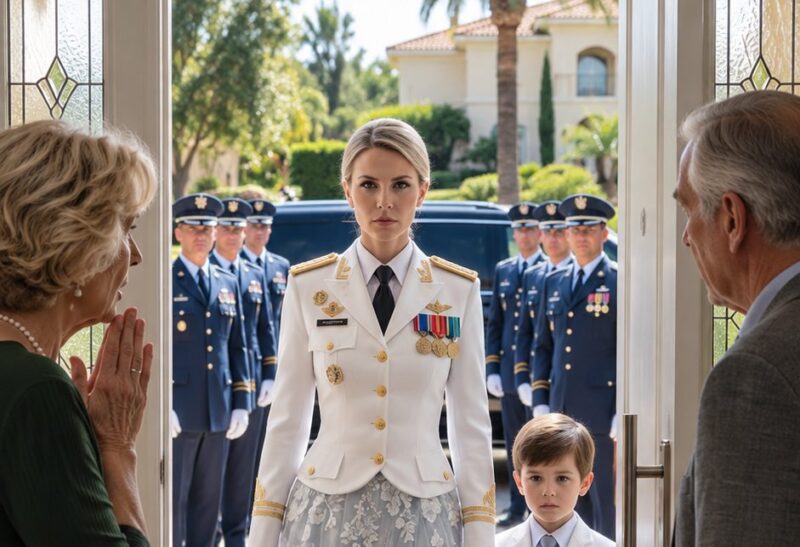
They thought leaving us there would make me helpless.
They had forgotten what I had spent years learning in the military.
When everything goes wrong, panic wastes time.
You assess.
You protect.
You survive.
The truck stopped so abruptly that Eli was thrown forward, striking his forehead against the seat.
I immediately reached for him.
“Eli, are you okay?”
Before he could answer, my father turned around.
“Get out.”
For a moment, I thought I had misunderstood him.
“What did you say?”
“You’re getting out. Now.”
I looked through the window.
There were no buildings nearby, almost no traffic, and nothing but darkness stretching across the Nevada desert.
The temperature was below freezing.
“Dad, Eli is with me.”
My mother turned slowly from the passenger seat.
Her expression was strangely calm.
“We know.”
I stared at her.
Then Dad opened my door.
He grabbed my backpack and dropped it onto the pavement. The zipper opened when it hit the ground, sending clothes across the shoulder.
A small medical pouch rolled underneath the truck.
I recognized it immediately.
“That’s Eli’s medical kit.”
My mother looked down at it.
She made no attempt to retrieve it.
Instead, she turned her face toward the windshield.
Something inside me shifted.
This hadn’t happened because of an argument.
Nobody had suddenly lost their temper.
This was deliberate.
And once I understood that, several strange moments from earlier that night took on an entirely different meaning.
Before we left, Dad had taken my apartment keys.
“You’re always misplacing things,” he had said.
Later, when we stopped for gas, Mom offered to put my wallet in her purse.
“For safekeeping.”
Then Dad unplugged my phone from its charger.
When I asked for it back, he changed the subject.
One incident might have meant nothing.
Three incidents formed a pattern.
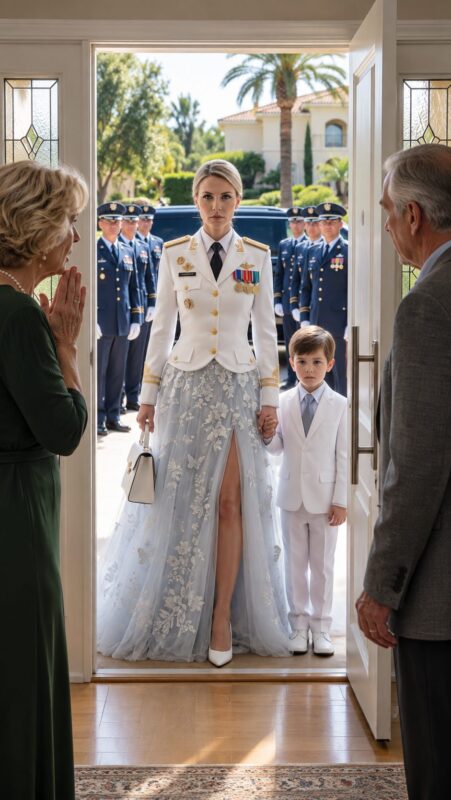
My parents hadn’t simply driven us into the desert.
They had spent hours making sure I would have no identification, no money, no keys, and no working phone when they left.
Dad reached into the truck one final time and placed Eli’s dinosaur blanket beside my backpack.
My son finally understood that they intended to leave.
“Grandpa?”
Dad didn’t answer.
“Please don’t go.”
Mom remained silent too.
The doors shut.
The truck moved forward.
I stood with Eli beside me as its taillights shrank into two tiny red dots and finally vanished.
My first reaction was fear.
Not for myself.
For my son.
But fear wasn’t going to keep him safe.
Training took over.
First priority: Eli.
Second: immediate hazards.
Third: communication and shelter.
I had spent years as a senior military officer, making decisions when circumstances changed without warning.
Yet standing beside my child on a freezing highway felt different from any professional crisis I had ever faced.
These weren’t strangers who had put us there.
They were my parents.
I pushed the thought aside.
There would be time to understand why later.
Right now, Eli needed me.
I removed my coat and wrapped it around him.
Then I checked the spot where his forehead had hit the seat.
A bruise was beginning to appear, but he was alert and responding normally.
“Look at me,” I said gently.
He did.
“We’re going to be okay.”
“You promise?”
“I promise.”
I pulled him close.
Then I began studying our surroundings.
That was when I saw the pole behind us.
At first, I assumed it was part of the highway infrastructure.
Then I noticed the camera mounted near the top.
A traffic camera.
I looked from the camera to the empty road.
If it had been operating, my parents had just documented their own actions.
Their truck stopping.
The license plate.
My father removing our belongings.
Eli and me being left behind.
The vehicle driving away.
They had chosen an isolated location because they believed there would be no witnesses.
But isolation wasn’t the same as invisibility.
I gathered our belongings and moved Eli farther from the roadway.
Then we waited.
A few minutes later, headlights appeared in the distance.
A truck approached and slowed.
For one terrible moment, I thought the driver might continue past us.
Instead, the truck pulled onto the shoulder.
A man climbed from the cab.
His eyes went immediately to Eli, who was still wrapped in my coat.
“Ma’am, are you two all right?”
I had spent years being the person other people relied on.
Admitting that I needed someone else felt unexpectedly difficult.
“No,” I said. “We need help.”
The driver didn’t waste time asking unnecessary questions.
He got us into his heated cab.
He gave Eli another blanket.
He found a charger for my phone and contacted emergency services.
Most importantly, he stayed.
By the time help arrived, Eli was warm and beginning to calm down.
By sunrise, investigators had obtained footage from the highway camera.
I watched part of it later.
There was no ambiguity.
My parents’ truck pulled over.
My belongings were removed.
My son and I were left beside the road.
Then the vehicle disappeared into the darkness.
Investigators also confirmed that my parents still had my wallet, apartment keys, and phone.
Whatever explanation they had intended to give no longer matched the evidence.
They had tried to make me powerless.
Instead, they had created a timeline.
Three months passed before I drove that route again.
This time, Eli sat safely beside me.
His dinosaur blanket was tucked against him.
Neither of us said much as the familiar desert came into view.
I wondered whether he remembered exactly where it had happened.
Then his voice broke the silence.
“Mom?”
I glanced at him.
“What is it?”
“Are we still a family?”
The question hit me harder than anything my parents had said that night.
I reached across the console and held out my hand.
Eli placed his small fingers in mine.
“We’re absolutely a family.”
“Even if it’s only us?”
I looked at him.
“Especially us.”
He smiled faintly and squeezed my hand.
For years, I had thought family was something you inherited.
That night taught me otherwise.
Blood can make people relatives.
It cannot make them loyal.
Family is built by the people who remain beside you when you’re frightened.
The ones who protect you when you’re vulnerable.
The ones who choose to stay.
My parents thought Highway 95 would become the place where they removed us from their lives.
Instead, it became the place where I finally understood that we didn’t need to chase people who had chosen to leave.
At the next stop, Eli leaned against me.
“I’m happy you stayed with me.”
I kissed the top of his head.
“There was nowhere else I would have been.”
Later, as we continued home, he fell asleep.
His hand remained loosely curled around two of my fingers.
I watched the Nevada desert pass beyond the windshield.
The landscape hadn’t changed.
But what it meant to me had.
It was no longer simply the place where my parents had abandoned us at 2:13 in the morning.
It was where I learned exactly what kind of mother I intended to be.
Whatever happened, Eli would never have to watch me disappear down a dark road.
Not when life was easy.
Not when everything went wrong.
Not ever.
My parents drove away believing they had taken everything from us.
They hadn’t.
They left me with the one thing that mattered most.
My son.
And together, we drove toward a life where neither of us would ever have to wonder who was staying.