At 6:52 on a rainy Thursday evening, a man who looked as though life had forgotten him walked into the salon where I worked.
We were eight minutes away from closing.
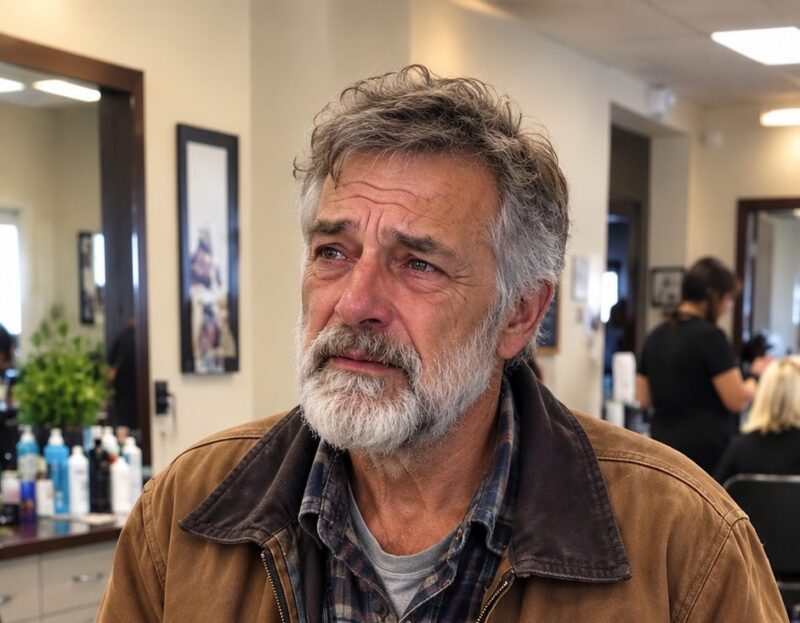
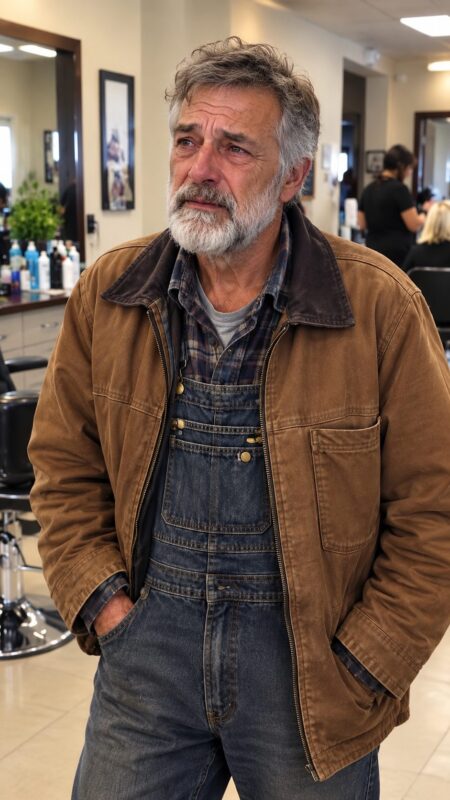
His faded brown jacket hung loosely from his shoulders. The soles of his boots were separating, and his long gray hair looked as though it hadn’t seen a comb in months.
But it was his eyes that made me pause.
They were a striking shade of blue, almost identical to my own.
The man approached the reception desk and unfolded a worn dollar bill.
“Excuse me,” he said softly. “I have an interview in the morning. I was hoping someone could make me look presentable. This is all I’ve got today, but I promise I’ll pay the difference.”
Kayla glanced at the money and shook her head.
“Sir, our basic haircut is fifty dollars.”
Before he could respond, Brenda, our manager, appeared from the back room.
“We’re closed for the evening.”
The man looked at the clock.
“I understand. I’m sorry for bothering you.”
He turned toward the door.
As he reached for the handle, his jacket sleeve slipped above his wrist.
I saw a tiny bluebird tattoo, its once-bright colors faded by decades.
My breath caught.
My mother had carried that exact design on her wrist for as long as I could remember.
“Wait!” I called.
Everyone turned.
“I can take one more customer.”
Brenda folded her arms.
“Lucy, if he can’t pay, the money comes out of your paycheck.”
“Then take it out.”
The man looked at me as though he couldn’t believe what he’d heard.
“Are you sure, miss?”
I pulled out my chair.
“Come sit down. Let’s get you ready for tomorrow.”
He told me his name was Raymond, though most people called him Ray.
As I washed his hair, I noticed his hands trembling slightly. He apologized repeatedly for the condition of his clothes and for keeping me late.
I assured him that none of it mattered.
When I began cutting his hair, he watched me in the mirror with an expression I couldn’t quite understand.
It wasn’t simply gratitude.
It was as though he were looking at someone he had been searching for his entire life.
Trying to make conversation, I mentioned my mother.
“She taught me how to hold scissors when I was little,” I said. “She used to cut my hair in our kitchen and sing while she worked.”
Ray’s expression changed.
“What did she sing?”
“Oh, an old song about rainbows and bluebirds. She loved it.”
His hands tightened around the chair’s armrests.
“Over the Rainbow?”
I stopped cutting.
“How did you know?”
He closed his eyes.
“June used to sing that song whenever she was happy.”
My stomach dropped.
June was my mother’s name.
I stepped back.
“Did you know my mother?”
Ray stared at his reflection for several seconds before reaching into his jacket.
He removed a weathered envelope, its edges softened by years of handling.
Written across the front were six words:
For Lucy. When he’s earned it.
I recognized the handwriting instantly.
My mother had written those words.
“Where did you get this?” I whispered.
Ray’s eyes filled with tears.
“Your mother gave it to me before she died.”
My heart began pounding.
“Who are you?”
He swallowed.
“My name is Raymond Bennett. And thirty years ago, I made the worst mistakes of my life.”
He paused, struggling to continue.
“Lucy, I’m your father.”
For several moments, the only sound in the salon was the humming of the overhead lights.
My father.
The man my mother had rarely spoken about.
The man I’d imagined countless times but had never expected to meet.
Ray explained that he and my mother had met when they were nineteen.
They were young, reckless, and completely in love.
On Mom’s twentieth birthday, they visited a small tattoo shop near the beach and had matching bluebirds inked onto their wrists.
They believed the birds symbolized freedom and a future they would build together.
But everything changed after Ray suffered a serious back injury.
What began as prescribed medication slowly became an addiction that controlled his life.
He lost his job. Bills piled up. Arguments replaced laughter.
When Mom learned she was expecting me, Ray promised to change.
He tried.
But he kept relapsing.
Four months after I was born, he committed a robbery and was sent to prison.
My mother took me away and built a life without him.
“She was right to protect you,” Ray admitted. “I wasn’t the kind of man a child deserved to have around.”
Years later, he finally entered a recovery program and began rebuilding his life.
Shortly before Mom passed away, she visited him.
She brought the envelope and told him something he would never forget.
“If you want to meet Lucy, don’t come with another apology. Come when you’ve become someone who can keep a promise.”
Ray had spent the next nine years working toward that moment.
He had stayed in recovery, completed counseling, and taken whatever honest work he could find.
But after losing his most recent job, he had also lost his apartment.
The interview scheduled for the following morning was his chance to start again.
He hadn’t planned to reveal who he was that evening.
He’d simply wanted to look respectable before approaching me properly.
Then he saw my face in the mirror.
And he couldn’t keep the truth hidden any longer.
I opened the envelope.
Inside was a photograph of my mother holding me as a newborn.
Beside her stood a smiling young man with dark hair and unmistakable blue eyes.
Their wrists were resting together.
Two tiny bluebirds.
There was also a handwritten letter.
Mom explained that she’d kept Ray away because she couldn’t risk exposing me to the instability of his addiction.
She wrote that he had loved me, even though he hadn’t known how to be a father.
She didn’t ask me to accept him.
She didn’t tell me to forgive him.
She simply wanted me to know the truth.
At the bottom was one final sentence.
Whatever you decide, sweetheart, remember that your arrival was never a mistake. You were wanted from the very beginning.
I pressed the letter against my chest and cried.
Ray remained in the chair, silent.
He didn’t reach for me.
He didn’t ask for forgiveness.
He simply waited.
The next morning, I drove him to his interview at a neighborhood community center.
Brenda surprised us by arriving early with a clean shirt, a warm jacket, and a pair of boots her husband no longer wore.
“Consider it an investment in your first day,” she told him.
Ray thanked her so many times that she finally waved him away.
“Go get that job.”
I waited in the parking lot while he interviewed.
After forty minutes, the center’s director came outside.
“Are you here with Raymond?”
“Yes.”
“Are you his daughter?”
The question caught me off guard.
I looked toward Ray, who stood nervously beside the entrance.
Then I answered.
“I am.”
The director smiled.
“Your father told me about his past. All of it. He didn’t try to hide anything.”
He turned to Ray.
“We believe people deserve the opportunity to prove they’ve changed. Can you start Monday?”
Ray covered his mouth with one hand.
“Yes, sir. Absolutely.”
For the first time since meeting him, I saw him smile without sadness behind his eyes.
But having a father wasn’t as simple as learning his name.
I had spent three decades believing he had abandoned me.
There were school concerts where I’d searched the audience for a man who never came.
Birthdays when I wondered whether he remembered the date.
Graduations when Mom had stood proudly beside me, carrying the responsibilities of two parents.
Those memories didn’t disappear because Ray had finally returned.
One Sunday afternoon, after we’d spent several weeks getting to know each other, I asked him the question I’d been afraid to say aloud.
“Why didn’t you choose us?”
He stared at the floor.
“I wish I could give you an answer that would make it hurt less.”
“Then tell me the truth.”
He looked up.
“I was selfish, sick, and afraid. I kept thinking I could fix everything tomorrow. And by the time I understood what I’d lost, your mother had already done the hardest part of raising you.”
I wiped my eyes.
“You missed everything.”
“I know.”
“You can’t make that up.”
“No,” he said quietly. “I can’t.”
Then he leaned forward.
“But I can be here now. If you’ll let me.”
I thought about it for a long moment.
“Every Sunday,” I finally said. “You can come over every Sunday.”
He nodded.
“I’ll be there.”
And he was.
Some Sundays, we cooked dinner.
Other Sundays, we watched old movies or sat on my porch drinking coffee.
He never arrived late.
He never forgot to call.
He never made another promise he couldn’t keep.
One afternoon, several months after our first meeting, Ray returned to the salon.
His community center uniform was freshly washed, and his gray hair was neatly trimmed.
He approached Brenda and placed fifty dollars on the counter.
“What’s this?” she asked.
“Payment for a haircut I received a while ago.”
She smiled.
“Ray, we already told you it was free.”
He shook his head.
“I promised I’d pay when I could. I’ve spent too many years breaking promises.”
Brenda accepted the money without another argument.
Then Ray turned toward me.
“Hello, Lucy.”
I looked at the man standing before me.
He wasn’t the father who had raised me.
He wasn’t the man who had attended my childhood birthdays or taught me to ride a bicycle.
But he was someone who had worked hard to become worthy of a second chance.
And somewhere along the way, he’d become important to me.
“Hey, Dad,” I said.
Ray’s smile vanished for an instant.
His eyes filled with tears.
“Would you say that again?”
I laughed through my own tears.
“Hi, Dad.”
He embraced me carefully, as though he feared the moment might disappear.
We had fourteen months together.
Fourteen months of Sunday dinners, long conversations, shared photographs, and small discoveries.
He took me to Galveston, where he’d first met Mom.
We walked along the shore while he described the girl she’d been at nineteen.
He remembered how she laughed, how she danced barefoot in the kitchen, and how she always believed that people were capable of changing.
I told him about my childhood.
About my first bicycle.
My high school graduation.
My first terrible haircut.
He listened to every story as though it were a treasure.
One day, I showed him a surprise.
I’d had a small bluebird tattooed on my wrist.
Ray gently held his arm beside mine.
His bird was faded and weathered.
Mine was bright and new.
He smiled sadly.
“Two bluebirds,” he whispered. “Still missing one.”
I placed my hand over his.
“She’ll always be with us.”
The following summer, Ray’s health began to decline.
At first, he insisted he was only tired.
But after several medical appointments, it became clear that his condition was serious.
Eventually, he was admitted to the hospital.
One evening, as I sat beside his bed, he reached for my hand.
“Lucy, can I ask you something?”
“Anything.”
“Would you cut my hair one last time?”
The next morning, I arrived carrying my scissors, comb, and a small mirror.
I placed a towel around his shoulders and began trimming his silver hair.
He closed his eyes.
For a while, neither of us spoke.
Then I started humming the melody Mom had sung to me when I was little.
Ray opened his eyes and smiled.
He joined in softly.
For those few minutes, I imagined my mother standing beside us.
Three people connected by a song, a pair of scissors, and three little bluebirds.
When I finished, I held the mirror in front of him.
“What do you think?”
He studied his reflection.
“Best haircut I’ve ever had.”
I smiled.
“You say that every time.”
“Because it’s true.”
Then he squeezed my hand.
“Thank you for letting me be your dad.”
I leaned down and kissed his forehead.
“Thank you for showing up.”
Those were among the last words we exchanged.
Ray passed away not long afterward.
While sorting through his belongings, I discovered his old wallet tucked inside a drawer.
Behind a photograph of Mom was a folded dollar bill.
I recognized it immediately.
The dollar he’d placed on our counter that first evening.
He’d never spent it.
He’d carried it with him through every paycheck, every Sunday visit, and every new beginning.
I took it to the salon and placed it in a frame beside my mirror.
Underneath, I added a small inscription:
One dollar. One chance. A lifetime of meaning.
But I wanted to do more than preserve his memory.
I wanted to continue what that evening had started.
So I asked Brenda whether we could open the salon one Sunday each month for people who needed help.
She agreed immediately.
We began offering free haircuts to people staying in shelters, veterans rebuilding their lives, parents preparing for job interviews, and anyone who simply couldn’t afford our services.
We called the event Bluebird Sunday.
At first, only a handful of people came.
Then word spread.
Other stylists volunteered.
Local businesses donated supplies.
People began arriving not only for haircuts but also for conversation, encouragement, and the simple feeling of being treated with dignity.
One recent Sunday, an elderly man entered the salon just as I was cleaning my station.
His jacket was worn, his shoes were dusty, and he looked uncomfortable standing among the bright mirrors and polished chairs.
“Excuse me,” he said. “I heard you sometimes help people who don’t have much money.”
“Of course.”
He reached into his pocket and unfolded a dollar bill.
“This is all I can offer.”
I stared at the money.
For one brief moment, I could almost see Ray standing in front of me again.
I gently pushed the man’s hand back toward him.
“Keep it.”
“But I don’t want charity.”
“Then think of it as a gift from someone who once received the same kindness.”
He looked confused.
I smiled and pointed toward my chair.
“Please, sit down.”
As I placed the cape around his shoulders, my eyes drifted toward the framed dollar hanging beside my mirror.
Below it was a photograph of Ray and me standing together on the beach.
Our wrists were touching.
Two bluebirds side by side.
For most of my life, I thought forgiveness meant pretending the past had never happened.
Now I understand that forgiveness doesn’t erase the years someone missed or the pain they caused.
It simply allows the future to become something different.
Ray couldn’t return to my childhood.
He couldn’t undo his mistakes.
And fourteen months would never replace thirty lost years.
But during the time we had, he taught me something I will carry for the rest of my life.
A person’s worst chapter doesn’t always have to be the final one.
Sometimes the smallest act of kindness becomes the beginning of a story nobody could have imagined.
Sometimes a stranger needs more than a haircut.
And sometimes, eight minutes before closing, the person walking through your door is carrying the missing piece of your own life.
I still think about that evening whenever I see someone hesitating outside our salon.
I remember the old boots, the trembling hands, and the crumpled dollar.
Then I open the door a little wider.
Because the greatest gift Ray left me wasn’t the money, the photographs, or even the bluebird tattoo.
It was the understanding that a second chance can change two lives at once.
And whenever someone asks whether we have room for one more customer, my answer is always the same:
“There’s a chair waiting for you. Come on in.”