THREE DAYS BEFORE MY FATHER NEARLY DIED, HE CAME TO MY HOUSE ASKING FOR $1,000. MY WIFE ROLLED HER EYES AND SAID, “HE SHOULD WORK HARDER INSTEAD OF BEGGING US.” BUT AFTER HIS EMERGENCY SURGERY, A LAWYER HANDED ME AN ENVELOPE THAT EXPOSED A THIRTY-YEAR FAMILY SECRET.
My father, Raymond Mercer, had always been fiercely independent.
For thirty-two years, he worked construction, enduring exhausting shifts and difficult conditions without complaining. When I needed money for college, he sold the motorcycle he’d spent years restoring.
He never asked for repayment.
So when he appeared at my door one Tuesday afternoon, looking unusually nervous, I immediately knew something was wrong.
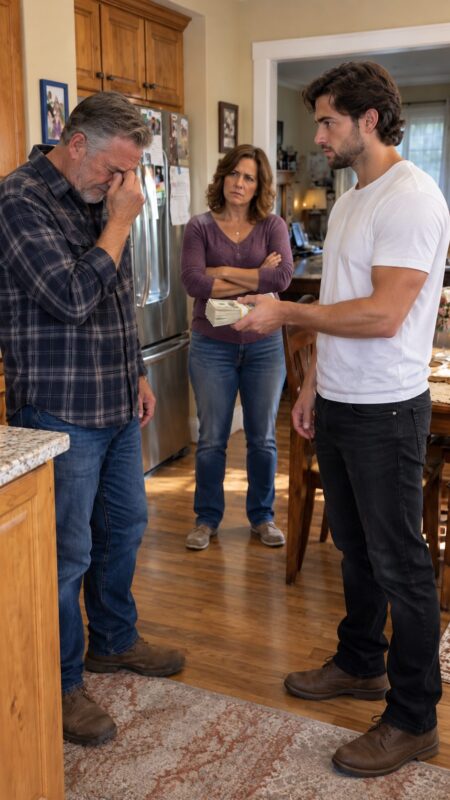
“Grant,” he murmured, twisting his old cap in his hands, “I need to borrow a thousand dollars.”
My wife, Natalie, was sitting at the kitchen table.
She looked up and laughed dismissively.
“Unbelievable. Why doesn’t he pick up another shift? We’re not responsible for supporting him.”
Dad’s face tightened.
“It’s all right,” he said. “I shouldn’t have asked.”
He turned to leave.
I hurried after him.
“Dad, wait. Tell me what’s happening.”
We stood beside his truck.
He glanced toward the house before answering.
“I need certified copies of some documents. And there’s an attorney I have to pay. Also, a medical test.”
“What kind of documents?”
“Adoption records.”
I frowned.
“Whose adoption?”
He looked at me with an expression I’d never seen before.
“Yours.”
For a moment, I couldn’t speak.
Before I could demand an explanation, he raised his hand.
“Please, Grant. Let me finish checking everything first. If I tell you now without proof, someone might convince you I’m confused.”
“Who would do that?”
His gaze drifted toward the kitchen window.
“Just trust me a little longer.”
I had a hundred questions.
But this was the man who had raised me, protected me, and sacrificed more than I could ever repay.
I withdrew the money and handed it to him.
“Whatever you’re dealing with, you don’t have to face it alone.”
Dad pulled me into an unexpected embrace.
“Thank you, son.”
When I returned inside, Natalie was furious.
“You gave him the money?”
“Yes.”
“Without even discussing it with me?”
I reminded her that Dad had sold inherited property years earlier to help us purchase our home.
She shrugged.
“That doesn’t mean he gets unlimited access to our finances.”
I didn’t argue.
Three days later, I received a call that made every disagreement seem meaningless.
Dad had collapsed.
Doctors discovered a life-threatening aortic aneurysm and rushed him into emergency surgery.
The hospital couldn’t promise he would survive.
I was grabbing my keys when the nurse added something strange.
“Your father left instructions concerning a sealed packet. His lawyer is waiting here to speak with you.”
“About what?”
“She’ll explain. But your father specifically requested that you meet her alone.”
At the hospital, I found attorney Priya Desai waiting outside the surgical department.
She introduced herself and guided me into a private room.
Then she placed a thick envelope on the table.
“Your father wanted you to receive this if anything happened before he could explain everything himself.”
My hands trembled as I opened it.
The first page was written in Dad’s familiar handwriting.
**“Grant, you may question everything after reading this. But never question whether you’re my son. I’ve loved you since the day I first held you.”**
I stopped reading.
“What is this supposed to mean?”
Priya spoke gently.
“Raymond and his wife raised you as their child, but neither was your biological parent.”
My heart began pounding.
“Then who are my parents?”
She hesitated.
“Your biological mother was Eleanor Mercer.”
I stared at her.
“Aunt Eleanor?”
She nodded.
The woman I’d known my entire life as Dad’s younger sister was actually the woman who had given birth to me.
Eleanor had been seventeen when she became pregnant.
She was frightened, overwhelmed, and uncertain about her future.
Raymond and his wife had been unable to have children, and the family eventually agreed that they would raise Eleanor’s baby.
They adopted me quietly.
Everyone decided the truth should remain hidden.
Even from me.
I remembered Eleanor’s gentle voice, the books she gave me every Christmas, and the way she sometimes watched me from across the room with tears in her eyes.
I’d always assumed she was simply sentimental.
Now those memories meant something entirely different.
Then Priya delivered another blow.
“Eleanor passed away eight weeks ago.”
I lowered my head.
I hadn’t even known she was seriously ill.
“She left a will,” Priya continued. “And you were named as her only beneficiary.”
Eleanor had never married.
She had no other children.
Everything she’d accumulated was intended for the son she had never been able to raise.
But proving my identity hadn’t been simple.
The original adoption files contained missing information and inconsistencies.
Dad had been gathering old hospital records, obtaining certified documents, and arranging legal verification.
He’d also organized a DNA comparison using a properly retained biological sample.
The results confirmed that Eleanor was my birth mother.
The thousand dollars had helped him complete the process.
Priya handed me another folder.
Inside were documents for a modest house in Marsh Hollow, owned outright, along with savings totaling more than sixty thousand dollars.
Then she mentioned something that made the inheritance seem almost insignificant.
“Eleanor also left a collection of personal letters addressed to you.”
“How many?”
“Nearly thirty.”
My throat tightened.
“She wrote to you every year, Grant. She simply never sent them.”
I sat silently, trying to understand how someone could love me for decades without ever being allowed to say so.
Then I asked about Dad’s warning concerning Natalie.
Priya explained that Raymond had instructed her to document the inheritance as my individual property, where legally possible.
“He wanted you to have time to make your own decisions,” she said. “Without pressure from anyone.”
Suddenly, I remembered Natalie’s reaction when Dad asked for help.
And I understood why he’d been worried.
Several hours later, the surgeon entered the waiting room.
Dad had survived.
His condition remained serious, but the operation had been successful.
I cried with relief.
The following morning, I sat beside his bed.
He opened his eyes and immediately searched my face.
“Priya told you?”
I nodded.
“Everything.”
He looked away.
“I’m sorry.”
“Why didn’t you tell me sooner?”
He sighed.
“Because I was afraid of losing you.”
I stared at him.
“You couldn’t have lost me over that.”
“I know that now.”
He explained that Eleanor had wanted me to grow up in a stable household without feeling torn between two mothers.
Over time, the secret became harder to reveal.
Then, several weeks earlier, Dad experienced a brief memory lapse.
Although his doctors found nothing alarming, the incident frightened him.
“What if my memory got worse?” he whispered. “What if I tried telling you one day and couldn’t explain it properly?”
So he’d started collecting evidence.
Not because he wanted money.
Not because he needed to control my life.
Because he was terrified of leaving me with unanswered questions.
I held his hand.
“You’re my dad. That hasn’t changed.”
He closed his eyes, and tears rolled down his cheeks.
Two weeks later, once the inheritance arrangements were in place, I told Natalie.
I explained everything from beginning to end.
My adoption.
Eleanor’s identity.
Her death.
The property.
The letters.
When I finished, Natalie remained quiet for several seconds.
Then she asked, “What’s the house worth?”
I blinked.
“What?”
“The one you inherited. How much could we get if we sold it?”
I stared at her.
“I just found out my aunt was actually my biological mother.”
“I heard you, Grant. But we have an opportunity here.”
“An opportunity?”
“We could sell her place, combine the money with our savings, and finally move into a better neighborhood.”
She began discussing real estate prices.
She didn’t ask whether I was devastated.
She didn’t wonder what Eleanor had been like.
She didn’t even ask whether Dad was feeling better.
Everything became a calculation.
“I’m keeping the house,” I said.
Natalie frowned.
“Don’t be ridiculous. We’re married. We should make financial decisions together.”
“This inheritance is legally mine.”
Her expression turned cold.
“So your father made sure I wouldn’t benefit from it.”
“He made sure I could decide what to do with it.”
She shook her head.
“He’s been interfering in our marriage for years.”
That was the moment something inside me changed.
I remembered every dismissive comment she’d made about Dad.
Every time she’d treated his kindness as an inconvenience.
Every argument that began whenever I wanted to help someone in my family.
And now, after learning that I’d lost a mother I never truly knew, her first instinct was to sell the only home that still held her memories.
Over the following months, Natalie and I tried discussing our differences.
But the more we talked, the clearer it became that we understood love and responsibility in completely different ways.
Four months later, we separated.
There was no spectacular argument.
No dramatic farewell.
Just the painful realization that the marriage we’d built wasn’t the partnership I’d believed it was.
Meanwhile, Dad continued recovering.
He needed more rest, regular appointments, and plenty of patience.
But he was alive.
And that mattered more than anything.
One Saturday, I drove to Marsh Hollow to see Eleanor’s house.
It stood behind a weathered wooden fence, surrounded by neglected flowerbeds.
Inside, the rooms were small but welcoming.
There were shelves crowded with detective novels, framed photographs of distant relatives, and handwritten recipes tucked into an old kitchen drawer.
Everything felt personal.
Everything felt like a life I’d never been invited to know.
In the bedroom closet, beneath a stack of folded blankets, I discovered a shoebox.
A faded blue ribbon was tied around it.
Inside were envelopes arranged by year.
Each one bore a familiar message.
“To My Son, On His Birthday.”
I sat on Eleanor’s bed and opened the oldest letter.
She wrote about my eighteenth birthday and how she’d imagined the kind of young man I’d become.
The next letter celebrated my first year at university.
Another mentioned my graduation.
She knew about my first promotion, my move into my own apartment, and the day I got married.
Family members had quietly shared photographs and updates.
She’d treasured every piece of news.
One letter contained a sentence I read over and over.
“I chose to let you grow up calling someone else your mother, but there has never been a day when I stopped being yours.”
I pressed the page against my chest.
For the first time, I grieved Eleanor not as a distant aunt, but as the mother I’d never had the chance to know.
I stayed in that room until evening.
Then I made a decision.
I wouldn’t sell the house.
I would restore it.
Over the following weekends, I repaired the porch, cleared the weeds, repainted the walls, and brought the neglected garden back to life.
I kept Eleanor’s books.
I preserved her photographs.
And I placed her letters in a wooden chest beside the bedroom window.
When Dad was finally healthy enough, I invited him to visit.
He stepped inside and stood motionless.
For several minutes, he simply looked around.
Then he whispered, “She loved this place.”
“I can tell.”
He walked into the kitchen and touched the old wooden table.
“She used to sit here and ask about you. Every time I visited, she wanted to know whether you were happy.”
I swallowed hard.
“Why didn’t she ever tell me herself?”
“Because she promised she wouldn’t disrupt the life we’d given you.”
He lowered his head.
“We all thought we were doing the right thing.”
I looked at him.
“Maybe you were trying to protect me. But I wish you’d trusted me with the truth.”
He nodded.
“You’re right.”
There was no excuse that could return the lost years.
No apology could give Eleanor and me the conversations we’d never shared.
But Dad was standing beside me.
And unlike Eleanor, he was still here.
I put my arm around him.
“We can’t change what happened. But we can stop hiding from it.”
He hugged me tightly.
Today, Dad still calls me several times a week.
He complains about his medication, asks whether I’m eating properly, and insists he could still fix my roof faster than any contractor.
Every birthday, I return to Marsh Hollow.
I make coffee, sit by Eleanor’s bedroom window, and read her letters.
Some make me smile.
Others bring tears.
But each reminds me that love can exist even when circumstances prevent it from being spoken aloud.
Sometimes I think back to that afternoon when Dad stood in my kitchen, embarrassed to ask for a thousand dollars.
Natalie saw an old man asking for money.
I saw a father who needed help.
Neither of us understood what he was really doing.
He was racing against his own fears, determined to leave me answers before it was too late.
I thought my father had come to borrow $1,000 because he had nothing left to give.
But he was actually preparing to hand me something no amount of money could replace.
The truth about my beginning, the letters of a mother who had never forgotten me, and the chance to finally understand the family I came from.
That day, I gave my father a thousand dollars.
In return, he gave me a missing part of my life.