Six days after our daughter was born, my husband went to dinner with his family.
He took my car.
He took the diaper bag.
He even took the car-seat base.
And he left me at home with our newborn because, according to him, that would make the evening “simpler.”
Ten minutes after Roland drove away, his mother sent me a message.
He needs one quiet night without you making everything difficult.
I read it twice.
Then I opened my contacts and called a number I hadn’t dialed in almost two years.
My father answered on the third ring.
“Dad,” I said, fighting to keep my voice steady. “Can you come get me?”
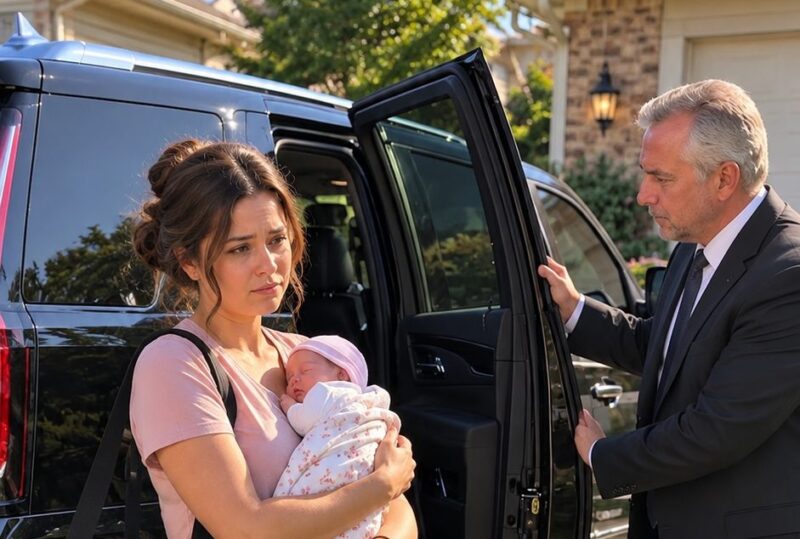
Half an hour later, a black Cadillac Escalade turned into my driveway.
But the decision to leave had started earlier that evening.
Roland had been buttoning his shirt while I stood in the kitchen, still wearing the hospital bracelet I hadn’t gotten around to cutting off. Wren was asleep against my chest, six days old and completely unaware of the tension surrounding her.
“What time should I get ready?” I asked.
Roland avoided my eyes.
“I’ve been thinking. Maybe you and Wren should stay home tonight.”
I frowned.
“Why?”
“You just had a baby. You need to rest.”
It almost sounded thoughtful.
Then I noticed my car keys in his hand.
Roland’s SUV was being repaired, so he intended to take my Camry.
“You’re leaving us here and taking my car?”
He sighed.
“Simone, please. Don’t make tonight complicated.”
Then he walked out.
My phone buzzed minutes later.
First came Beverly’s message.
Then Roland’s sister, Faye, posted a photograph from the restaurant.
I enlarged it.
Seven relatives sat around the table.
There were seven chairs.
Seven glasses.
Seven carefully arranged place settings.
No extra chair.

No space for a stroller.
No indication that anyone had expected a mother and her newborn to arrive.
Suddenly, everything became painfully clear.
This wasn’t a last-minute decision Roland had made because I looked tired.
Wren and I had never been included.
I walked upstairs and pulled out a travel bag.
Diapers.
Formula.
Baby clothes.
My clothes.
Wren’s yellow hospital blanket.
Then I called my father.
We had spent nearly two years pretending the other person no longer existed.
When he answered, neither of us spoke at first.
Finally, he said my name.
“Simone?”
My throat tightened.
“I need somewhere to go.”
His response came immediately.
“Are you and my granddaughter safe?”
I closed my eyes.
“Yes.”
“Good. Stay where you are. Raymond is coming.”
He didn’t demand an explanation.
He didn’t remind me how long it had been since I called.
He didn’t ask me to apologize first.
Raymond arrived thirty minutes later.
I had known him since I was a teenager. He had worked for Dad for years, and seeing his familiar face nearly broke the composure I had been holding onto.
He opened the Escalade’s rear door.
A brand-new infant car seat had already been installed.
Then he handed me a cream-colored envelope.
Across the front, in my father’s handwriting, was the name I had once carried:
Simone Celeste Caldwell.
Before walking out, I left my house key on the kitchen counter.
Beside it, I placed a note.
Roland,
Wren and I are safe.
We’re going somewhere neither of us has to wonder whether we belongs.
When you understand why your mother deserves a place at your family’s table but your wife and daughter don’t, you can call me.
We had barely reached the driveway when my phone rang.
Roland.
He had seen us on the security cameras.
“What are you doing? Where are you taking Wren?”
“I’m taking her somewhere she was actually expected.”
“It was dinner, Simone. One dinner.”
I looked through the window at the house where I had spent too long convincing myself that every exclusion was too small to matter.
“No, Roland. Tonight was simply the first time I stopped calling it ‘one dinner.’”
I ended the call.
When Raymond pulled through the gates of my childhood home, I expected the place to feel unfamiliar after two years away.
Instead, almost nothing had changed.
Then I walked upstairs.
The room next to my childhood bedroom had been converted into a nursery.
A crib stood against one wall.
Tiny clothes filled the dresser.
There were bottles, blankets, diapers, wipes, and everything else a newborn might need.
My father had never met Wren.
He hadn’t even known when I would let him meet her.
But he had prepared for her anyway.
With shaking hands, I opened the envelope Raymond had given me.
Inside was an old brass key.
My bedroom key.
Beneath it was a short note.
Your room is still yours.
Come home when you’re ready. Explanations can wait.
That sentence undid me.
I had spent months trying to make myself easier to accept.
Quieter.
More understanding.
Less demanding.
I had worked so hard to earn a place in my husband’s family that I had forgotten what it felt like to have a place that was simply mine.
My father, Charles Caldwell, was a wealthy man. Over four decades, he had built a logistics company into one of the largest privately owned operations in the Southeast.
Roland knew my maiden name.
Until that night, however, he had never understood what it represented.
But money had nothing to do with why Dad and I were estranged.
Two years earlier, he had warned me that Roland’s family treated me like an outsider.
I accused him of being controlling.
He accused me of ignoring what was happening in front of me.
We both said things we regretted.
I walked away and stayed away.
The next morning, Dad met his granddaughter.
He stopped in the doorway when he saw Wren in my arms.
For a man who could command an entire boardroom without raising his voice, he suddenly looked uncertain.
“That’s her?” he whispered.
“That’s Wren.”
I placed her carefully in his arms.
He stared down at her.
His eyes filled.
“I lost six days.”
“You didn’t know.”
“I could have tried harder.”
I touched his arm.
“So could I.”
Roland arrived that afternoon.
“I’m here for my wife and daughter,” he announced.
I shook my head.
“You’re here because we finally left.”
He lowered his voice.
“I messed up.”
“You didn’t forget to invite me, Roland. You knew I wasn’t invited. You left your six-day-old daughter behind, took the only car with her equipment in it, and told me I was creating a problem.”
“I’m sorry.”
I believed that he meant it.
But remorse wasn’t enough to repair what had taken years to damage.
“If you want this marriage, things change.”
“What do I have to do?”
“We go to counseling. You establish boundaries with your family. You stop expecting me to accept disrespect just to keep everyone else comfortable. And you rebuild my trust instead of asking me to pretend it was never broken.”
Roland nodded.
For once, there was no argument.
The next several months tested both of us.
He came to counseling.
He listened.
He stopped defending Beverly every time she crossed a line.
When she eventually tried to interfere again, Roland told her something I had waited years to hear.
“If you disrespect Simone, you don’t get access to Wren. They are not separate issues. Simone is her mother.”
I wasn’t there when he said it.
That mattered more than he realized.
For the first time, he was protecting our marriage even when there was no audience.
Dad never celebrated being right.
He never reminded me of his warning.
Instead, he learned how to warm bottles, mastered diaper changes, and became the kind of grandfather who rearranged meetings because Wren had smiled at him that morning.
Three months after I came home, I found him asleep in his favorite armchair.
Wren was sleeping against his chest, her tiny fingers curled around one of his.
On the side table sat my old brass bedroom key.
I picked it up.
And for the first time, I understood why Dad had never changed the lock.
He hadn’t preserved my room because he was waiting for my marriage to fail.
He had preserved it because he wanted one door in my life that would never close just because I made a mistake.
Eventually, Roland and I returned home together.
Our marriage wasn’t magically repaired.
It was rebuilt slowly, through uncomfortable conversations, boundaries, counseling, and choices Roland had to make repeatedly rather than once.
I took the brass key with me.
I still have it.
Not because I expect to need it.
Not because I’m secretly preparing to leave.
I keep it because it reminds me of something I once forgot.
You shouldn’t have to beg the people who love you to make room for you.
Family isn’t determined by who shares your last name.
It isn’t even determined by who gets invited to dinner.
Family is the person who looks at the table and immediately notices that your chair isn’t there.
Someday, Wren will be old enough to ask why Grandpa keeps a room upstairs with her mother’s name attached to an old brass key.
When she does, I’ll tell her:
“Because there was a time when Mommy forgot that she deserved a seat at the table.
And Grandpa kept the door open until she remembered.”