At thirty-six, I agreed to marry a seventy-four-year-old millionaire.
I wasn’t in love with him.
He knew that.
In fact, love had nothing to do with our agreement.

I needed stability for my ten-year-old daughter, Brielle. Everett Langston had more money than he could spend and an enormous Raleigh house that had been painfully empty for years.
He offered us a deal that sounded almost impossible.
Three years.
Separate bedrooms.
No expectation of romance.
He would pay for Brielle’s medical treatment, her schooling, and our household expenses. When the arrangement ended, I would receive a small townhouse and enough money to rebuild our lives independently.
I thought I understood exactly what I was agreeing to.
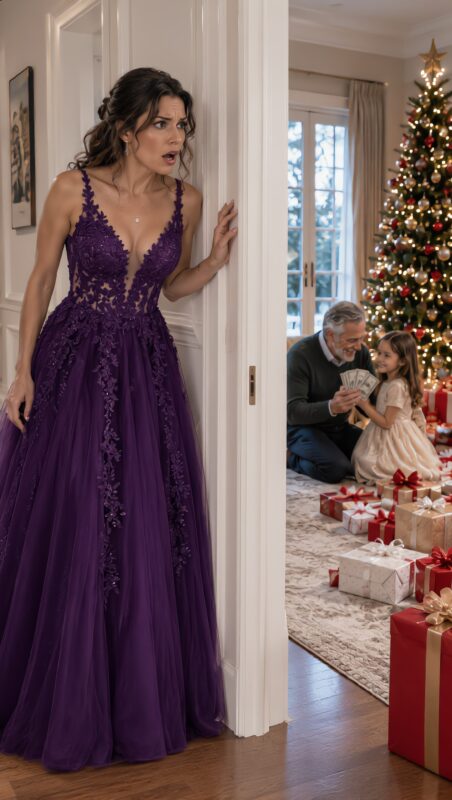
Then I caught Everett secretly giving Brielle cash.
She shoved it into her pocket the second she noticed me.
Neither of them explained.
Weeks later, I woke in the middle of the night and discovered Brielle wasn’t in bed.
Then Everett’s voice drifted upstairs.
“Faster, sweetheart. Your mother could come down any minute.”
My heart began pounding.
I rushed downstairs.
What I found waiting in the living room forced me to reconsider nearly everything I believed about him.
My name is Laurel, and before Everett entered our lives, I measured time in bills.
Rent was due in six days.
The pharmacy payment could wait until Friday.
The electricity bill had to be paid before Brielle’s next appointment.
That was how I lived.
Brielle had recurring health problems, and raising her alone meant every unexpected expense could knock our entire month apart.
Her father had disappeared when responsibility became difficult.
So I worked.
One of my jobs was cleaning Everett Langston’s home.
I’d been doing it for two years when he unexpectedly asked me to join him in his study.
Everett was wealthy, reserved, and intimidating in the way some older men become after spending decades being obeyed.
He motioned toward a chair.
“Laurel, I have an unusual question.”
“How unusual?”
“Marriage.”
I almost laughed.
He didn’t.
“You’re seventy-four.”
“I’m aware.”
“And I’m thirty-six.”
“Also aware.”
I stared at him.
Everett explained himself.
His wife, Marjorie, had died years earlier. Their marriage had been happy, but they’d never been able to have children.
After her death, Everett’s house became quieter every year.
He wasn’t searching for another great romance.
He wanted people around him.
A family.
He also knew what Brielle and I were facing.
“You need security,” he said. “I have more security than I need and nobody to share my life with.”
It sounded cold when stated that way.
Yet strangely, it was one of the most honest offers anyone had ever made me.
I didn’t agree immediately.
But eventually, fear about Brielle’s future outweighed fear of what strangers might think.
We married quietly.
The gossip wasn’t quiet.
People assumed I had found a rich elderly man and attached myself to his fortune.
I stopped explaining.
Everett fulfilled every promise.
Brielle received consistent medical care.
She entered a better school.
Our refrigerator stayed full.
Bills stopped frightening me.
And Everett never once crossed the boundaries we’d established.
What I hadn’t expected was how quickly Brielle would become attached to him.
Everett taught her chess.
She taught him how to use emojis correctly.
He insisted she was cheating whenever she beat him.
She insisted he was a terrible loser.
Within months, “Mr. Langston” disappeared.
He became Grandpa Everett.
I watched their relationship grow with equal amounts of gratitude and fear.
Because I had learned something very different about people.
My father died when I was young.
Brielle’s father left.
Every time I’d depended deeply on someone, eventually I had been left carrying the consequences alone.
So I waited for Everett’s generosity to reveal its hidden cost.
Then the secrets started.
One afternoon, I heard voices inside his study.
Everett was whispering.
“Your mother absolutely cannot know.”
I froze outside the door.
Then I peeked inside.
Brielle was drawing an enormous birthday card.
Everett had somehow managed to glue glitter to his sleeve.
I nearly laughed from relief.
I told myself to stop being suspicious.
Then, several days later, I saw Everett hand Brielle cash.
Not a few dollars.
Enough that I noticed.
Brielle quickly tucked it away.
I said nothing.
But the old fear returned.
A few weeks later, I woke sometime after midnight.
I checked Brielle’s room.
Empty.
Then I heard her downstairs.
Everett whispered:
“Quickly. We haven’t got much time before your mother wakes up.”
I didn’t stop to think.
I hurried down the staircase and pushed open the living-room door.
Everett looked up.
So did Brielle.
They were sitting on the carpet beneath the Christmas tree.
The room looked as though a gift-wrapping store had exploded.
Paper covered the floor.
Tape was stuck to Everett’s sleeve.
Ribbons hung from the coffee table.
Several badly wrapped presents sat beneath the tree.
Brielle held up one of them.
“Grandpa, this looks terrible.”
Everett frowned at it.
“I spent forty years running businesses.”
“And?”
“Apparently gift wrapping requires a completely different skill set.”
“You used way too much tape.”
“That makes it secure.”
Then they noticed my face.
Brielle groaned.
“Mom! You ruined the surprise!”
Everything clicked into place.
The money.
The whispers.
The secrecy.
Everett had given Brielle money so she could choose my Christmas presents herself.
They’d been sneaking downstairs at night to wrap them.
There was no dark secret.
There was simply a grandfather helping a little girl surprise her mother.
I went upstairs before they could see me cry.
Sitting on the edge of my bed, I finally admitted something uncomfortable.
Everett hadn’t given me reasons to distrust him.
Other people had.
I had carried their failures into his house and expected him to eventually become one of them.
After that night, something between us changed.
Not romantically.
Something more important.
I stopped thinking of Everett as the wealthy man I had made an arrangement with.
He became ours.
And we became his.
One evening, he told me about Marjorie.
They had spent years hoping for children.
Eventually, doctors told them it wasn’t going to happen.
“I thought I’d missed my chance at having a family,” he said.
Upstairs, Brielle dropped something loudly.
Everett smiled.
“Turns out my family was simply extremely late.”
Then his nephew Reid entered our lives.
Reid distrusted me immediately.
I understood why.
From the outside, my marriage to Everett looked suspicious.
But Reid kept visiting.
He watched Everett and Brielle argue over chess.
He saw me remind Everett about medication.
He watched us eat ordinary dinners together.
Eventually, he apologized.
“I was wrong about you.”
“That must have hurt.”
“Terribly.”
We became friends.
Then friendship became something neither of us intended.
Everett noticed.
Of course he did.
He noticed everything.
He simply waited.
Then a serious health scare forced all of us to think about how temporary our strange little arrangement might be.
Everett recovered.
That Christmas, he asked me to sit with him.
A folder rested on the table.
“I want a divorce,” he said.
My stomach dropped.
“What?”
He pushed the folder toward me.
Inside was the deed to the townhouse he’d promised me.
My name was already on it.
There were also documents establishing savings for Brielle and money reserved for her education.
I stared at him.
“The three years aren’t over.”
“They are as far as I’m concerned.”
“That wasn’t our agreement.”
Everett leaned back.
“Our agreement was that you’d bring life into this house.”
“I don’t remember agreeing to that.”
“I may have hidden it in the fine print.”
I almost smiled.
Then his expression softened.
“Laurel, this stopped being an arrangement a long time ago.”
I mentioned Reid.
Everett nodded.
“I know.”
“I don’t want you thinking—”
“Stop.”
He placed his hand over mine.
“I helped you because I chose to. That doesn’t give me ownership of the rest of your life.”
Tears filled my eyes.
“You owe me nothing,” he said. “Brielle owes me nothing. Love that requires repayment isn’t love.”
Our marriage ended quietly.
Our family didn’t.
Months later, Reid asked me to marry him.
He didn’t promise to rescue me.
That was precisely why I believed him.
“I want you to have your own life,” he said. “I just hope you’ll let me build mine beside it.”
I said yes.
We married in Everett’s garden.
Everett walked me down the path.
Afterward, Brielle approached Reid with a question she’d apparently been planning for weeks.
“Can I call you Dad now?”
Reid smiled.
“If you want.”
“I wasn’t asking permission. I was warning you.”
Everett laughed louder than anyone.
Years passed.
I returned to school and eventually became a teacher, fulfilling the dream I’d abandoned when survival became more urgent than ambition.
Reid and I later had a son.
We named him Everett James.
When Everett held his namesake for the first time, he stared down at him for a long while.
Then he whispered:
“I waited seventy-four years for grandchildren, and suddenly they’re multiplying.”
On Everett’s seventy-eighth birthday, our entire family gathered in his backyard.
He raised his glass.
“For years, I told myself I had helped Laurel and Brielle.”
He glanced at us.
“I gave them a house.”
Then he looked at Brielle.
“They gave me a home.”
Nobody spoke for a moment.
Later that evening, Everett headed inside.
“Good night, kids,” he called.
The answer left my mouth before I had time to think.
“Good night, Dad.”
He stopped.
Slowly, he turned.
His eyes found mine.
“What was that?”
I knew he’d heard me perfectly.
So I smiled.
“Good night, Dad.”
His eyes filled.
Mine did too.
Years earlier, I had walked into Everett Langston’s life believing I was making a bargain.
Three years of my life in exchange for Brielle’s security.
I thought he was giving us money.
I was wrong.
He gave Brielle the grandfather she’d never had.
He gave me the kind of fatherly love I’d stopped expecting.
And we gave a lonely old man the family he’d spent most of his life believing he would never have.
The townhouse mattered.
The medical bills mattered.
The education fund mattered.
But none of those became the most valuable thing Everett gave me.
The greatest gift was much harder to accept.
He taught me that not every kindness hides an invoice.
Some people don’t help you because they want to own you.
Sometimes they simply have love with nowhere to go.
And sometimes the family you spend your whole life missing arrives in a form you never would have thought to look for.