BORN INTO SILENCE—UNTIL ONE WOMAN SAW WHAT OTHERS MISSED
For eight years, the boy had a quiet, almost unnoticed habit: he would lightly touch the same spot on his ear again and again. It wasn’t driven by pain or anxiety—just a soft, repeated motion. Those around him dismissed it as a minor quirk, something unimportant.
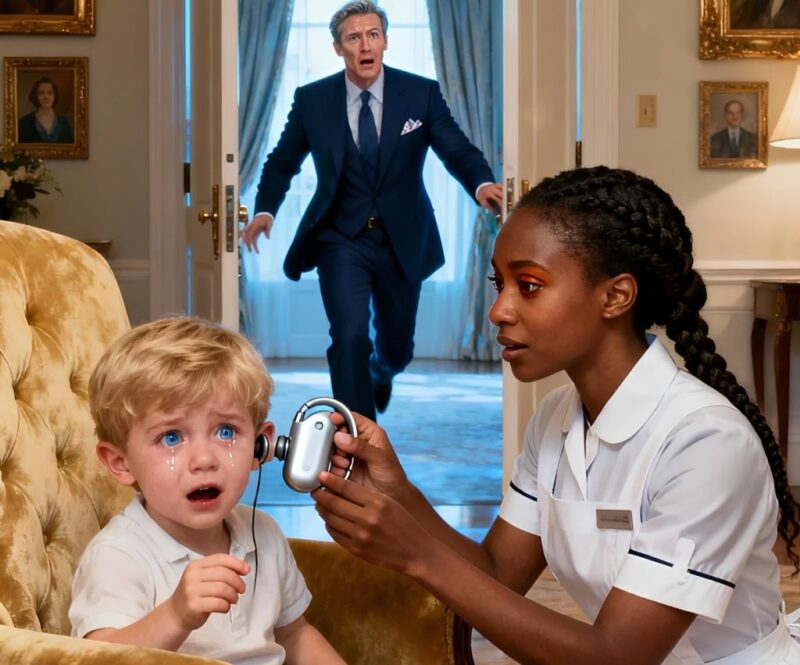
Doctors across the globe offered the same calm, final conclusion: nothing could be done. The diagnosis was firm—congenital, irreversible deafness. Oliver Hart, a billionaire used to bending circumstances to his will, heard those words in countless languages. Different voices, same certainty.
Refusing to give up, he took his son, Sha, from one country to another—Switzerland, Japan, Germany—searching for answers in the world’s most advanced clinics. Each visit followed the same pattern: complex tests, careful explanations, and ultimately, quiet defeat. With every failed attempt, hope slipped further away.
Sha was everything to him. His wife had died giving birth, leaving behind not only a child, but a silence that seemed to fill their lives. Still, Oliver spoke to his son daily—telling stories, describing the world, painting pictures with words—as if somehow his voice could reach him in another way.
And somehow, it felt like it did.
Sha would watch him closely, his large eyes calm and thoughtful, occasionally smiling as if he understood more than anyone expected. He grew up surrounded by luxury he could not hear—music that never reached him, laughter that existed only for others. Yet his small gesture remained unchanged: fingers brushing the same place on his ear.

Experts called it a coping mechanism. No one looked deeper.
Eventually, Oliver stopped searching—not because he accepted the truth, but because he could no longer face disappointment. Their home became a quiet sanctuary, where the subject of hearing was silently avoided.
Then Marta came into their lives.
She was an older housekeeper, steady and observant. She had no formal education in medicine, no impressive credentials—just years of experience watching people and understanding what others overlooked. From her first days in the house, she noticed the boy’s habit.
But unlike everyone else, she paid attention.
She saw that it was always the same spot, always the same movement. It happened more often after baths, when he was tired, or when someone embraced him from behind. She didn’t rush to conclusions. She simply observed, patiently.
One afternoon, while Oliver was away, she saw Sha repeat the motion—this time slightly differently.
She approached him carefully and studied his ear. Not with clinical detachment, but with quiet curiosity. Behind the ear, she noticed something barely visible—a tiny irregularity, almost hidden beneath the skin.
Slowly, she reached out and touched the exact spot.
Sha reacted—not with pain, but with surprise. His eyes widened, and instead of pulling away, he stayed still, as if something unfamiliar had just been recognized.
That night, Marta spoke to Oliver. Without drama, without complex language, she shared what she had seen. At first, Oliver resisted—he had heard too many theories, too many empty hopes. But something in her calm certainty made him reconsider.
The next morning, he sought out another specialist—not the most renowned, but someone willing to truly listen.
This time, things were different.
After a series of focused tests, the truth emerged: a tiny, rare structural issue deep within the ear—something so specific it had gone unnoticed before, yet something that could be corrected.
For the first time in years, there was genuine hope.
The operation was scheduled. It wasn’t called a miracle—just a chance.
When the surgery ended, the doctor offered cautious optimism. Nothing more. Sha awoke slowly, disoriented, while Oliver sat beside him, speaking softly as he always had.
Then, something subtle happened.
A metal tray clattered in the next room.
Sha blinked… then turned his head.
Time seemed to stop.
He touched his ear again—but this time not out of habit. This time, it was curiosity.
Tears filled Oliver’s eyes as he watched, afraid to even move, as if the moment might disappear.
In the days that followed, Sha began responding—first to faint sounds, then to voices, and eventually to laughter. It wasn’t immediate or flawless, but it was real.
Doctors discussed medical explanations and probabilities. Oliver said nothing. His gaze went to Marta.
She continued her work as always—quiet, steady, unchanged. When Oliver tried to thank her with gifts or money, she declined with a simple smile.
“I didn’t do anything special,” she said. “I just noticed what was already there.”
From that moment on, Oliver understood something no fortune had ever taught him: truth doesn’t always reveal itself in prestigious places or expert opinions. Sometimes, it lives in the smallest details—waiting for someone willing to truly see.
And the boy who once lived in silence became the one who taught everyone how to listen.