By the time my son’s bride introduced me to the room, I already knew exactly what her family thought of me.
Caroline lifted the microphone and smiled toward a ballroom filled with people who wore wealth as naturally as perfume.
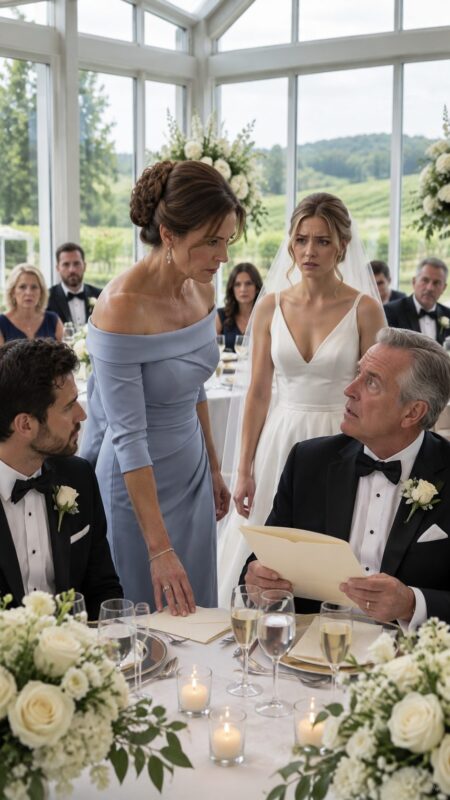
“And this is Ethan’s mother,” she said. “She doesn’t usually attend events like this, so we’re very happy she made it.”
Laughter scattered across the room.
Not loud.
Not cruel enough for anyone to admit later that it had been cruel.
But enough.
I looked at my son.
Ethan stared down at his place setting.
That was the moment that hurt.
Not Caroline’s words.
Not the laughter.
His silence.
I lowered my eyes, opened my purse, and touched the cream envelope resting inside.
The wedding reception was being held at a private vineyard property outside Napa, the sort of place where the stone walls looked centuries old even though half of them had probably been rebuilt for photographs.
Caroline’s family, the Whitmores, came from old, polished money.
Their surname appeared on donor walls, private investment groups, hospital buildings, and charity galas.
They never needed to brag.
They simply expected everyone else to notice.
Caroline’s father, Preston, had sized me up the night before.
At the rehearsal dinner, he had asked, “Ethan tells me you worked in education.”
“School administration,” I said.
“For long?”
“Long enough.”
He smiled politely and nodded.
Conversation finished.
In his mind, he had already filed me away.
Modest job.
Modest house.
Modest life.
Ethan knew there was more to the story.
He knew that after his father left, I worked mornings at a district office, evenings handling payroll for a local business, and weekends doing contract work from our kitchen table.
He knew I had sometimes paid his tuition deposit before paying the electric bill.
He knew I learned consulting work at night, built a client list slowly, and eventually turned that work into a company that became more successful than I ever talked about.
I never hid it from him.
I simply didn’t build my identity around money.
But Ethan wanted badly to fit into Caroline’s world.
And somewhere along the way, he had discovered that belonging was easier if he allowed people to underestimate where he came from.
The seating chart said enough.
Caroline’s parents sat near the newlyweds.
So did her grandparents, godmother, two uncles, and several cousins.
I was placed far enough away that I needed to lean around a floral arrangement to see my own son.
The woman seated beside me smiled when I arrived.
“Could I get another water?”
I looked at her.
Then she looked at my place card.
Her expression changed.
“Oh. I’m sorry. I thought you were with the venue.”
I smiled.
“It happens.”
Dinner ended.
Then came the speeches.
Preston stood first.
He spoke about tradition, family history, responsibility, and the importance of “shared standards.”
I noticed that he looked toward Ethan when he said it.
Caroline followed.
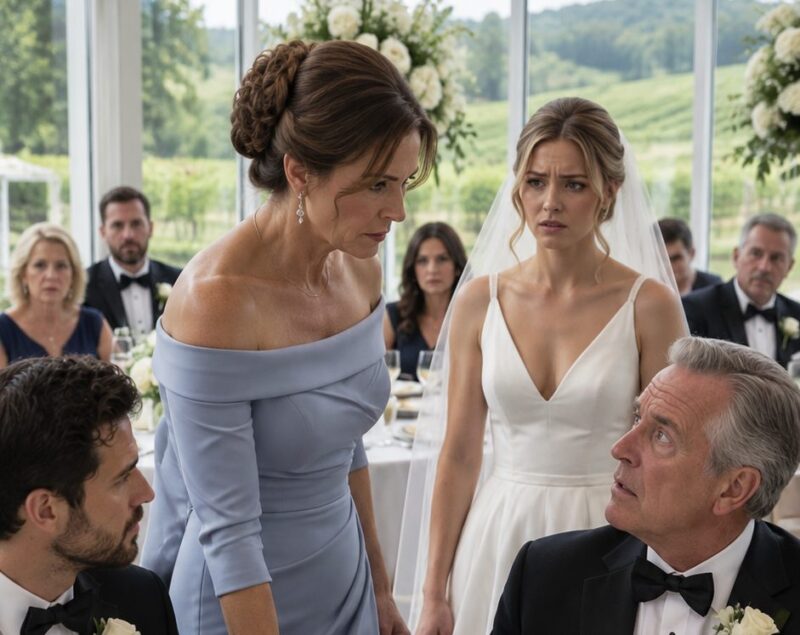
She thanked the wedding planner.
The photographer.
The florist.
The stylist.
The pianist.
The vineyard staff.
Even the woman who had repaired a loose button on her dress that morning.
Then someone called from the room, “What about Ethan’s mother?”
Caroline laughed.
She turned toward me.
And made the comment about my not being accustomed to places like this.
People chuckled.
Ethan said nothing.
Then my phone vibrated.
I looked at the screen.
A message from my attorney.
Confirmed. Everything is complete.
I read it once.
Then I put the phone away.
Across the room, Preston raised his champagne glass as though nothing unusual had happened.
That was when I made my decision.
Some men see quiet women and assume there is nothing behind the silence.
They see a simple dress and imagine an empty bank account.
They hear “school administration” and stop listening.
Preston had made all three mistakes.
Inside my handbag was an envelope I had brought for another reason entirely.
I had not intended to open it at the wedding.
Now I stood.
Ethan looked up immediately.
“Mom?”
I walked toward the head table.
The room slowly quieted.
I placed the envelope in front of Preston.
Caroline frowned.
“What’s that?”
I smiled.
“Something the family may want to see.”
Preston opened it.
His face changed before he reached the second page.
Inside were copies of several documents.
A purchase agreement.
A financial guarantee.
Correspondence between my company and the vineyard’s ownership group.
Three weeks earlier, my consulting firm had completed the acquisition of the parent company that controlled the estate.
But that wasn’t the document that made Preston stop breathing for a moment.
The event guarantee did.
Two months before the wedding, a financing arrangement tied to Preston’s business had collapsed.
The vineyard required an immediate deposit to hold the date.
Preston had quietly failed to provide it.
My company had.
More specifically, I had personally guaranteed the payment.
Without that guarantee, the wedding Caroline had just mocked me at would never have taken place there.
Caroline turned toward her father.
“Is this true?”
Preston stared at the papers.
He didn’t answer.
I looked at Caroline.
“You said I wasn’t accustomed to places like this.”
Her expression tightened.
“You’re right.”
The room went silent.
“I’m accustomed to places where people introduce guests with respect. I’m accustomed to rooms where someone’s value isn’t decided by the label on a dress or the surname on a donor wall.”
Then I looked at Ethan.
His face had gone pale.
“I did not bring those documents to embarrass your wife or her family,” I said. “I brought them because there was business to discuss later.”
I paused.
“But I will not sit quietly while my own son watches people treat me as though the life that raised him is something to hide.”
Ethan stood.
“Mom, please.”
“I’m sorry,” he said.
I believed him.
That didn’t make the damage disappear.
A sincere apology can open a door.
It cannot walk through it for you.
I picked up my purse and left the ballroom.
I had almost reached the front drive when I heard Ethan behind me.
“Mom.”
I stopped.
He came toward me without his jacket.
His eyes were wet.
“I just wanted them to accept me.”
I nodded.
“I know.”
“I wanted them to think I belonged.”
I looked at him for a long moment.
“And you thought belonging meant making sure they never saw what you came from.”
He closed his eyes.
“I messed up.”
“Yes.”
“I forgot who made all of this possible.”
I shook my head.
“No.”
He looked confused.
“You built your own life, Ethan. You studied. You worked. You made your own choices.”
Then I touched his arm.
“My job was to make sure you had a safe place from which to begin.”
His face crumpled.
He hugged me.
I hugged him back.
Then I stepped away.
“Go back inside.”
“I don’t want you leaving like this.”
“This night is still your wedding.”
He looked toward the reception hall.
“What am I supposed to do tomorrow?”
“That depends on what kind of man you want to become.”
I left.
The next few weeks were quiet.
Then the calls started.
Not dramatic calls.
Not desperate apologies.
Just Ethan checking in.
Later, he began visiting.
At first, our conversations were awkward.
Then honest.
Months after the wedding, he showed up at my small beige house holding two paper cups of coffee.
No tailored suit.
No vineyard.
No audience.
He sat at my kitchen table and apologized again.
This time he didn’t mention Caroline.
He didn’t blame her parents.
He didn’t say he had been nervous, pressured, or overwhelmed.
He simply said, “I was ashamed of the wrong thing.”
That mattered.
Rebuilding trust was slow.
But he kept returning.
Not with gifts.
With effort.
One Sunday evening, we were standing in my kitchen making pancakes when Ethan flipped one badly enough that half of it folded over itself.
He stared at it.
“Does this still count as dinner?”
I laughed.
“Pancakes have always counted as dinner in this house.”
He smiled.
And suddenly I remembered him at ten years old, sitting at the same counter in mismatched socks, asking if syrup counted as a vegetable.
For the first time since the wedding, something between us felt familiar again.
It wasn’t because my son had returned to the person he used to be.
People don’t really go backward.
It was because he had finally stopped being embarrassed by the road that brought him forward.