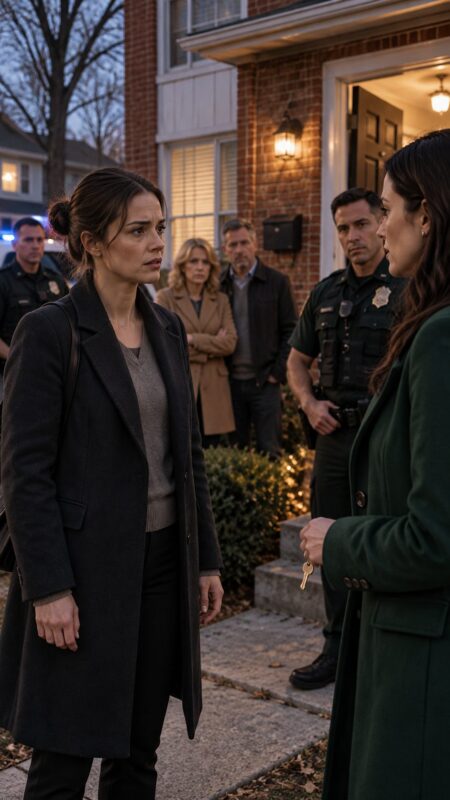
I knew something was wrong the moment I saw my sister standing outside my duplex with a key in her hand.
It was not a key I had ever given her.
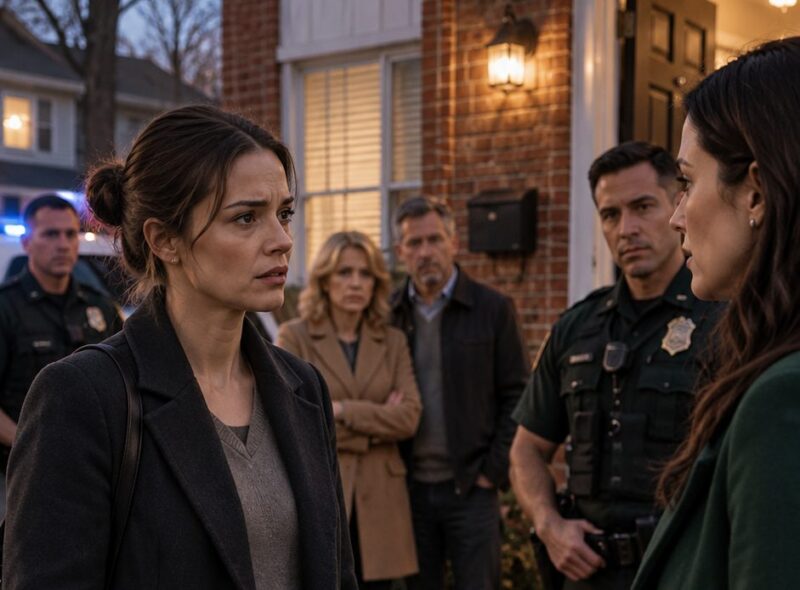
Two police cruisers were parked along the curb. A man and woman stood near the front steps, visibly confused, holding a printed property listing that advertised my upstairs unit for $310,000.
Dileia had apparently brought them there for a showing.
There was just one problem.
The duplex was mine.
Only mine.
And my sister had no legal right to enter it, advertise it, or sell it.
Seven months earlier, when I bought the property on Caldwell Street, I had told almost no one in my family.
That was not secrecy for the sake of secrecy.
It was self-protection.
In my family, good news had a habit of becoming a group asset.
A raise meant someone needed a loan.
A free weekend meant someone needed a favor.
Owning property would have meant endless opinions, expectations, and requests.
I had always been the reliable one.
When my father needed help, I drove for hours without complaining.
When my parents struggled to understand Medicare, I researched every option for them.
If paperwork had to be filled out, a bill disputed, or a problem solved, I was usually the person everyone called.
Dileia lived by a different rhythm.
She was thirty-one and technically worked in real estate, but her income was unpredictable. She could earn a decent commission and somehow be short on money a few weeks later.
When that happened, someone usually stepped in.
My mother.
My father.
Occasionally me.
I eventually stopped living that way.
After moving to Charlotte for a civil engineering job, I became careful with money.
I rented a modest apartment.
I accepted drafting work on weekends.
I skipped expensive vacations.
Over time, I saved $67,000.
At twenty-eight, I used part of it to buy a 1962 brick duplex for $276,000.
The deed listed one owner.
Me.
The downstairs tenants had been there for years and paid on time, so I kept them.
The upstairs unit needed work.
I refinished the hardwood, repainted the walls, replaced dated light fixtures, repaired small plumbing problems, and updated anything that looked neglected.
I did most of it slowly, one project at a time.
Before I started, I also installed security cameras.
That decision probably saved me from months of confusion.
One Tuesday afternoon, at 4:47, I was driving toward Greensboro for my mother’s birthday dinner when my phone sent me a motion notification.
I assumed it was a contractor or delivery.
Then I opened the camera feed.
Two people I had never seen before were walking through Unit B.
A few seconds later, Dileia came into view.
She was pointing out the kitchen.
Opening doors.
Showing them around like she owned the place.
And in her hand was a key.
I pulled into a parking lot and called 911.
I did not rush back to Charlotte.
There was no need.
The cameras were recording.
The police had the address.
My deed, insurance information, and closing documents were saved digitally.
So I kept driving to Greensboro.
At 5:23, my phone rang.
The caller identified himself as Officer Reyes.
“Your sister says you gave her permission to show the property.”
“I did not.”
“Do you own the building?”
“Completely.”
Within minutes, I emailed him copies of the deed, title documents, and insurance records.
By the time I got back to Charlotte, the situation was clear.
Dileia had created a sales listing for my upstairs unit.
She had used photographs of the rooms I had restored.
She had described the property as though she were representing the owner.
The couple she brought through the duplex, Greg and Sandra, had responded to the listing honestly.
They were not part of the scheme.
Sandra looked horrified when she realized what had happened.
“We really thought this was legitimate.”
“I know,” I told her.
And I did.
They had been deceived too.
After they left, I turned to Dileia.
“Where did you get the key?”
She folded her arms.
“I was going to explain.”
“Explain what? The key, or the fact that you listed my property for sale?”
For a moment, she said nothing.
Then she finally admitted it.
“I already had interested buyers. I figured we could sell it and split the money.”
I stared at her.
“We?”
She looked annoyed.
“There is no ‘we,’ Dileia. Your name is nowhere on the deed.”
That was when she switched arguments.
She started talking about family.
About how much she had supposedly done for our parents.
About how I had always been “the successful one.”
About how people helped each other.
I stopped her.
“This is not about who drove Dad to an appointment or who paid for Christmas dinner three years ago. You tried to sell property that does not belong to you.”
She had no answer for that.
I looked at Officer Reyes instead.
“What documentation do you need from me?”
That night, I treated the situation like any other serious problem.
I changed the locks.
I downloaded the security footage.
I saved screenshots of the fake listing.
I documented the officers’ names and case information.
Then I contacted the listing platform and had the advertisement removed.
The next morning, I called Patricia, my real estate attorney.
I told her the entire story.
When I finished, she asked, “What do you actually want out of this?”
The answer surprised even me.
I did not want to punish Dileia.
I did not want criminal drama.
I did not want family members choosing sides for the next ten years.
I wanted clarity.
“I want something in writing that she can never reinterpret later.”
Patricia understood.
I wanted Dileia to formally acknowledge three things:
She did not own any part of the duplex.
She had no right to enter it without permission.
And she had no authority to advertise, represent, lease, or sell it.
Two weeks later, Patricia prepared the agreement.
By then, the expenses caused by Dileia’s actions totaled $2,935.
The document required her to repay that amount and sign a formal acknowledgment that she had no legal interest in Caldwell Street.
My mother called almost immediately.
“Can’t you just work this out privately?”
“This is private,” I said. “It’s also being documented.”
“She’s your sister.”
“I know.”
My father was quieter.
“I wish it hadn’t gotten this far.”
“So do I.”
That was the strange thing about boundaries.
People talk about them as though setting one feels powerful.
It didn’t.
It felt sad.
Necessary, but sad.
Dileia hired an attorney of her own.
For nineteen days, nothing happened.
Then she signed.
Four days later, a payment of exactly $2,935 arrived.
No apology.
No dramatic confession.
No satisfying final confrontation.
Just paperwork completed correctly.
For me, that was enough.
By April, I rented Unit B to a woman named Josephine.
A week after she moved in, she sent me an email.
She said the floors were beautiful.
Then she added that she could tell someone had taken real care restoring the place.
I sat at my kitchen table and read that sentence twice.
For months, the duplex had represented conflict.
Police calls.
Attorney emails.
Fake listings.
A sister I no longer trusted.
Josephine’s message gave the building back to me.
Not legally.
That had never changed.
Emotionally.
Caldwell Street stopped being the place where my sister betrayed me.
It became a rental property again.
The rent arrived.
The downstairs tenants stayed.
The new locks worked.
Repairs got done.
Life became ordinary.
My relationship with Dileia never returned to what it had been.
Sometimes I missed her.
Sometimes I missed the version of our relationship I thought we had.
But I stopped confusing love with access.
I could care about my sister without giving her permission to cross every line.
Months later, I stood inside the upstairs unit after a routine inspection.
Before leaving, I placed a new brass key into the front lock.
For weeks, keys had carried a different meaning for me.
They reminded me of the one Dileia had held outside my property.
The one she had no right to possess.
But that afternoon, the feeling was gone.
The key in my hand was simply mine.
It belonged to a building I had worked for, paid for, repaired, and protected.
I turned it once.
The lock clicked.
I opened the door.
And for the first time in months, that was all it meant.