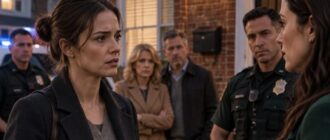
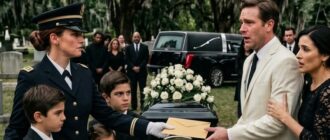
My father gave away the only VIP pass to my military academy graduation.
He handed it to my stepsister.
Then he told me I had done nothing special enough to need it.
To him, I was still just a junior member of the service.
What he didn’t know was that the academy was preparing to honor me in front of the entire audience.
Three days before graduation, I came home after a twenty-two-hour duty shift feeling completely drained.
My shoulders ached from carrying gear. My eyes burned from lack of sleep. I had barely made it through the front door when my stepmother called from the kitchen.
“Natalie, take care of the dishes before you go upstairs. Brianna has an early photo shoot tomorrow.”
Brianna was stretched across the couch scrolling through her phone.
My father, Richard, sat nearby with his tablet.
Neither of them asked how my shift had gone.
I set my bag down and pulled out a thick envelope stamped with the academy’s gold insignia.
“Dad,” I said, “graduation is Friday.”
He looked up briefly.
“I only received one VIP guest pass. I wanted you to have it.”
For years, I had imagined that moment.
I had pictured him in the audience while I crossed the stage.
Maybe he would finally understand what the last four years had cost me.
Richard took the envelope.
For one second, I thought he might smile.
Instead, he turned and handed it to Brianna.
She sat up immediately.
“Seriously?”
Dad nodded.
“You’ll get more use out of it.”
I stared at him.
“That ticket was for my graduation.”
He sighed.
“Natalie, don’t make everything about you. You’re one of plenty of junior service members finishing training. Brianna might meet senior officers, donors, important people. That could actually help her.”
Brianna was already examining the pass.
“This is VIP?”
“Yes,” Dad said. “Enjoy it.”
I waited for him to look at me.
He didn’t.
So I picked up my bag and went upstairs.
My family knew almost nothing about what I had actually accomplished.
That was partly my fault.
I had stopped telling them.
After years of watching their eyes glaze over whenever I mentioned training, research, or evaluations, I learned to keep important things to myself.
They didn’t know I had finished at the top of my academic cohort.
They didn’t know I had helped lead a military research project that received a major award.
They didn’t know I had accepted an officer’s commission.
And they definitely didn’t know what role I would have at graduation.
They assumed my career was ordinary because they had never taken enough interest to discover otherwise.
Friday morning arrived with wind and freezing rain.
I reached the academy early in full uniform.
The main entrance was crowded with families, officers, and graduates.
A few minutes later, a dark luxury sedan pulled up near the VIP entrance.
My father stepped out.
Then my stepmother.
Then Brianna, wearing a fitted coat and holding my gold pass between two fingers like an accessory.
She lifted her phone toward the building.
“This is going to look incredible on my feed.”
I walked past them toward the academy doors.
As a graduate, I didn’t need a guest pass.
My identification gave me entry.
Before I reached the steps, Dad called after me.
“Natalie.”
I turned.
He looked me over.
My uniform was wet from the rain.
“What are you doing?”
“Going inside.”
He frowned.
“Not through here. Brianna’s trying to get pictures.”
I said nothing.
“Seriously,” he added, stepping closer. “You’re soaked. Don’t ruin the background.”
Then he put a hand against my shoulder and moved me backward so Brianna could walk past.
The three of them went inside.
I stayed on the steps.
Rain ran down the brim of my cover.
For a few seconds, I forgot where I was.
All I could think about was everything it had taken to reach that morning.
The nights without sleep.
The injuries.
The impossible schedules.
The evaluations.
The years of forcing myself forward.
And beneath all of that, one embarrassing hope I had never completely let go of:
I wanted my father to be proud of me.
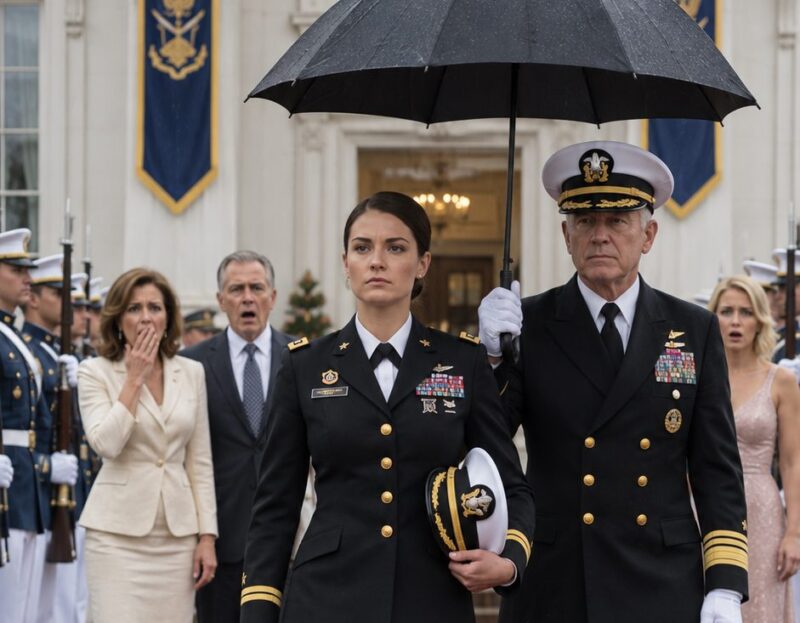
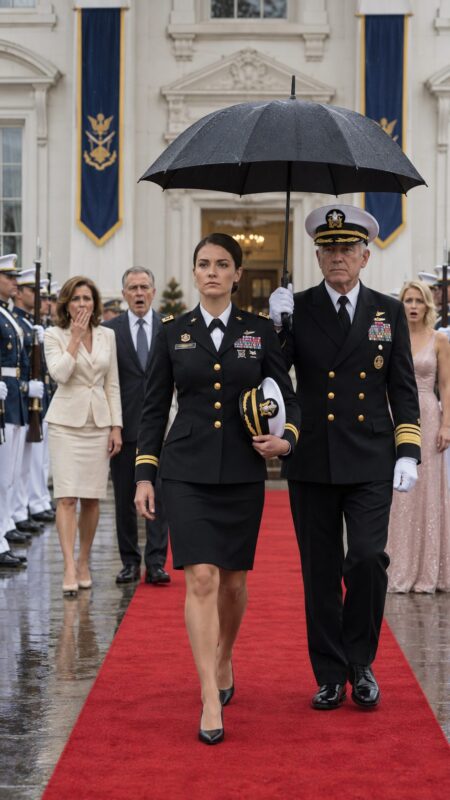
Then, without warning, the rain stopped hitting my uniform.
I looked up.
An umbrella had appeared over my head.
I turned.
General Marcus Ellison, the academy Commandant, was standing beside me in ceremonial dress.
He looked genuinely alarmed.
“Captain Reed?”
I straightened automatically.
“Sir.”
“What are you doing out here?”
I glanced toward the doors.
“I was just about to go in.”
He checked his watch.
“We’ve been searching for you.”
I frowned.
“For me?”
“For almost half an hour.”
He stepped closer.
“The ceremony is delayed.”
I stared at him.
Then he said it plainly.
“We cannot begin without the Distinguished Graduate.”
My breath caught.
He continued.
“You’re delivering the keynote address, receiving the academy’s highest leadership distinction, and being recognized for your work on the research program.”
For a moment, I couldn’t speak.
Then General Ellison smiled faintly.
“Everyone is waiting, Captain.”
He escorted me inside himself.
The doors opened.
Hundreds of people rose.
The sound of chairs moving filled the auditorium.
Senior officers stood first.
Then faculty.
Then graduates and families.
The entire room was on its feet.
I saw my father in the VIP section.
His expression changed before the announcer even finished saying my name.
“Captain Natalie Reed, Distinguished Graduate.”
Brianna lowered her phone.
My stepmother stopped smiling.
Dad looked down at the printed program in his lap.
Then back at me.
For years, I had imagined that moment.
I thought I would look for pride in his face.
I thought seeing it would finally make everything feel complete.
But as I walked toward the stage, something inside me shifted.
I no longer needed it.
General Ellison presented the award.
The applause seemed to go on forever.
When it was time for my speech, I stood behind the podium and looked across the room.
Then I said the words I wished someone had told me years earlier.
“Sometimes the people closest to us fail to see what we are becoming. That does not make the work smaller. It does not make the sacrifice less real. Keep going until you stop depending on other people to tell you what your effort is worth.”
The auditorium became completely still.
Then came the applause.
After the ceremony, I walked outside.
Dad followed me.
For once, he didn’t look confident.
“I had no idea,” he said.
I turned toward him.
“You could have.”
He looked down.
“I should have asked.”
“Yes.”
His voice dropped.
“I should have been proud of you long before today.”
That hurt more than I expected.
“I wanted you to be.”
He nodded, and his eyes filled.
“I’m sorry.”
I believed he meant it.
But sincerity doesn’t erase history.
“I love you, Dad,” I said. “But I’m not going to keep accepting being treated like I matter less just because I love you.”
He didn’t argue.
I walked away.
Months later, a package arrived at my apartment.
Inside was a framed photograph from graduation.
General Ellison was pinning the award onto my uniform.
I turned the frame over.
Dad had written a message on the back.
I spent too many years waiting for you to become someone I understood. I should have tried to understand the person you already were.
I sat with that sentence for a long time.
It didn’t repair everything.
Neither did the apology.
Trust doesn’t rebuild because someone finally says the right thing.
It rebuilds when they keep showing up differently afterward.
Still, I placed the photograph on my shelf.
Not because of what my father had written.
Because of what the image represented.
For most of my life, I had measured success against an invisible standard.
Would this make Dad proud?
Would this finally be enough?
Would this make him notice me?
Graduation changed that.
The medal mattered.
The speech mattered.
The recognition mattered.
But the real change happened before I ever stepped onto the stage.
Standing in the rain, then walking through those doors with the Commandant beside me, I finally understood something I should have learned years earlier.
My father’s approval could have been meaningful.
But it was never supposed to define me.
For the first time in my life, I stopped asking whether he was proud.
I already knew I was.