Caroline rested her head against the window of Flight 402 and watched the darkness beyond the glass.
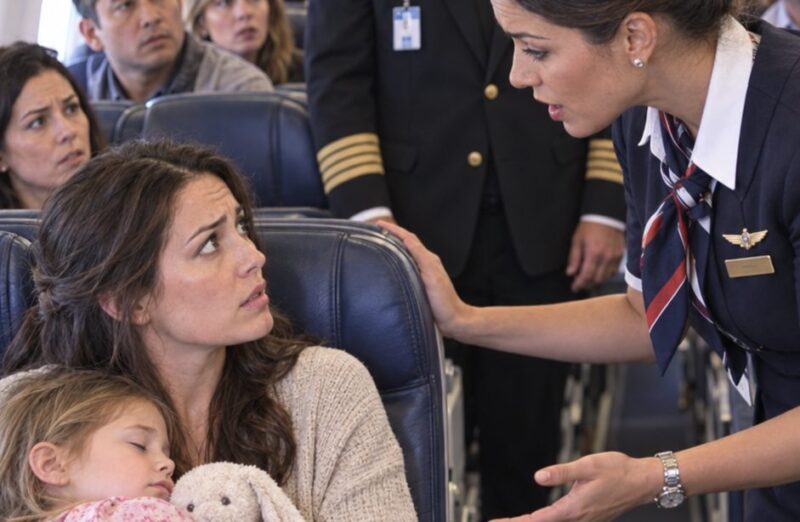
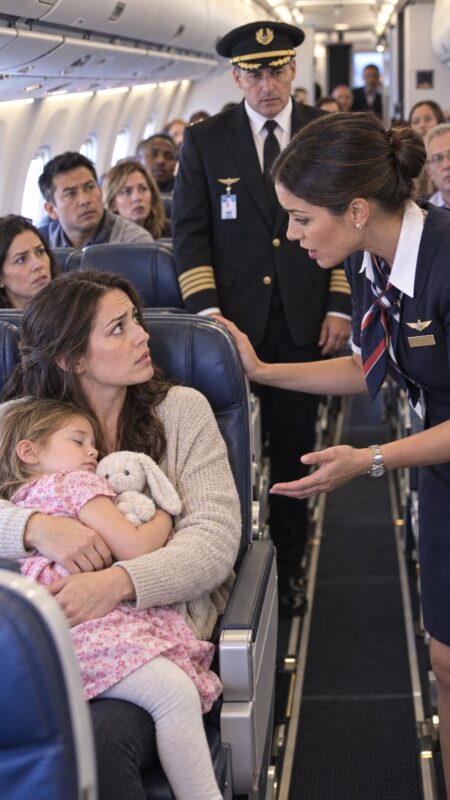
To the passengers around her, she looked ordinary—a tired mother on an overnight flight to Europe, trying to get through the journey in peace.
No one knew what she had once been.
Six years earlier, Caroline had flown F-16s for the U.S. Air Force.
She had lived by checklists, radio calls, and split-second decisions. The cockpit had once felt more familiar to her than any living room.
Then Ronald died.
Her husband had been killed during a classified aviation mission, and after his death, Caroline walked away from military life. She moved to Minneapolis, devoted herself to raising their son, Christopher, and tried to build a future that had nothing to do with fighter jets, uniforms, or missions she could never discuss.
For six years, she told herself that part of her life was over.
Then the intercom came on.
“If there is anyone on board with military aviation experience, identify yourself immediately.”
The cabin went silent.
Passengers exchanged nervous looks. A child began to cry several rows back.
Caroline did not move at first.
She had spent years learning how not to react to that world.
But training does not disappear just because you stop wearing a uniform.
She unfastened her seatbelt and stood.
A flight attendant hurried toward her.
“I’m a former fighter pilot,” Caroline said. “Take me to the flight deck.”
The attendant’s expression changed.
A moment later, the cockpit door opened.
Caroline stepped inside and immediately understood that this was not a mechanical failure.
Three men had taken control of the flight deck.
The captain and first officer were still alive, but both were under guard.
Caroline’s eyes swept across the controls.
Then they stopped on a red folder lying on the console.
A black emblem was stamped across its cover.
The Apex Syndicate.
She knew the symbol instantly.
Years earlier, the same international network had been linked to the classified operation in which Ronald had died.
Her pulse quickened.
Then the man who appeared to be in charge turned toward her.
He spoke one word.
Her old military callsign.
Caroline felt the air leave her lungs.
This was no coincidence.
They had known she was aboard Flight 402.
The announcement requesting someone with military aviation experience had been bait.
They had brought her into the cockpit on purpose.
Their plan became clear quickly.
They needed someone with advanced flight training to take the aircraft along a route that would help them avoid regional defense surveillance.
Nearly three hundred passengers had unknowingly become part of their operation.
Caroline forced every trace of fear from her face.
She sat down and acted cooperative.
When the hijackers gave her a new flight path, she entered the coordinates into the navigation system.
At the same time, hidden within a routine sequence of commands, she triggered an emergency transmission through the aircraft’s automated systems.
The signal went out.
But Caroline knew that did not mean rescue was close.
They might have minutes.
They might have much less.
She scanned the weather display.
A powerful storm system lay directly ahead.
Dark clouds.
Severe turbulence.
Heavy electrical activity.
To any pilot, it was something to avoid.
Caroline saw a possibility.
She turned to the leader.
“If you want to stay off conventional tracking patterns, we need to use the storm.”
He studied her suspiciously.
She continued.
“The cloud cover gives us protection. If we stay outside it, we’ll be easier to detect.”
He hesitated.
Then he told her to continue.
Caroline guided Flight 402 toward the storm.
The first wave of turbulence hit hard.
The cabin shook.
Loose objects rattled.
The aircraft dropped slightly, then climbed again.
Inside the cockpit, the hijackers widened their stances to stay upright.
Caroline kept both hands steady on the controls.
Then she looked toward the captain.
Their eyes met.
She gave him the smallest possible nod.
He understood.
Caroline tightened her harness.
Her hand moved toward the controls.
Then she disconnected the automated flight system.
Without warning, she put the aircraft into a sudden steep descent.
The maneuver was controlled, but violent enough to catch the unrestrained intruders completely off balance.
They were thrown away from their positions.
Caroline and the captain remained secured.
That was all the crew needed.
The captain moved first.
The first officer followed.
Within seconds, the situation inside the cockpit changed.
Control returned to the flight crew.
Caroline pulled the aircraft out of the descent and began leveling it.
The altimeter stabilized.
The jet climbed back into controlled flight above the Atlantic.
Only then did she allow herself to take a full breath.
She changed course.
Flight 402 was no longer following the route the hijackers had demanded.
It was heading toward a secure military airfield in Spain.
By the time the aircraft touched down, tactical teams were already positioned along the runway.
The hijackers were taken into custody.
The red folder was seized.
Investigators later discovered that its contents contained information tied to the Apex Syndicate and eventually helped authorities uncover more of the network that had been connected to Ronald’s final mission.
News crews gathered outside almost immediately.
Caroline refused to speak with them.
She wanted no interviews.
No photographs.
No public praise.
She asked for only one thing.
A private room with a secure connection.
Then she called Christopher.
When his face appeared on the screen, something inside her finally softened.
“I’m safe,” she told him.
For six years, Caroline had treated her military past like a door that needed to remain closed.
Flight 402 changed that.
The skills she had tried to leave behind had just helped save hundreds of people.
For the first time, she understood that her past had not taken her away from her family.
It had helped her protect other families.
Months later, Caroline accepted a new position in defense aviation.
She began training pilots and helping develop flight tactics.
At first, she stayed away from active flying.
That seemed easier.
Safer.
But Christopher noticed.
He had already lost his father to aviation, and even though he rarely said it, he was afraid that the same world might take his mother too.
One evening, he finally spoke.
“Are you ever going to fly again,” he asked, “or are you just going to watch everyone else do it?”
Caroline looked at him.
For a moment, she thought he was challenging her.
Then she saw the fear behind the question.
Christopher was not wondering whether she was brave enough to fly.
He was wondering whether he was brave enough to watch her leave the ground.
The next day, Caroline returned to a flight line for the first time in six years.
She climbed into a training aircraft.
The engine started.
The runway stretched ahead.
And for the first time since Ronald’s death, she did not feel like she was betraying the life she had built.
She felt like she was recovering a part of herself.
When the trainer landed later that day, Christopher was waiting near the barrier.
Caroline climbed down carrying her helmet and walked toward him.
He watched her quietly.
“I needed to remember something,” she said.
Christopher waited.
“The sky is part of who I am. But you are more important than any flight.”
His expression slowly changed.
Then he smiled.
Caroline looked back toward the runway.
For years, she had seen the sky as the place where her old life had ended.
Now, for the first time, it looked different.
Not like an ending.
Like a beginning.